

Spanish real estate agent regulation explained
TL;DR:
- Spanish real estate agent regulation varies by autonomous community, requiring buyers to verify regional compliance before engaging. Key requirements include regional registration, professional liability insurance, and clear mediation contracts; failure to verify exposes buyers to legal and financial risks. Informed due diligence, including legal review and registry checks, is essential to safeguard property transactions across Spain.
Spain defines real estate agent regulation not through a single national licensing law but through a patchwork of autonomous community rules, general consumer protection legislation, and contract law. This means that whether you are buying a villa in Mallorca or an apartment in Seville, the rules governing your agent depend entirely on where the property sits. Spanish real estate agent regulation explained properly requires understanding which regional framework applies, what professional standards your agent must meet, and how to verify compliance before you commit any funds.
What are the main regional regulatory frameworks for real estate agents in Spain?
Spain has no single national licensing law for real estate brokerage. Regulation relies on autonomous community laws combined with general consumer protection rules, which means the obligations placed on an agent in Andalucía differ substantially from those placed on one operating in Madrid or Valencia. This fragmented structure is the single most important fact for any international buyer to grasp before engaging an agent.
The two most developed regional frameworks are those of Andalucía and the Balearic Islands.
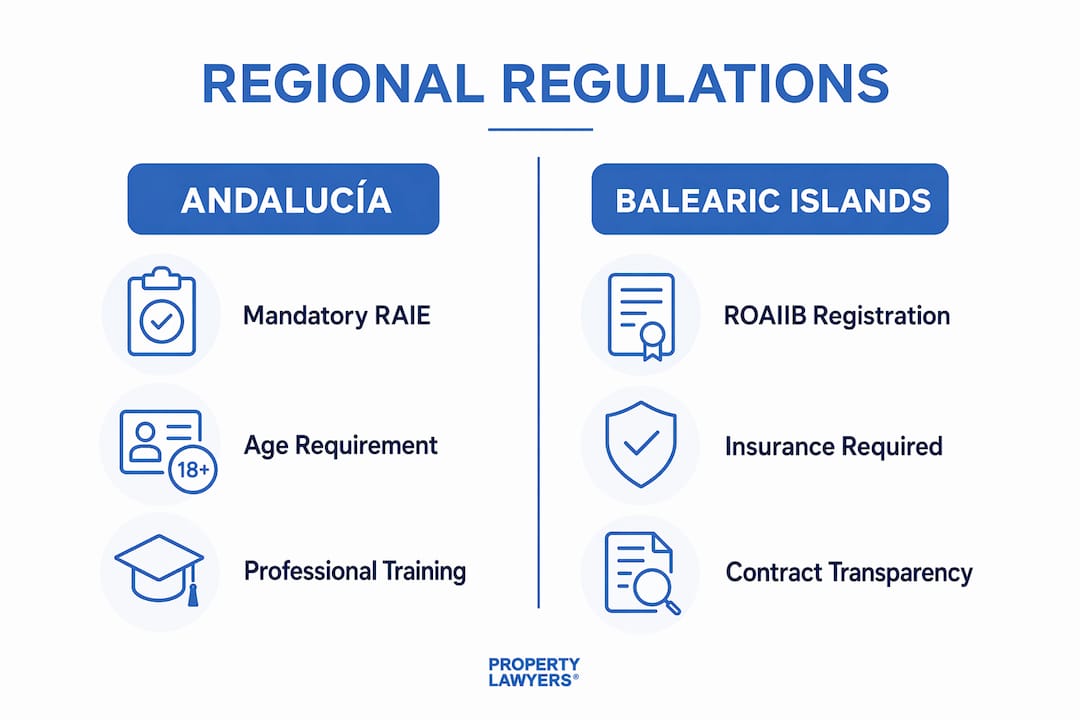
- Andalucía: Ley 5/2025 establishes the Registro de Agentes Inmobiliarios Especializados, known as the RAIE. Registration is public, administrative, free, and mandatory for all residential real estate agents operating in the region. Agents register via a declaración responsable and must hold professional liability insurance and financial guarantees for handling client deposits.
- Balearic Islands: The ROAIIB (Registre Oficial d’Agents Immobiliaris de les Illes Balears) is voluntary but carries significant weight. Registered agents must hold €100,000 civil liability insurance and €60,000 deposit insurance if they handle client funds directly. Registration signals a professional standard that unregistered agents cannot claim.
- Other communities: Catalonia, Valencia, and Madrid each maintain their own registries or professional association frameworks, though none currently impose the same mandatory structure as Andalucía’s Ley 5/2025.
Spain’s fragmented regulation means buyers must identify the autonomous community where their property sits before assessing which rules apply. An agent who is fully compliant in the Balearics may not meet the mandatory registration requirements now in force in Andalucía. Cross-community activity adds further complexity, since no mutual recognition system currently exists between regional registries.
What professional requirements must Spanish real estate agents comply with?
The professional obligations placed on agents vary by region, but several core requirements appear consistently across the most regulated communities. Understanding these gives buyers a clear benchmark against which to assess any agent they consider working with.
Insurance and financial guarantees are the most concrete requirements:
- In the Balearic Islands, ROAIIB registration requires €100,000 in civil liability cover and €60,000 in deposit insurance for agents handling funds directly.
- In Andalucía, Ley 5/2025 mandates both professional liability insurance and a caución (financial guarantee) to protect client deposits held by the agent.
- Agents operating outside these regions may carry no mandatory insurance at all, which represents a direct risk to buyers paying reservation deposits or arras through an unverified intermediary.
Training and qualifications are addressed most explicitly in Andalucía, where the RAIE registration process requires agents to demonstrate professional competence, including completion of a 100-hour training course aligned with the qualification thresholds set by Ley 5/2025. This requirement does not exist uniformly across Spain, making Andalucía’s framework one of the most buyer-protective in the country.
Contract transparency is a requirement that applies across all communities under general consumer protection law. Agents must provide clear written mediation agreements that define the scope of their services, the commission rate, and the conditions under which that commission becomes payable. Vague or unsigned agreements expose both parties to legal risk.

Pro Tip: Before signing any mediation agreement, ask the agent to confirm in writing whether they hold professional liability insurance and, if they are handling your deposit, what deposit guarantee is in place. In Andalucía and the Balearic Islands, this documentation should be straightforward to produce.
Growing autonomous community regulation is professionalising the market and improving consumer protection across Spain. Buyers who understand these requirements are far better placed to distinguish a compliant professional from an unregistered intermediary.
How do contract terms and commissions work under Spanish real estate law?
The legal basis for an agent’s commission in Spain is the written mediation contract, known as a contrato de mediación or contrato de corretaje. Without a clear written agreement, commission disputes become significantly harder to resolve, and courts have shown a willingness to interpret ambiguous language in ways that neither party anticipated.
The Spanish Supreme Court’s 2026 ruling is particularly instructive here. The court clarified that ambiguous contract terms regarding mediation actions can broaden an agent’s commission entitlement beyond the simple act of introducing a buyer. If a contract states that commission is due “through the mediator’s actions” without defining what those actions are, courts may award full commission even where the agent’s role was limited. This ruling has direct implications for buyers who sign mediation agreements without reading them carefully.
Practical steps for buyers reviewing a mediation contract:
- Confirm the commission rate in writing. Typical Spanish commissions range from 2% to 5% of the sale price. Any figure outside this range warrants clarification.
- Clarify the payment schedule. Commission is commonly split, with 50% payable on signing the arras (preliminary contract) and the remainder on completion at the notary. Confirm this structure explicitly.
- Define the mediator’s scope. The contract should state precisely what actions the agent must perform to earn commission. Avoid phrases such as “through the agent’s intervention” without further definition.
- Check who pays. In Spain, commission is typically paid by the seller, but some agents include clauses that create obligations for buyers. Read every clause before signing.
- Seek legal review. Contract clarity is essential due diligence. A property lawyer can identify ambiguous clauses before they become disputes.
Many disputes arise from brokerage agreements where vague mediation clauses trigger unintended commission obligations. The cost of a legal review before signing is negligible compared to the cost of litigation after completion.
How can buyers verify a Spanish real estate agent’s compliance?
Verifying an agent’s regulatory compliance is a practical process, not a bureaucratic one. The key is knowing what to ask for and where to check before any money changes hands.
Registry checks:
- For properties in Andalucía, ask the agent for their RAIE registration number and verify it directly through the regional registry. Mandatory registration under Ley 5/2025 means there is no legitimate reason for an agent to be absent from the register.
- For properties in the Balearic Islands, check the ROAIIB register. While registration is voluntary, an agent’s absence from the register means they have not committed to the €100,000 liability insurance threshold. This matters when you are selling or buying property in a high-value market.
- For other communities, contact the relevant regional consumer protection authority or professional association to confirm whether a registry exists and whether the agent appears on it.
Documentation to request:
- A copy of the agent’s professional civil liability insurance policy, including the coverage limit and expiry date.
- Confirmation of deposit insurance if the agent will hold your arras or reservation funds directly.
- A signed copy of the mediation agreement before any payment is made.
Pro Tip: Create a short checklist before your first meeting with any agent: registration number, insurance certificate, and a draft mediation agreement. An agent who cannot produce these promptly is a risk you do not need to take.
The table below summarises the key verification steps by region:
| Region | Registration type | Insurance minimum | Verification method |
|---|---|---|---|
| Andalucía | Mandatory (RAIE) | Required (Ley 5/2025) | Check RAIE registry directly |
| Balearic Islands | Voluntary (ROAIIB) | €100,000 civil liability | Check ROAIIB register |
| Catalonia, Valencia, Madrid | Varies by community | Not uniformly mandated | Contact regional authority |
| All regions | N/A | Recommended as minimum | Request certificate directly |
Buyers should verify registration status and request proof of insurance before paying any deposit or signing any contract. These checks are the most direct protection available to international buyers in a market where agent standards vary considerably by location. Understanding why unlicensed agents pose risks is the first step toward avoiding them.
Key takeaways
Spanish real estate agent regulation is governed by regional law, not national licensing, making compliance verification by buyers a non-negotiable step in any property transaction.
| Point | Details |
|---|---|
| No national licensing law | Agent regulation depends on autonomous community rules; Andalucía and the Balearic Islands have the most developed frameworks. |
| Mandatory vs voluntary registration | Andalucía’s RAIE is mandatory under Ley 5/2025; the Balearic Islands’ ROAIIB is voluntary but signals professional standards. |
| Insurance requirements | ROAIIB agents must hold €100,000 civil liability cover; Andalucía mandates both liability insurance and deposit guarantees. |
| Contract clarity is critical | Ambiguous mediation agreements can trigger unintended commission obligations under the 2026 Supreme Court ruling. |
| Buyer verification steps | Check regional registry status, request insurance certificates, and obtain a signed mediation agreement before paying any funds. |
The regulatory direction of travel is clear, but buyers cannot wait for it
Having worked with international buyers across Spain for many years, I find the most common mistake is assuming that because an agent speaks English and has a professional website, they are operating within a regulated framework. That assumption is understandable, but it is not safe.
The trend toward professionalisation through regional registration is genuinely positive. Andalucía’s Ley 5/2025 is the most significant step forward in Spanish real estate agent regulation in a generation. The Balearic Islands’ ROAIIB, though voluntary, has raised standards meaningfully in one of Spain’s most active international property markets. These developments reflect a broader recognition that consumer protection in real estate requires more than general contract law.
What concerns me is the pace of change relative to buyer awareness. Many international buyers transact in regions where registration is voluntary or non-existent, and they have no framework for assessing agent quality beyond reputation and referral. The 2026 Supreme Court ruling on commission entitlement is a warning: courts will enforce what contracts say, even when buyers did not understand what they were signing.
My view is that buyers should treat agent compliance verification the same way they treat property due diligence. You would not skip a title search or an embargo check. Do not skip an insurance certificate request either. The regulatory environment is improving, but the responsibility for protection still sits largely with the buyer.
— Sophie
How Property-lawyers can help you transact with confidence
Understanding agent regulation is one layer of protection. Having a qualified property lawyer review your mediation agreement, verify agent credentials, and guide you through the full transaction is another. The two work together.
Property-lawyers connects international buyers with independent, English-speaking real estate lawyers across Spain who understand the specific regulatory requirements of each autonomous community. Whether you are purchasing in Andalucía under the new RAIE framework or investing in the Balearic Islands where ROAIIB standards apply, a specialist solicitor can confirm agent compliance, review your mediation contract for ambiguous commission clauses, and protect your deposit from the outset. Find your Spanish property solicitor through Property-lawyers today.
FAQ
Is a real estate agent licence required in Spain?
Spain has no single national licensing requirement for real estate agents. Regulation depends on the autonomous community where the property is located, with Andalucía imposing mandatory RAIE registration under Ley 5/2025 and other regions operating voluntary or association-based frameworks.
What is the RAIE and who must register?
The RAIE (Registro de Agentes Inmobiliarios Especializados) is Andalucía’s mandatory public registry for residential real estate agents. All agents operating in the residential market in Andalucía must register via a declaración responsable and hold professional liability insurance and deposit guarantees.
How much commission does a Spanish real estate agent charge?
Typical commissions range from 2% to 5% of the sale price, commonly split between the arras signing and completion at the notary. The exact rate and payment structure must be defined in the written mediation contract.
What insurance should a compliant agent hold in the Balearic Islands?
Agents registered with the ROAIIB in the Balearic Islands must hold a minimum of €100,000 civil liability insurance and €60,000 in deposit insurance if they handle client funds directly. Unregistered agents carry no mandatory insurance obligation.
Why does contract language matter so much in Spanish agent agreements?
The Spanish Supreme Court’s 2026 ruling confirmed that vague mediation clauses can be interpreted broadly, potentially entitling an agent to full commission even where their role was limited. Precise contract language is the most direct protection against unintended commission liability.
Recommended
- Spanish real estate law: a buyer’s guide for 2026
- Why avoid an unlicensed Spain property agent
- Land Registry Spain — Registro de la Propiedad Guide for Buyers | Property Lawyers
- How to register as autonomous lawyer in Spain

Sophie Gutenberg is a legal content specialist focused on Spanish property law, real estate transactions, conveyancing, due diligence and tax issues affecting international property buyers in Spain. She works alongside qualified Spanish property lawyers .
