
International buyers: 3 steps before signing a private sale in Spain
A private property sale between individuals, a compraventa entre particulares, is entirely legal in Spain and happens every day in Marbella, Mallorca and beyond. Before you go further, do three things: request a nota simple, sign a written arras agreement, and instruct a Spanish property lawyer. Watch the tax split too: resale property triggers ITP, new build triggers IVA plus AJD, and buyers must withhold 3% when the seller is a non-resident.
TL;DR:
- Verifying the property’s ownership status requires requesting a continued nota simple to detect any new charges before paying a deposit.
- Buyers should complete all legal checks, including planning permissions and seller residency, before signing any private sale agreement.
- Expect to pay around 10% to 12% of the purchase price in total costs, including taxes, notary fees, registration, and gestoría charges.
- If the seller is a non-resident, the buyer must withhold 3% of the purchase price and file modelo 211 to avoid liability.
- Instructing a qualified, region-specific Spanish lawyer before signing the arras protects against undisclosed charges and legal pitfalls.
Table of Contents
- What are the steps in a private property sale in Spain?
- What legal checks matter before signing?
- How much tax will you pay on a private sale?
- How long does the process take, from arras to registration?
- How do you choose the right Spanish property lawyer?
- Why private sales in Spain go wrong, and how to avoid it
- Find a vetted lawyer before you sign anything
- Sources
- FAQ
What are the steps in a private property sale in Spain?
Buying directly from a private seller, without an estate agent managing the paperwork, means the responsibility for checks falls on you and your lawyer. The sequence below is the order that actually protects your money.
- Request the nota simple first. Before any money changes hands, get this document from the Registro de la Propiedad. It confirms who legally owns the property and reveals any mortgages, charges or embargos attached to it.
- Agree the arras and put it in writing. This deposit contract locks in the price and completion date. Decide whether it is penitential (either party can walk away by forfeiting or returning double the deposit) or confirmatory (breach allows a claim for full performance), since the two carry very different consequences if a sale falls through.
- Sort financing and valuation early. If you need a mortgage, Spanish banks require a formal valuation and their own paperwork trail. Starting this while the arras is being drafted avoids a bottleneck later.
- Book the notary and prepare your taxes. Once financing is confirmed, fix a signing date, gather funds for ITP or IVA, and instruct your lawyer or gestoría to handle registration straight after completion.
Each step depends on the one before it. Skipping the nota simple to “save time” is the single most common reason private sales in Spain go wrong.
What legal checks matter before signing?
The nota simple tells you who owns the property and what debts sit against it, but it is only the starting point. A private sale between individuals lacks the safety net an estate agency sometimes provides, so the checks below fall to you and your lawyer.
- Read the nota simple carefully. Look at the registered owner’s name, the property description, and any recorded charges such as mortgages or embargos.
- Verify planning permission and licences. In the Balearics and along the Costa del Sol, illegal extensions or missing tourist rental licences are common and can block a future resale.
- Confirm the seller’s identity and residency status. Whether the seller is Spanish-resident or not changes your tax obligations directly.
- Check for community debts. Unpaid community fees can transfer to the new owner in some circumstances, so ask for a certificate from the administrator.
Private contracts, on their own, cannot confirm any of this. A signature on a deposit agreement does not verify legal title, and that gap is exactly where a Spanish property lawyer earns their fee, running the searches a private buyer cannot easily do alone.
Pro Tip: Ask your lawyer to request the nota simple in “continued” form if the sale will take more than a few weeks to close. It flags any new charges registered after your first check, which a one-off ordinary nota simple will not catch.
How much tax will you pay on a private sale?
Costs differ sharply depending on whether you are buying a resale property or a new build, and getting this wrong at the budgeting stage is a frequent source of stress for foreign buyers.
- Resale property: buyers pay Impuesto de Transmisiones Patrimoniales (ITP), which ranges from 6% to 10% depending on the autonomous community. Andalusia, the Balearics and Catalonia each set their own rate, so check the Transfer Tax guide for your specific region before assuming a figure.
- New build: buyers pay IVA at 10% of the price plus Actos Jurídicos Documentados (AJD), typically 0.5% to 1.5%, calculated on the declared value in the deed. The legal process for new build purchases works differently to a resale, since the developer, not a private seller, is the counterparty.
Budget roughly 10% to 12% on top of the purchase price to cover tax, notary fees, registration and gestoría charges, a figure repeated across practical buying guides for foreign buyers in Spain.
One rule catches out more international buyers than any other: if the seller is a non-resident, the buyer must withhold 3% of the price and file it with Hacienda using modelo 211. Miss this and the liability can follow the buyer, not the seller.
How long does the process take, from arras to registration?
Most private sales in Spain run from arras signing to full registration in two to four months, though mortgage financing or complex title issues can stretch that.
- Weeks 1 to 2: Nota simple obtained, arras signed, deposit paid.
- Weeks 2 to 6: Mortgage processing (if applicable), further title checks, gestoría preparation.
- Signing day: The notary verifies identity, checks the property description and formalises the escritura pública. If a mortgage is involved, you have the right to receive the mortgage deed three days before signing to review its terms.
- Within 30 days: ITP or AJD payment deadline. Modelo 211, if applicable, is due within one month of signing.
- Following weeks: Registration at the Registro de la Propiedad. This is the step that actually protects your ownership against undisclosed third-party claims.
How do you choose the right Spanish property lawyer?
Selecting a lawyer for a private sale matters more than for an agency-managed one, because there is no agent double-checking paperwork on your behalf. Look for someone registered to practise in Spain, fluent in English, and genuinely familiar with your target region, since conveyancing quirks in Mallorca differ from those in Marbella or Barcelona.
Ask direct questions on your first call: who actually performs the nota simple and planning checks, what the total fee will be in writing, and how long searches typically take before completion. A lawyer who hesitates to answer any of these plainly is worth reconsidering.
Red flags are usually easy to spot once you know what to look for:
- Refusal to give a written fee estimate before you instruct them.
- Vague answers about who handles the registry searches.
- No verifiable registration with a Spanish bar association.
Pro Tip: Ask for two or three past client references from buyers in the same region as your target property, not just generic testimonials. A specialist real estate lawyer with genuine regional experience will have these ready without hesitation.
Why private sales in Spain go wrong, and how to avoid it
The mistake I see repeated most often in private sales isn’t legal complexity. It’s sequencing. Buyers get emotionally committed to a property, agree terms verbally, and only think about the nota simple after they’ve already paid a deposit. By then, if there’s an undisclosed charge on the title, the leverage has shifted entirely to the seller.
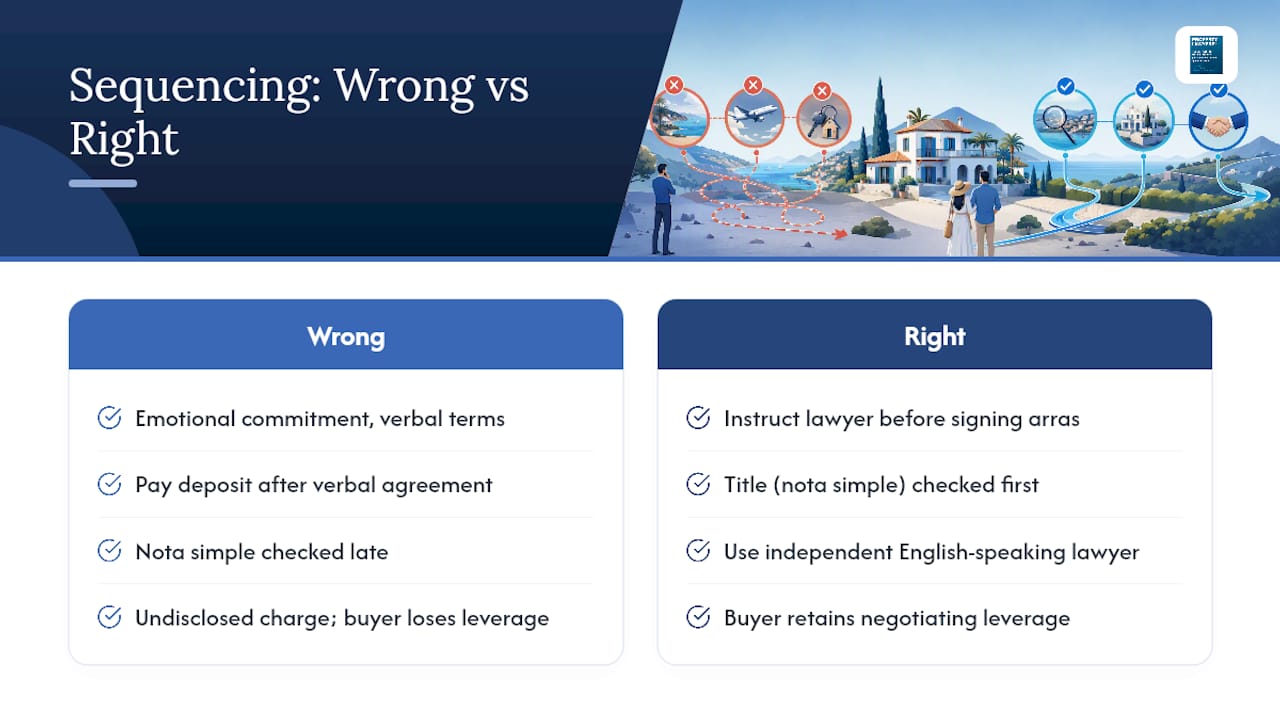
Instructing a lawyer before signing the arras, not after, is the single change that prevents most of the disputes I come across in this market. It costs little and changes everything about your negotiating position.
There are services that help international buyers find independent English-speaking lawyers across Spain, rather than relying on whoever the seller’s agent recommends. That independence is the point.
If you are about to sign anything, speak to a lawyer first.
— Sophie
Find a vetted lawyer before you sign anything
Buying privately in Spain saves the agency commission, but it shifts every legal check onto you and whoever you instruct running them. You can use online directories to search by region, read lawyer profiles, and contact an English-speaking specialist directly, without going through a generic call centre.
Whether you’re negotiating a villa in Marbella or an apartment in Palma, start with the buying guide and lawyer directory to see who covers your region, or go straight to the Marbella lawyer listings if that’s your target area. If tax is your main worry right now, the property purchase tax guide breaks down what you’ll owe before you commit to a figure. Book an initial enquiry through any profile and get a written fee estimate before you sign the arras.
Sources
- Agencia Tributaria (official tax site)
- Ministry / Registries guidance on nota simple and property registry
- Council of Notaries: steps to follow when buying and mortgage formalities
This article is general information, not a substitute for advice from a qualified lawyer. Consult a qualified legal professional about your own circumstances before acting on anything here.
FAQ
Is a compraventa entre particulares legal in Spain?
Yes. Buying or selling property directly between individuals is entirely legal, provided the sale follows the same registry checks, tax filings and notary process as an agency-managed sale.
What is a nota simple and why does it matter?
It’s a document from the Registro de la Propiedad showing the registered owner and any charges, mortgages or embargos on a property, and it’s the essential first check before paying any deposit.
How much tax will I pay buying a resale property?
Expect ITP of between 6% and 10% depending on the autonomous community, plus additional costs typically adding around 10% or more once notary, registration and gestoría fees are included.
What happens if the seller is a non-resident?
The buyer must withhold 3% of the purchase price and file modelo 211 with Hacienda within one month of signing, as an advance against the seller’s tax liability.
Do I need a lawyer for a private property sale?
It isn’t a legal requirement, but a Spanish property lawyer runs the title, planning and residency checks a private buyer cannot easily do alone, and Property-lawyers.com connects you with vetted, English-speaking specialists by region.
Recommended
- Legal checks before buying property in Spain
- How foreign buyers are protected under Spanish law
- Buyer due diligence in Spain: your 2026 guide
- Spanish property purchase process: a guide for buyers

Sophie Gutenberg is a legal content specialist focused on Spanish property law, real estate transactions, conveyancing, due diligence and tax issues affecting international property buyers in Spain. She works alongside qualified Spanish property lawyers .
