

Condominium law in Spain: a guide for buyers
The moment you complete the purchase of an apartment in Spain, you automatically become a member of a legal community with binding financial obligations, voting responsibilities, and enforceable rules — whether you live in the property, rent it out, or leave it empty. Many international buyers discover this only after the fact. Understanding what is condominium law Spain means understanding the Ley de Propiedad Horizontal, the legal framework that governs shared ownership in Spanish buildings, and the comunidad de propietarios structure that comes with it. This guide explains both clearly, so you can protect your investment from day one.
Table of Contents
- Overview of condominium law in Spain
- How the community of owners functions
- Key distinctions between condominio and comunidad de propietarios
- Practical implications for international buyers and investors
- Impact of Spain’s short-term rental regulations on condominium law
- Our perspective: why international buyers underestimate community law
- Find a trusted property lawyer in Spain
- Frequently asked questions
Key Takeaways
| Point | Details |
|---|---|
| Ley de Propiedad Horizontal | Governs all shared-property buildings and creates the Comunidad de Propietarios legal entity. |
| Automatic community membership | Ownership of a unit with common areas automatically binds you to the community with no opt-out. |
| Mandatory community fees | Owners must pay community fees regardless of residency or tenancy arrangements. |
| Legal distinction matters | Condominio (Civil Code) and comunidad de propietarios (Horizontal Property Law) are different legal concepts with distinct rules. |
| Short-term rental compliance | You must navigate national, regional, and community rules before renting short term within a comunidad. |
Overview of condominium law in Spain
Spain’s rules on shared property ownership are primarily governed by the Ley de Propiedad Horizontal, which translates as the Horizontal Property Law. This legislation sets the framework for organising owners of buildings with shared or common elements, covering everything from maintenance responsibilities to decision-making procedures.
Two key terms underpin this legal framework, and it is worth understanding both from the outset:
- Comunidad de Propietarios (Community of Owners): the homeowners’ association formed automatically when a building contains multiple individually owned units with shared common areas. Every owner is a member by law.
- Condominio: a form of co-ownership of an undivided property share, regulated separately under the Spanish Civil Code. This applies in different circumstances and carries different legal rules.
Under the Ley de Propiedad Horizontal, each owner holds exclusive rights to their individual unit. At the same time, they share responsibility for common elements such as staircases, lifts, roofs, gardens, and swimming pools. These responsibilities are not optional. They are tied directly to the property title.
Membership in the comunidad de propietarios is automatic. You do not apply to join. You do not choose to participate. The moment ownership transfers to you, you are legally part of the community. For international buyers unfamiliar with this structure, it can come as a genuine surprise. Consulting the legal glossary on key Spanish property terms before purchase is a sound first step.
How the community of owners functions
Understanding the legal framework, we now focus on how these owners’ communities operate and impose obligations on their members.
The comunidad de propietarios is a functioning legal entity with governance rules, financial obligations, and enforcement mechanisms. It is not a voluntary residents’ group. It has real legal authority over all owners within the building.

Governance and meetings
A comunidad de propietarios must hold at least one ordinary owners’ meeting per year to approve accounts and budgets under the Ley de Propiedad Horizontal. Extraordinary meetings can be called at any time when urgent matters arise.
Key governance features include:
- Voting rights weighted by cuota: each owner’s vote carries weight proportional to their cuota de participación, a percentage assigned to their unit based on size and location within the building.
- Majority decisions: most routine decisions require a simple majority, but significant changes to the building or its rules require higher thresholds.
- Elected president: the community elects a president from among the owners, who acts as the legal representative of the community.
Financial obligations
Community fees are payable by the property owner, not the tenant, even if the owner does not live in the flat. Failure to pay can lead to legal debt recovery proceedings. This is a point many international landlords overlook when they assume their tenant will handle community costs.
The steps a community can take against a non-paying owner are clearly defined:
- Issue a formal demand for payment.
- Pass a resolution at a community meeting confirming the debt.
- Notify the debtor owner of the resolution.
- Initiate legal proceedings through the courts if payment is still not made.
- Register the debt against the property title, which can affect future sales.
Pro Tip: Before attending your first owners’ meeting, request the community’s statutes and the most recent annual accounts. These documents reveal the financial health of the building and any ongoing disputes you may be inheriting.
Owners who fail to pay community fees also lose their right to vote at meetings, though they retain the obligation to comply with community decisions. This is a significant practical consequence for absentee owners who may not realise a debt has accumulated. If you are buying property in Spain, understanding these obligations before signing is essential. Seeking legal advice from a qualified Spanish property lawyer will help you review community statutes and fee histories before you commit.
Key distinctions between condominio and comunidad de propietarios
With the operational basics clear, we now examine a crucial legal distinction that affects owners’ rights and responsibilities.
Many international buyers use the terms condominio and comunidad de propietarios interchangeably. They are not the same thing, and confusing the two can lead to pursuing entirely the wrong legal remedy when disputes arise.
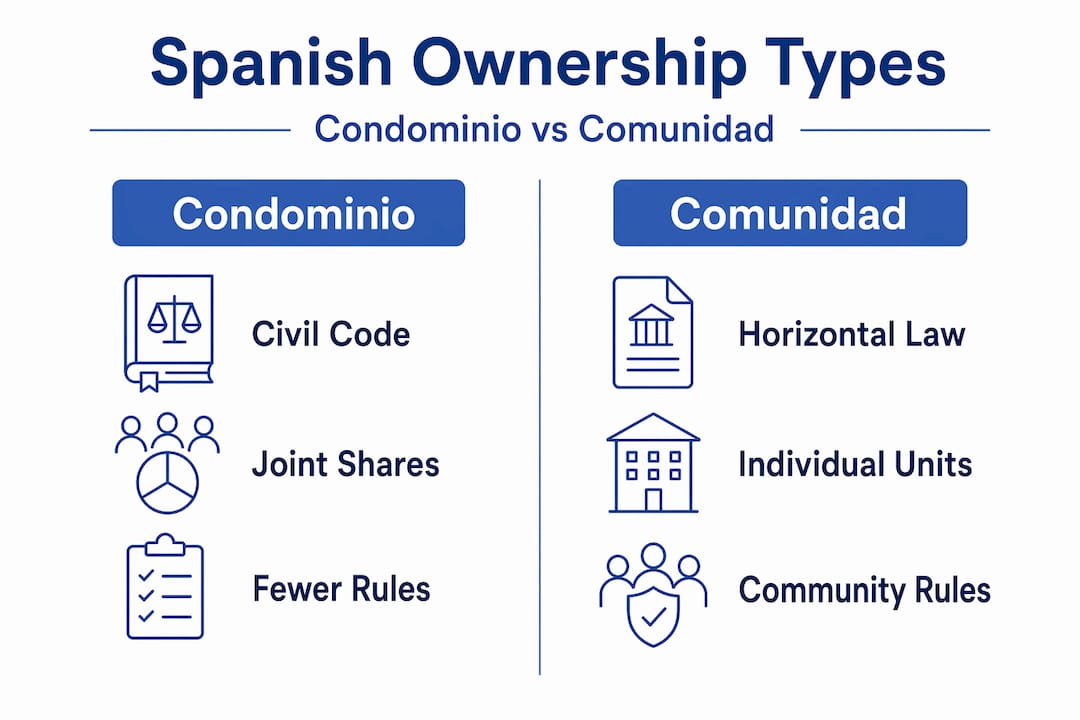
| Feature | Condominio | Comunidad de propietarios |
|---|---|---|
| Governing law | Spanish Civil Code | Ley de Propiedad Horizontal |
| Ownership structure | Undivided shares of a whole property | Individual units plus shared common elements |
| Legal entity | Not a separate legal entity | Functions as a legal entity |
| Dispute resolution | Civil Code remedies, including division of property | Community meeting resolutions and court proceedings |
| Governance rules | Agreed between co-owners | Statutory rules under Horizontal Property Law |
| Typical context | Rural properties, inherited land, joint purchases | Apartment buildings, urbanisations, gated communities |
The distinction matters in practice. If you co-own a rural property with a family member under condominio, either party can request a judicial division of the property if agreement breaks down. That remedy does not exist in the same form within a comunidad de propietarios, where the community structure and its rules govern disputes instead.
Key points to remember:
- Condominio applies to undivided co-ownership and is governed by the Civil Code.
- Comunidad de propietarios is a structured legal community under the Ley de Propiedad Horizontal.
- Their obligations, governance mechanisms, and dispute resolution routes differ substantially.
- Applying Civil Code remedies to a horizontal property dispute, or vice versa, will not produce the result you need.
Understanding which structure applies to your property is fundamental to your legal strategy as an owner. The legal glossary provides plain-language definitions of both terms, and a real estate lawyer Spain can confirm which framework governs your specific situation.
Practical implications for international buyers and investors
Now that we know the legal structures, here are the real-world effects and responsibilities international buyers should prepare for.
Spanish condominium regulations create concrete obligations that apply regardless of where you live or how you use your property. These are not administrative formalities. They have financial and legal consequences.
Community fees and non-payment risks
Community fee obligations apply irrespective of residency, and non-payment risks legal debt recovery measures including interest charges. If you purchase a property with outstanding community debts, you may inherit those debts as the new owner. Spanish law limits inherited community debt liability to the year of purchase and the previous three years, but this can still represent a significant sum.
Key responsibilities for international owners include:
- Paying community fees on time, even from abroad.
- Monitoring community correspondence, often issued only in Spanish.
- Attending or sending a proxy to annual meetings to protect your voting rights.
- Ensuring your tenant complies with community rules, as you remain responsible.
Pre-purchase due diligence
Due diligence should include certificates confirming the property is free of community debts before purchase. This certificate, known as a certificado de deudas con la comunidad, is issued by the community administrator and must be provided by the seller at the time of signing the deed. If the seller cannot produce it, treat this as a serious warning sign.
A property with unpaid community fees is not just a financial liability. It signals a seller who has been absent from community obligations, which may point to wider maintenance or governance issues within the building.
Tenants and community rules
Tenants must comply with community rules but do not hold voting rights; the owner manages compliance and remains legally responsible. If your tenant causes a disturbance, violates community rules, or damages common areas, the community will pursue you as the owner, not the tenant directly.
Pro Tip: Include a clause in your rental contract requiring the tenant to comply with the community’s statutes and rules. Attach a copy of those rules to the contract so there is no ambiguity about what is expected.
Reviewing the property buying guide and consulting a real estate lawyer Spain before purchase will help you identify any outstanding debts, review community statutes, and understand your obligations as an owner. The legal glossary is also a useful reference for understanding the terminology you will encounter in community documents.
Impact of Spain’s short-term rental regulations on condominium law
With ownership and resident responsibilities outlined, consider how short-term rental regulations intersect with community dynamics.
If you plan to let your Spanish property on a short-term basis through platforms such as Airbnb or similar services, you face not one but three layers of compliance. Spain’s national short-term rental code introduced VUDA registration and requires annual reporting, but community rules may add further restrictions that override your plans entirely.
The compliance steps for short-term letting within a comunidad are:
- Register with the VUDA system at national level, providing property details and owner information.
- Obtain a regional tourist licence from the relevant autonomous community authority, as requirements vary significantly between regions such as Andalucía, Catalonia, and Valencia.
- Check the community statutes for any clauses restricting or prohibiting short-term letting within the building.
- Attend or monitor community meetings where restrictions on short-term rentals may be voted upon and introduced.
- Comply with any community-imposed conditions on guest behaviour, noise, and use of common facilities.
It is worth noting that a community of owners can vote to restrict or ban short-term rentals within the building, provided a qualified majority of three-fifths of owners agrees. This means a property that is legally licensed for tourist letting at regional level may still be effectively prohibited from operating if the community votes against it. Verifying community policy before purchasing a property with rental income in mind is not optional. It is essential. Consulting a specialist on rental licences will help you navigate all three compliance layers before you commit to a purchase.
Our perspective: why international buyers underestimate community law
Most international buyers focus their legal attention on the purchase contract, the title search, and the mortgage. These are important. But in our experience, the ongoing obligations of community membership cause more post-purchase frustration than almost any other aspect of owning property in Spain.
The reason is straightforward. Community law is invisible at the point of purchase. You do not see the unpaid fees, the contentious neighbour disputes, or the pending special assessments for roof repairs until you are already an owner. By then, the obligations are yours.
There is also a language barrier that compounds the problem. Community meetings are conducted in Spanish. Minutes are circulated in Spanish. Fee demands arrive in Spanish. International owners who do not engage with these communications can find themselves in debt, stripped of voting rights, and unaware of decisions that directly affect their property.
The conventional advice is to hire a property lawyer for the purchase. Our view is that you should also instruct a lawyer or property administrator to manage your community obligations on an ongoing basis, particularly if you are not resident in Spain. The cost is modest compared to the risk of accumulated debts or missed votes on decisions that affect your building’s maintenance and value.
Spain’s property management laws are not designed to be hostile to foreign owners. But they do assume active participation. The buyers who fare best are those who treat the comunidad de propietarios not as a background formality but as a legal relationship that requires ongoing attention.
Find a trusted property lawyer in Spain
Navigating Spanish condominium regulations, community obligations, and short-term rental compliance is genuinely complex for international buyers. The legal structures are specific, the documentation is in Spanish, and the consequences of getting it wrong are financial and legal.

Property-lawyers.com connects international buyers with independent, specialist real estate lawyers across Spain who understand both the legal framework and the practical realities of buying property in Spain. Whether you need pre-purchase due diligence, a review of community statutes, or ongoing legal support as an owner, our directory helps you find the right lawyer for your situation. Use our buying property in Spain resources to prepare, and let a qualified lawyer guide you through the rest.
Frequently asked questions
Is membership in a comunidad de propietarios optional for international buyers?
No. Membership is automatic and tied to the property title; there is no opt-out for any owner, regardless of nationality or residency status.
Who is responsible for paying community fees if the property is rented out?
The property owner must pay community fees even when the property is let. Community fees are payable by the owner, not the tenant, unless the lease expressly states otherwise.
Can tenants participate in the owners’ meetings and vote?
Tenants do not hold voting rights in owners’ meetings. Tenants must comply with community rules, but the owner remains responsible for ensuring that compliance.
What legal differences exist between condominio and comunidad de propietarios?
Condominio under Civil Code refers to joint ownership shares with separate legal rules and dispute remedies, whereas comunidad de propietarios is a horizontal property community governed by the Ley de Propiedad Horizontal with its own distinct governance structure.
What compliance is required to rent a property short term within a comunidad?
Owners must complete national VUDA registration, obtain the relevant regional tourist licence, and comply with any community rules that restrict or prohibit short-term letting within the building.
Recommended
- Property Buying Guide Spain: Legal Advice for Foreign Buyers
- Legal Glossary – Buying Property in Spain | Property Lawyers
- How to Buy a Property in Spain With 100% Confidence |
- Property Lawyers in Spain | English-Speaking Real Estate Solicitors

Sophie Gutenberg is a legal content specialist focused on Spanish property law, real estate transactions, conveyancing, due diligence and tax issues affecting international property buyers in Spain. She works alongside qualified Spanish property lawyers .
