

Protect Your Share: Shared Home Ownership in Spain and 10 Year Rule
Copropiedad vivienda means two or more people own the same property in undivided shares, not separate physical parts of it. Under Article 400 of the Spanish Civil Code, any co-owner can demand the property be divided at any time, and that right never expires. If you are buying with a partner, sibling, or friend, get percentages written into the escritura and agree an exit plan before you sign, or you risk losing control of the outcome later.
TL;DR:
- Any co-owner can demand property division at any time, with no expiration on this right, regardless of existing agreements or circumstances.
- Selling a share does not require permission, but all owners must consent to major changes or complete sale of the property, while minor decisions are majority-driven.
- Properly recording ownership percentages in the escritura and registering at the Property Registry is essential to enforce actual contributions and prevent disputes.
- A written pacto de copropiedad covering percentages, use, costs, and exit procedures decreases the likelihood of conflicts and simplifies resolution.
- Judicial division is a costly last resort, so owners should consider mediation and clear valuation methods in advance to avoid forced auctions below market value.
Table of Contents
- What is copropiedad (proindiviso) in Spain?
- Rights and obligations of co-owners: use, costs and selling a share
- Recording ownership shares correctly in the escritura pública
- Buying with others: mortgages, tax and reducing future conflict
- Managing the property day to day
- How to exit a copropiedad: buyout, sale or judicial division
- Checklist and clauses for a pacto de copropiedad
- When to hire a lawyer for a copropiedad matter
- Tax and fiscal responsibilities of shared ownership
- Maintaining common areas and shared spaces
- Resolving disputes without going to court
- Community rules and planning regulations affecting copropiedad
- Typical disputes and how they tend to resolve
- Simple next steps for readers in Spain
- Sources
- FAQ
What is copropiedad (proindiviso) in Spain?
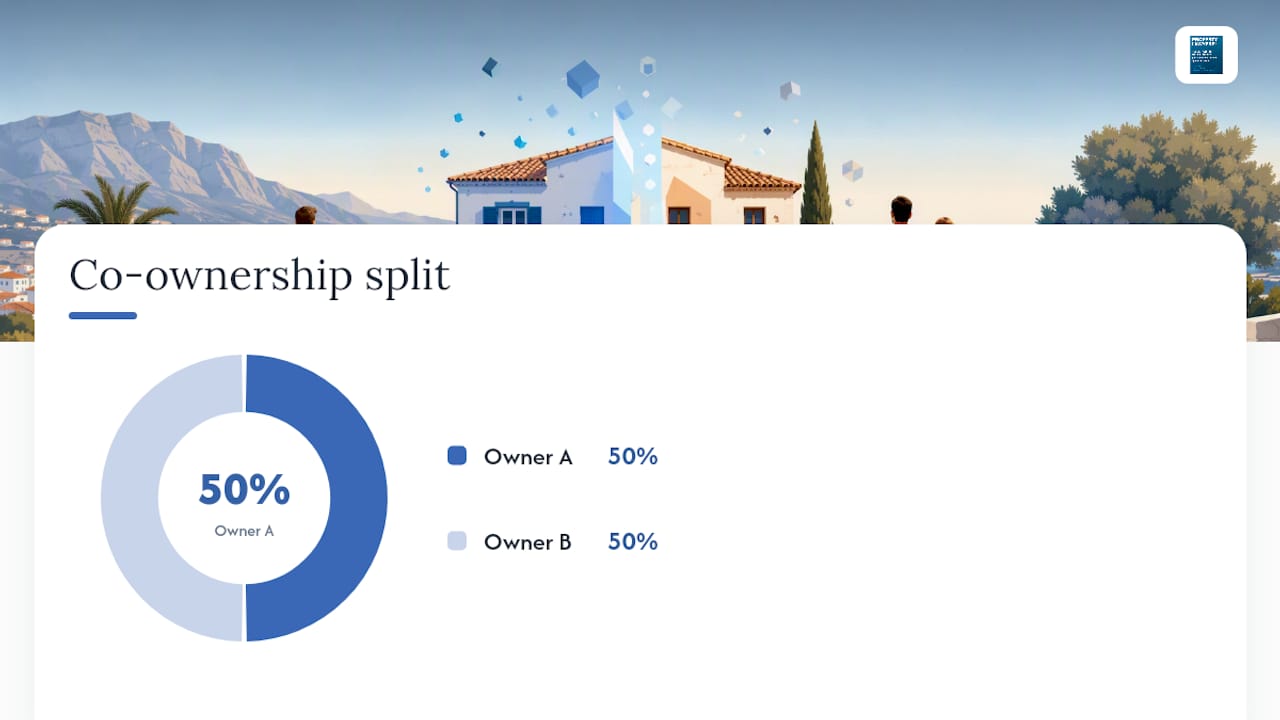
Copropiedad, also called proindiviso, is a legal structure where several people own one property together, each holding an abstract percentage of the whole rather than a specific room or floor. If two friends buy a Málaga flat 50/50, neither owns “the kitchen” or “the bedroom.” Each owns half of everything, from the front door to the roof tiles, and that share can be sold, mortgaged, or inherited independently of the other owner’s wishes.
This arises constantly in Spain, often without anyone planning it. A couple buying a holiday home in Mallorca puts both names on the deed. Siblings inherit their parents’ apartment in Barcelona and become co-owners overnight, whether they wanted to or not. Two investors split the cost of a rental property near Ibiza Town to make the numbers work. All of these are legally identical: a community of owners governed by property co-ownership rules under the Civil Code.
The legal framework sits in Articles 392 to 406 of the Civil Code. Article 392 defines the community of property by quotas, and the remaining articles set out how owners use the property, share expenses, and eventually leave the arrangement. The most consequential of these is Article 400, which gives every co-owner the right to request division of the common thing at any point, a right the law treats as impossible to permanently waive.
Here is what typically triggers a copropiedad situation in the Spanish property market:
- Inheritance: Parents leave a property to two or more children, who become co-owners by default until they formally divide the estate.
- Couples buying together: Unmarried partners or spouses under separate property regimes often register both names on the escritura.
- Friends or investors pooling funds: Common in coastal hotspots and the Costa Blanca, where buying alone is out of reach financially.
- Divorce or separation: A former marital home can remain in joint names for years after a couple splits, especially if neither wants to force a sale immediately.
- Partial sale of a share: An owner sells only their percentage to a third party, bringing a stranger into the community.
None of these situations is inherently a problem. What causes friction is the absence of a written agreement covering percentages, usage, and what happens if one owner wants out.
Rights and obligations of co-owners: use, costs and selling a share
Every co-owner has the right to use and enjoy the whole property, not just a portion equivalent to their percentage. That sounds generous until two owners disagree about who lives there, and it is one of the most common sources of dispute in copropiedad arrangements. The law allows use by any owner provided it does not prevent the other co-owners from exercising their own rights or damage the property in the process.
Decision-making splits into two tiers. Day-to-day administration, such as choosing a maintenance contractor or agreeing minor repairs, is decided by a majority of quotas, not a majority of people. Acts of disposition, meaning selling the whole property, mortgaging it, or making major structural changes, need the consent of all owners, because no single co-owner can bind the others to a decision that affects their capital.
Selling your own share is different from selling the whole property, and this is where many buyers get confused:
- You can sell your quota without permission from the other owners; a share in a proindiviso is your property to dispose of.
- Existing co-owners may have pre-emption rights (retracto and tanteo) in specific circumstances, letting them match a third-party offer before an outside buyer completes.
- Buyers of a minority share should expect limited practical control, since majority decisions on administration remain with whoever holds the largest quota.
- Selling to a stranger rarely solves underlying disputes, since the new owner inherits the same legal position and the same unresolved tensions.
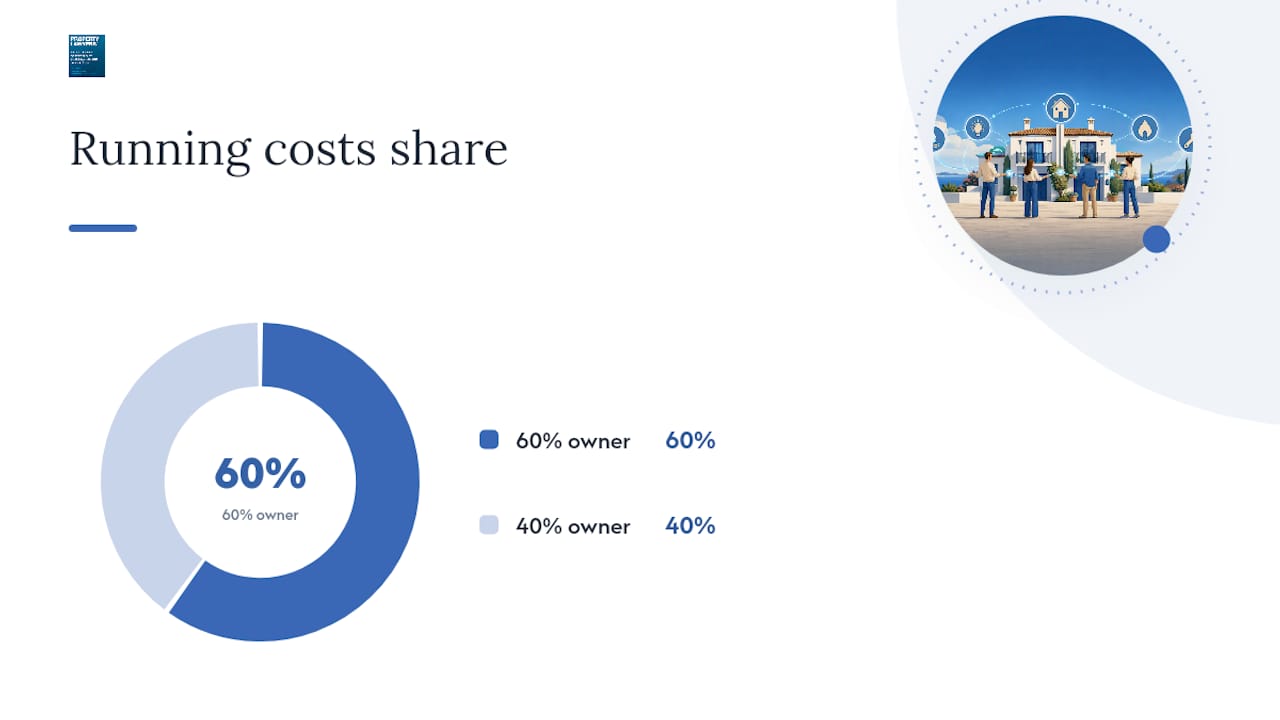
Running costs are shared proportionally to each owner’s percentage, covering IBI (the annual property tax), community fees where the building has a residents’ association, insurance, and repairs. A 60/40 split in ownership means a 60/40 split in these bills, regardless of who actually lives there.
Pro Tip: If one owner occupies the property exclusively while the other pays half the bills without living there, put a fair compensation figure in writing early. Courts frequently order retroactive payment for exclusive use once a dispute reaches them, and agreeing the number in advance avoids a messy backdated calculation.
Recording ownership shares correctly in the escritura pública
Unequal shares are entirely legal in Spain, but they only count if the public deed says so clearly. If the escritura is silent on percentages, or ambiguous, the default legal presumption is an equal split between owners, regardless of who actually paid what. This catches out a surprising number of couples and friends who contributed unequal amounts but never thought to specify it at the notary.
Getting this right matters because Spanish courts and the Property Registry both work from the deed, not from memory or informal understandings between the parties.
Documents that help establish true financial contributions if a dispute ever arises include:
- Bank transfer records showing exactly who paid what, and when, during the purchase.
- Receipts for the deposit, notary fees, and any renovation work funded unequally.
- A private agreement (documento privado) signed before completion, setting out the intended percentages.
- Correspondence with the estate agent or seller referencing the agreed contribution split.
Once the escritura is signed with correct percentages, register the quotas at the Property Registry (Registro de la Propiedad). This step is often overlooked, but it makes ownership shares enforceable against third parties, not just between the co-owners themselves. Skipping registration does not invalidate the escritura, but it weakens your position if a dispute or a sale to an outsider ever tests it. The legal glossary covers related terms like extinción de condominio if you want to understand what happens further down the line.
Buying with others: mortgages, tax and reducing future conflict
Most joint buyers in Spain finance the purchase with a shared mortgage, and banks treat this arrangement more simply than owners expect. If both parties sign the loan, the lender can pursue either borrower for the full outstanding amount, regardless of ownership percentage. That is solidary liability in practice: your 30% ownership share does not cap your 100% exposure to the bank if your co-owner stops paying.
This gap between ownership percentage and mortgage liability is precisely what catches unprepared buyers off guard.
The bank does not care how you split ownership on paper. It cares that someone pays the monthly instalment, and it will chase whichever borrower is easiest to collect from.
Tax obligations on purchase apply per owner in proportion to their share, covering transfer tax or VAT depending on the property type, plus the usual notary and registry costs. If you later want to change the split, perhaps buying out your co-owner entirely, that internal transaction can itself trigger tax, so check the specific implications with a lawyer before assuming a simple handover between owners is cost-free. Rates and exemptions vary by region and by the buyer’s residency status, which is exactly the kind of detail worth confirming through property purchase tax guidance specific to your situation.
Practical arrangements that reduce friction from day one include:
- A joint bank account dedicated solely to shared costs like IBI, community fees, and utilities, funded proportionally each month.
- A shared folder or spreadsheet logging every payment, so nobody has to reconstruct history from memory two years later.
- Adequate buildings insurance in both names, avoiding disputes over who was responsible for cover if something goes wrong.
- A written note of any unequal upfront contribution, cross-referenced with the escritura percentages, kept somewhere both owners can access.
Managing the property day to day
Copropiedad works best with a light structure around it, even between people who trust each other completely. Without some framework, small disagreements about repairs or bills tend to accumulate into bigger ones.
A workable governance model for most residential co-ownerships looks like this:
- Nominate one owner as administrator for routine matters, such as instructing tradespeople or paying recurring bills, with authority capped below a set spending threshold.
- Hold a short annual review, even informally over coffee, to agree the coming year’s budget for maintenance and confirm nothing has changed regarding occupancy.
- Keep written minutes of any decision involving spending above the administrator’s threshold, even a two-line email confirming what was agreed.
- Set a clear occupation arrangement, whether that means one owner living there year-round and compensating the other, or a rota for holiday-home use.
- Agree a fixed process for unpaid contributions, starting with a written reminder, moving to a formal letter before legal action, and only escalating to court as a last resort.
Pro Tip: Send a written reminder by email or registered post the moment a payment is missed, even if the amount is small. A documented history of chasing unpaid contributions strengthens your position significantly if the dispute eventually needs a lawyer or a judge.
Compensating exclusive occupation is worth formalising rather than leaving as a vague understanding. If one owner lives in the Marbella apartment full time while the other lives abroad, a simple monthly figure covering the non-occupying owner’s share of the property’s rental value avoids resentment building silently over years.
How to exit a copropiedad: buyout, sale or judicial division
Every co-owner has three realistic routes out of a proindiviso, and the difference between them in cost and stress is substantial.
The first and cheapest route is a voluntary agreement: one owner buys out the other at an agreed price, the property is sold to a third party with proceeds split by quota, or the parties agree an adjudication where one owner keeps the property and compensates the other financially. All three depend entirely on the owners agreeing, which is why a pacto de copropiedad signed at the outset makes this route far more likely to succeed later.
Where agreement fails, any owner can file for judicial division under Article 400, and this route follows a fairly predictable sequence:
| Stage | What happens |
|---|---|
| Filing | One co-owner files the actio communi dividundo, requesting the court divide the common property |
| Valuation | The court appoints an independent expert (peritaje) to value the property |
| Division attempt | If the property can be physically divided fairly, the court orders that split |
| Indivisible property | Where physical division is impractical, the court adjudicates to one owner with compensation, or orders sale |
| Public auction (subasta) | If no owner wants to buy out the others, the property goes to public auction and proceeds are split by quota |
Auctions rarely achieve the property’s true market value, which is the single biggest financial argument for avoiding this route wherever possible. A property that might sell for €400,000 on the open market can fetch considerably less at a forced auction, simply because buyers at auctions expect a discount for the process itself.
Three practical mitigations reduce the risk of ending up here:
- Fix a valuation method in advance in your pacto de copropiedad, such as an average of two independent appraisals, so nobody can stall by disputing the property’s worth.
- Agree a realistic timetable for buyout negotiations before anyone involves a court, giving both sides a fair window to arrange financing.
- Try mediation before filing anything with a court; it is faster, cheaper, and keeps the decision in the owners’ hands rather than a judge’s.
The right to request division cannot be permanently signed away. Owners can agree a temporary indivision pact, but Spanish legal practice limits this to a maximum of ten years, after which either owner can demand division regardless of what was previously agreed.
Checklist and clauses for a pacto de copropiedad
A pacto de copropiedad is a private agreement between owners that sits alongside the escritura and sets out how the arrangement actually works in practice. It is not legally required, but skipping it is one of the most common regrets among people who later fall into dispute.
Essential clauses worth including:
- Ownership percentages, matching exactly what is recorded in the escritura, with no ambiguity.
- A use schedule, covering who lives there, when, and how holiday use is rotated if the property is not a full-time residence.
- Cost-sharing rules, specifying how IBI, community fees, insurance, and repairs are split and by what date payments are due.
- Transfer rules, restricting or governing how an owner can sell their share to a third party.
- Pre-emption rights, giving existing owners first refusal if one owner wants to sell.
- Exit mechanics and a valuation formula, fixing how a buyout price is calculated to avoid disputes when the time comes.
- An agreed indivision term, respecting the ten-year statutory limit rather than attempting an unenforceable permanent restriction.
Keep supporting documents alongside the pacto itself: bank transfer records, receipts for major expenses, and any amendments signed by all owners as circumstances change. Amendments should be dated and signed the same way as the original pacto, never agreed verbally and left unrecorded, since verbal agreements about property matters are notoriously difficult to enforce if a relationship later breaks down.
Pro Tip: Review your pacto every couple of years, particularly after a major life change like marriage, a new child, or a job relocation abroad. Circumstances that made a use schedule sensible in year one often stop making sense by year five.
When to hire a lawyer for a copropiedad matter
A specialist lawyer earns their fee quickly in copropiedad situations, because the cost of an unclear escritura or a missing pacto tends to dwarf the cost of proper advice at the outset. Three moments justify instructing a lawyer specifically:
- Drafting the pacto de copropiedad, ensuring clauses on valuation, exit, and pre-emption actually hold up if tested later.
- Reviewing the escritura before signing, checking percentages are recorded correctly and match what was actually paid.
- Litigating a division if voluntary agreement breaks down, where procedural knowledge of the actio communi dividundo materially affects the outcome and the cost.
At a first appointment, it is worth asking direct questions: how much experience does this lawyer have specifically with proindiviso cases, what strategy would they recommend for your situation, and how are fees structured, fixed or hourly. A lawyer who answers vaguely on the first question is worth reconsidering.
Users can find English-speaking property lawyers across Spain’s regions, including Marbella, Málaga, Mallorca, Ibiza, and Barcelona through appropriate directories. The property buying guide is a sensible starting point if you are still at the purchase stage, and the directory itself helps you find a specialist by location once you know what you need.
Tax and fiscal responsibilities of shared ownership
Each co-owner in a Spanish proindiviso is fiscally responsible for their share of the property, not the whole thing, but this only works cleanly if the escritura percentages are accurate. Annual IBI is normally billed to the property as a whole, so owners need an internal agreement on who forwards payment and by when, since the local council does not split the bill by percentage automatically.
Income tax treatment differs depending on whether the property is rented out or used privately. If the property generates rental income, each owner declares their proportional share of that income individually, not the household total. This matters for non-resident owners in particular, since non-resident tax rates and reporting deadlines in Spain differ from those applying to residents, and getting the proportional split wrong on a tax return can trigger unwanted attention from the tax authority.
Wealth tax and inheritance tax also apply per owner rather than to the property as a single unit, which is one reason inherited copropiedad situations between siblings sometimes create very different tax positions for each heir depending on their personal circumstances and existing assets elsewhere. Buying out a co-owner’s share, as mentioned earlier, can itself be a taxable transaction, so timing an internal buyout without checking the tax consequences first is a common and avoidable mistake.
Maintaining common areas and shared spaces
Where a copropiedad involves shared structural elements, a roof, a shared driveway, a pool serving more than one dwelling, maintenance responsibility follows the same proportional logic as every other cost in the arrangement. The practical difficulty is less about who pays and more about who decides what needs doing and when.
Routine maintenance, such as gutter clearing or a boiler service, sits within the majority-of-quotas decision-making threshold discussed earlier, meaning the owner with the larger percentage can usually authorise it without unanimous sign-off. Larger structural work, a new roof or significant damp treatment, typically needs agreement from all owners because it represents a more significant financial commitment and affects the property’s underlying value.
A recurring maintenance fund, even a modest one, avoids the awkward scramble that happens when an unexpected repair bill lands and one owner cannot immediately produce their share of the cost. Setting aside a small monthly contribution into the joint account mentioned earlier, specifically earmarked for maintenance rather than day-to-day bills, means the money is already there when something breaks.
Resolving disputes without going to court
Judicial division is the last resort, not the first step, and Spanish legal practice increasingly favours mediation as a faster, cheaper alternative before anyone files papers with a court. A mediator does not decide the outcome, but helps both owners reach a voluntary agreement on buyout price, timing, or occupation arrangements, which then gets formalised in writing.
Arbitration is a further option where the parties have agreed in advance, often through a clause in the original pacto de copropiedad, to submit disputes to a private arbitrator rather than a public court. This tends to be faster than litigation and keeps proceedings confidential, though it usually costs more upfront than mediation.
Both routes work best when the pacto de copropiedad already contains an agreed valuation method and timetable, since much of what makes judicial division slow and expensive is the fighting over what the property is worth and how quickly a buyout must complete. Removing that fight in advance, through a fixed formula agreed while relations are still good, is consistently what separates a smooth exit from an expensive one.
Community rules and planning regulations affecting copropiedad
If the property sits within a residential complex governed by a community of owners (comunidad de propietarios), the building’s own internal rules add a further layer on top of the co-ownership arrangement between the individual owners. Community statutes typically govern shared costs for lifts, gardens, and security, and these obligations apply regardless of how the individual apartment’s ownership is split internally between co-owners.
Local urban planning regulations can also affect what co-owners are permitted to do with the property, particularly around short-term rental licensing in popular tourist areas like Ibiza and parts of the Costa del Sol. If co-owners plan to rent the property out, checking rental licence requirements for the specific municipality is essential before assuming income can simply be split and declared. Some town halls have paused new licences entirely or capped numbers, which affects the practical value of a rental-focused copropiedad arrangement regardless of what the owners privately agree between themselves.
Typical disputes and how they tend to resolve
The most common dispute pattern involves one owner occupying the property while the other pays their share of costs without living there, and resentment building over years without either side raising it directly. These usually resolve once a fair occupation-compensation figure is calculated and backdated, often with a lawyer’s help to reach a number both sides accept as reasonable.
A second recurring pattern is inherited siblings disagreeing on whether to sell or keep a property, sometimes for years, while maintenance is neglected because nobody wants to fund repairs on a property they may not keep. These frequently end in one sibling buying out the others once a fair valuation is agreed, avoiding the cost and delay of judicial division.
A third pattern involves a minority co-owner who feels excluded from decisions dominated by a majority quota holder. Spanish law’s majority-by-quota rule for administration is legally sound but can feel unfair in practice, and these disputes often resolve through a clearer written governance agreement rather than litigation, since the underlying legal position rarely changes in the minority owner’s favour.
Simple next steps for readers in Spain
Copropiedad is not a problem to solve after the fact. It is a structure to set up properly before you complete on a purchase, or to formalise quickly if you have inherited or already bought jointly without a written agreement in place.
If you are already in a proindiviso without documentation, start by gathering proof of every payment made, bank transfers, receipts, anything showing who funded what. Draft a short pacto covering percentages, use, and an exit formula, even a simple one, and have a lawyer review it before both owners sign. That single document tends to prevent the vast majority of disputes this article has described.
If you are about to buy with a partner, sibling, or friend, treat the percentage split and the exit plan as part of the purchase itself, not an afterthought to sort out later. Agree the numbers before you fund anything, get them written into the escritura correctly, and register the quotas at the Property Registry.
Property-lawyers exists to connect you with a vetted, English-speaking property lawyer in the region where you are buying, whether that is Marbella, Mallorca, Ibiza, Málaga, or Barcelona. The Madrid solicitors directory and the wider property buying guide are useful starting points if you want to speak to someone before you sign anything.
— Sophie
Sources
Spanish copropiedad law sits in Articles 392 to 406 of the Civil Code, with Article 400 being the single most important provision for anyone buying jointly. The process typically follows a fairly predictable sequence covering valuation and auction stages, described in detail above.
For a plainer-language explanation of proindiviso and how to exit one, Legia.es covers the statutory basis and the ten-year limit on indivision pacts. International buyers wanting a foreigner-focused overview of how joint ownership works in Spain will find ListyCo’s guide useful for the practical basics before consulting a lawyer for their specific situation.
This article is general information, not a substitute for advice from a qualified lawyer. Consult a qualified legal professional about your own circumstances before acting on anything here.
- Joint ownership (proindiviso) in Spain — general guidance
- Spanish Civil Code, Articles 392-406
FAQ
What does it mean to own a property in copropiedad?
It means two or more people hold an abstract percentage share of the whole property, rather than owning separate physical parts of it, and any owner can legally request the property be divided at any time under Article 400 of the Civil Code.
Is multiproperty (timeshare) legal in Spain?
Timeshare, or multipropiedad, is a distinct legal arrangement from standard copropiedad and is regulated separately in Spain; it is legal but governed by specific consumer-protection rules rather than the Civil Code articles on proindiviso discussed here.
What percentage of Spaniards own their home?
Home ownership is common in Spain, though exact national percentages vary by year and source; what matters for copropiedad purposes is that a significant share of those owned homes involve more than one registered owner, whether through couples, inheritance, or joint purchase.
What does the Civil Code say about copropiedad?
Articles 392 to 406 govern community of property by quotas, with Article 400 giving every co-owner an imprescriptible right to request division, meaning no owner can be forced to remain in the arrangement indefinitely.
Can I be forced to sell my share of a jointly owned property?
You cannot be forced to sell to a specific person, but if a co-owner files for judicial division and the property cannot be fairly split or bought out by agreement, it may go to public auction with proceeds divided by quota.
Recommended
- 10 important steps before buying property in Spain
- Spanish real estate law: a buyer’s guide for 2026
- Jointly owned property in Spain: guide for international buyers
- Spain’s 10-year structural guarantee for new-build property

Sophie Gutenberg is a legal content specialist focused on Spanish property law, real estate transactions, conveyancing, due diligence and tax issues affecting international property buyers in Spain. She works alongside qualified Spanish property lawyers .
