

From €150, What Buyers Pay for Property Lawyer Fees in Spain
Simple contract reviews start around €150 to €400, while full conveyancing packages commonly land between €500 and €3,000, and sometimes higher for expensive or complex deals. Spanish VAT (IVA) at 21% almost always applies on top. Before anything else, ask for a written quote that spells out exactly what’s included.
TL;DR:
- Lawyer fees for property transactions in Spain typically range from €150 to €400 for simple contracts, up to €1,500 for full due diligence, plus 21% VAT.
- Fees vary based on the billing model, with fixed fees being cheaper for lower-value properties and percentage fees growing at higher prices, especially above €300,000.
- A lawyer’s work includes due diligence, contract review, notary coordination, and sometimes tax filings, with costs influenced by property complexity, party involvement, and urgency.
- Each side generally pays for their own lawyer, and it is essential to get a detailed, written scope of work before instructing a lawyer.
- Taxes and notary fees often surpass legal costs in total expenses when buying or selling property in Spain.
Table of Contents
- How much are honorarios abogado compraventa in Spain?
- What does a lawyer’s fee actually cover?
- What makes fees go up or down?
- Worked examples: what you’d realistically pay
- Who pays the lawyer, and when?
- How to agree fees in writing before you commit
- Other costs beyond the lawyer’s bill
- Why a specialist property lawyer earns their fee
- Get a clear fee estimate before you commit to a lawyer
- Sources
- FAQ
How much are honorarios abogado compraventa in Spain?
Lawyer fees for a Spanish compraventa vary more by billing model than by region, though location plays a part too. Three structures dominate the market:
- Fixed fees for straightforward purchases, often covering due diligence and completion for a set price agreed upfront.
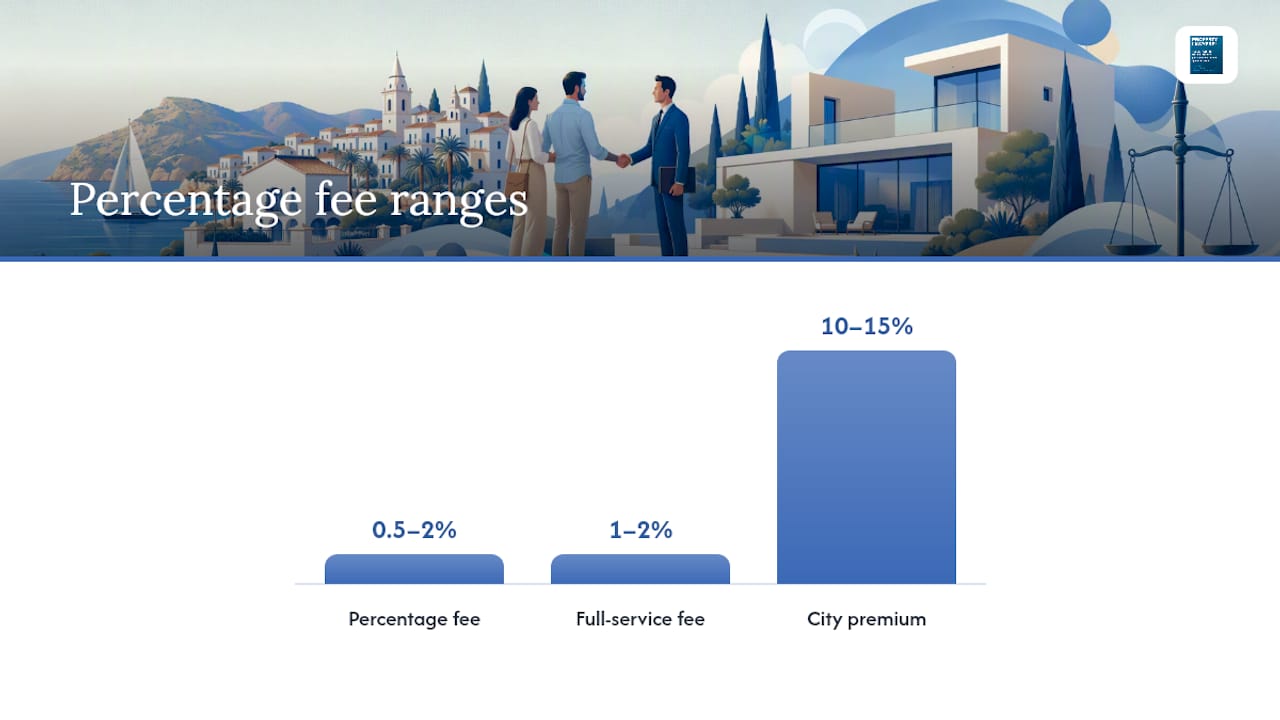
- Percentage-based fees, usually 0.5% to 2% of the purchase price, common on higher-value properties where the work scales with risk.
- Hourly rates, used less often for standard purchases but typical for disputes, complex inheritance cases, or ongoing advisory work.
Full-service conveyancing fees often sit between 1% and 2% of the property price plus VAT, according to typical market figures for the Spanish legal sector. At the lower end, a basic contract review can cost as little as €150 to €400, while full due diligence alone often runs €500 to €1,500, based on pricing bands reported across Spanish legal advisories.
Location matters too. Fees in Madrid and Barcelona tend to run 10% to 15% higher than in smaller provinces, reflecting higher overheads and demand for bilingual specialists in those cities. Marbella, Mallorca and Ibiza often sit closer to the city-level end of the scale too, given the extra due diligence that holiday-home purchases sometimes require.
What does a lawyer’s fee actually cover?
A property lawyer’s fee in a Spanish compraventa isn’t just a signature on a contract. It typically bundles together several distinct pieces of work:
- Due diligence — checking the land registry (Registro de la Propiedad), confirming there are no outstanding cargas (charges or debts), and reviewing the certificado registral to confirm the seller actually owns the property free of hidden claims.
- Contract review and negotiation — reviewing or drafting the reservation contract and the private purchase agreement, and negotiating terms on the buyer’s or seller’s behalf.
- Notary coordination and registration — liaising with the notary, checking the completion deed (escritura), and ensuring the property is properly registered afterwards.
- Tax filings — some lawyers include ITP or IVA filing assistance as standard; others treat this as an extra. Always ask which applies.
An independent lawyer’s due diligence is not something the notary does. The notary in Spain is a neutral public official, responsible for formalising the deed, not for protecting the buyer’s specific interests. That protective role belongs to your own lawyer, which is precisely why paying for one matters, especially if you’re buying from abroad.
What makes fees go up or down?
Fee quotes vary because the underlying legal work varies. A few factors consistently move the price:
- Title complexity — a property with an outstanding mortgage, multiple previous owners, or unclear boundaries takes longer to clear.
- Number of parties involved — inheritance sales, divorces, or company-owned properties often mean more signatories and more checks.
- Litigation risk — if there’s a dispute over boundaries, debts, or occupancy, expect hourly billing rather than a fixed fee.
- Translation and bilingual support — international buyers often need documents translated or a bilingual lawyer present at signing, which adds cost.
- Urgency — a fast-tracked completion sometimes carries a premium, particularly around city centres like Madrid or Barcelona.
Pro Tip: Ask your lawyer to flag, in writing, any factor from your specific case (inheritance, mortgage, non-resident seller) that could push the fee above the initial estimate. A good lawyer will tell you upfront rather than surprise you later.
Worked examples: what you’d realistically pay
Numbers help more than percentages in the abstract. Here’s how the two most common models compare across three typical property values, assuming a full-service package (due diligence, contract review, notary coordination, and completion support), excluding tax filing unless stated:
| Property price | Fixed-fee estimate (excl. IVA) | 1% fee (excl. IVA) | Total with 21% IVA (fixed) | Total with 21% IVA (1% model) |
|---|---|---|---|---|
| €150,000 | €1,200 | €1,500 | €1,452 | €1,815 |
| €300,000 | €1,800 | €3,000 | €2,178 | €3,630 |
| €600,000 | €2,500 | €6,000 | €3,025 | €7,260 |
These figures sit within the ranges reported by Spanish property fee surveys, but they’re illustrative rather than guaranteed. On lower-value properties, a fixed fee is usually cheaper than a percentage model. On higher-value deals, the gap widens fast, which is why many lawyers switch to fixed or capped fees above a certain threshold. Always ask which model applies before assuming the percentage quoted is final.
Who pays the lawyer, and when?
In most Spanish transactions, each side hires and pays their own lawyer. There’s no fixed national rule forcing one party to cover both, though customs shift slightly by region and by how a deal is negotiated.
- Buyers almost always pay for their own due diligence and contract review.
- Sellers who use a lawyer usually pay separately, often for a lighter scope of work (title checks, tax calculations).
- A retainer or deposit is common when signing the engagement letter, with the balance invoiced at or after completion.
- VAT at 21% appears as a separate line on the invoice; it isn’t usually reclaimable for private individual buyers.
How to agree fees in writing before you commit
A verbal estimate isn’t worth much once a dispute arises over what was included. Before instructing a lawyer, get this in writing:
- A signed engagement letter setting out the scope of work, what’s excluded, and the payment schedule.
- Confirmation on tax filings — ask explicitly whether ITP, IVA, or plusvalía calculations are part of the fee or billed separately.
- Notary attendance — confirm whether your lawyer will attend signing in person or only review documents beforehand.
- Translation costs and turnaround times, especially if you need documents in English alongside Spanish.
Watch for open-ended hourly quotes with no cap, and vague scope descriptions that don’t name specific tasks. Well-drafted engagement letters list searches, debt checks, and tax filings explicitly, precisely so nothing gets added later as a surprise extra.
Pro Tip: If two quotes look identical in price but one lists specific tasks (registry search, cargas check, notary attendance) and the other just says “full service”, ask the vague one to itemise. The itemised quote is usually the safer bet, even at a similar price.
Other costs beyond the lawyer’s bill
Lawyer fees are only one line in the total cost of buying or selling in Spain. Depending on the transaction, you’ll also typically face:
- Notary fees, set by regulated scales and based on the property price.
- Land registry fees for recording the new ownership.
- ITP (transfer tax) on resale properties, or IVA on new-build purchases, both of which usually exceed lawyer fees in absolute terms.
- Plusvalía municipal, a local tax typically falling on the seller, tied to the increase in land value during ownership.
Taken together, taxes and notary costs usually dwarf legal fees as a share of the total bill. That’s worth remembering when a lawyer’s quote feels like the biggest number on the table. It rarely is.
Why a specialist property lawyer earns their fee
Fees vary with transaction complexity and location. Compare lawyers serving Mallorca, Marbella, Madrid, Barcelona and Ibiza rather than judging a quote on headline price alone.
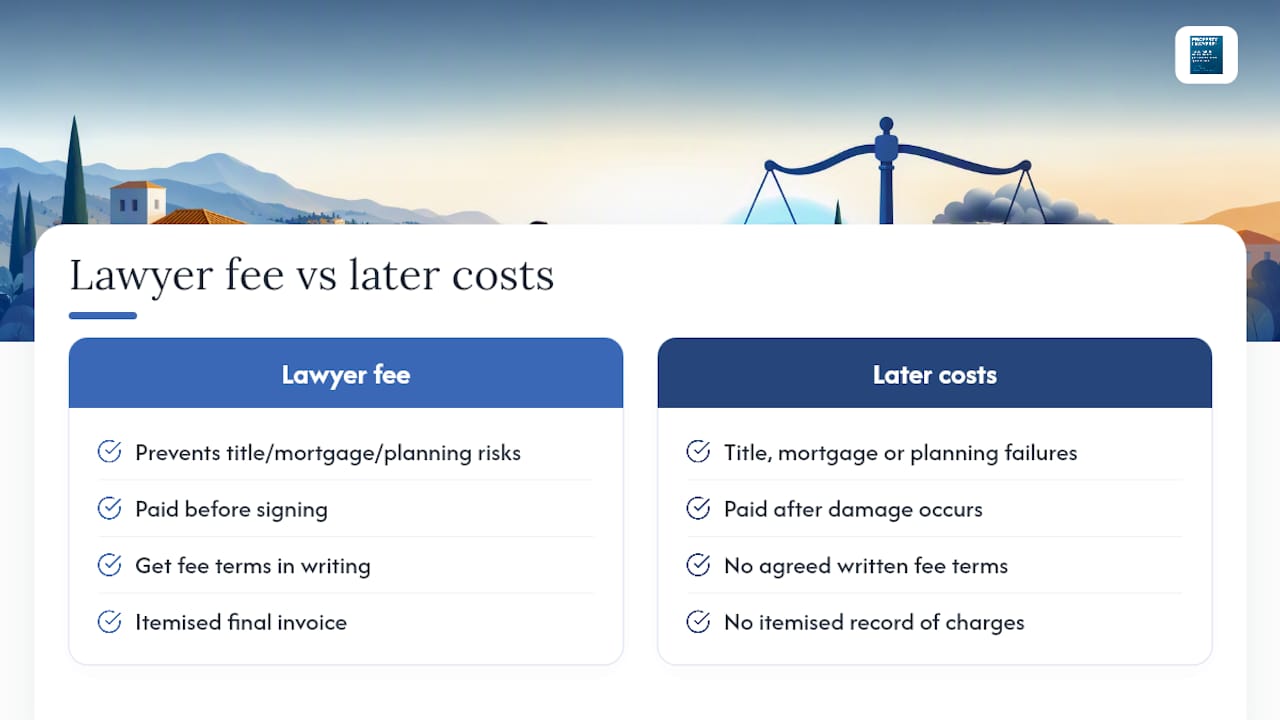
Treating legal fees purely as a cost misses the point. The real comparison is against what a bad title search, an unresolved mortgage, or a planning breach could cost you later, and that’s usually far more than any lawyer’s invoice. Independent legal advice exists to catch exactly those risks before you sign anything binding.
Getting fee terms in writing, with an itemised invoice at the end, remains the simplest protection buyers have when comparing quotes across different firms or regions. It also makes it far easier to hold a lawyer accountable if the scope of work changes midway through a transaction.
— Sophie
Get a clear fee estimate before you commit to a lawyer
Comparing quotes without a benchmark leaves you guessing whether €1,200 or €3,000 is fair for your specific deal. Property-lawyers gives you a shortcut. As an online directory of property lawyers, it lets you browse profiles by region, city, and specialism, so you’re comparing like-for-like fee structures rather than apples to oranges.

Before requesting quotes, it’s worth reading the full fee guide so you know which questions to ask and which inclusions to expect. If you’re buying in the capital, the Madrid lawyer directory is a direct starting point for local quotes; for other regions, the national buying guide connects you with lawyers across Marbella, Mallorca, Ibiza, and beyond. Request a fee estimate today and get your written scope of work before you sign anything.
Sources
- Abogado para comprar vivienda: qué hace y cuánto cobra
- Spanish property purchase costs
- Precio abogado inmobiliario: cuánto cuesta y qué debes saber en 2026
FAQ
What do lawyer fees usually cost for a simple property purchase?
A basic contract review can cost €150 to €400, while a full due diligence and completion package often runs €900 to €1,800 for a standard purchase.
Who pays the lawyer’s fees in a Spanish property sale?
Each party typically hires and pays their own lawyer; there’s no fixed rule requiring one side to cover both, though customs vary slightly by region.
Is VAT charged on top of lawyer fees in Spain?
Yes, legal fees in Spain usually carry 21% IVA, which should appear as a separate line on the invoice.
Do I need a lawyer if I already have a notary?
Yes, a notary is a neutral official who formalises the deed but doesn’t perform the independent due diligence that protects your specific interests as a buyer.
Recommended
- Property Lawyer Costs Spain — What You Should Expect to Pay
- Why hire a lawyer when buying property in Spain
- What does property registration cost in Spain?

Sophie Gutenberg is a legal content specialist focused on Spanish property law, real estate transactions, conveyancing, due diligence and tax issues affecting international property buyers in Spain. She works alongside qualified Spanish property lawyers .
