

What does property registration cost in Spain?
TL;DR:
- Property registration costs in Spain are fixed by a national tariff, ranging from approximately €24 to €1,200 based on property value. Buyers must budget for additional expenses such as notary, gestoría, taxes, and legal fees, often totaling 10-15% above the purchase price. Timely registration safeguards legal ownership, with process duration typically spanning 2 to 4 weeks after signing the notary deed.
Property registration cost in Spain is defined as the government-regulated fee charged to officially record a property purchase in the Registro de la Propiedad, Spain’s Land Registry. This fee is not negotiable. It follows a national tariff scale tied directly to the declared value of the property, and it forms one part of a broader set of acquisition costs that every buyer must budget for. Understanding what does property registration cost in Spain, and how it fits alongside notary fees, taxes, and gestoría charges, is the foundation of accurate purchase planning.
How are property registration fees in Spain calculated?
Spain’s Land Registry fees follow a national tariff known as the arancel, which is fixed by law with no room for negotiation. The scale is degressive, meaning the percentage rate applied decreases as the property value rises. This structure moderates costs for higher-value transactions while maintaining a minimum floor for all purchases.
The fee ranges from €24.04 minimum to approximately €1,200 for residential properties, with the rate typically sitting between 0.10% and 0.50% of the declared purchase price. For a property valued at €200,000, you would generally expect to pay somewhere between €400 and €700 in registration fees alone. That figure is predictable, which is one of the few genuine advantages of the Spanish system for international buyers.
Registry fees are typically 50–70% of notary fees for the same transaction, and notary fees themselves usually range from €600 to €1,500. This relationship gives you a useful cross-check when reviewing your cost estimates. If your notary fee is quoted at €900, your registration fee should fall somewhere between €450 and €630.
The sliding scale tariff applies fixed plus percentage components that decrease across higher price bands. This means a buyer purchasing a €500,000 property pays a lower effective percentage than someone buying at €100,000, even though the absolute fee is higher.
Pro Tip: Ask your gestoría or lawyer to provide a written breakdown of the expected registration fee before signing the notary deed. Because the arancel is fixed, any figure they give you should be accurate to within a small margin.
What additional costs come with registering property in Spain?
Registration fees are only one component of Spain’s property acquisition expenses. Buyers who focus solely on the registry fee often face surprises at the point of completion. The full picture includes several distinct cost categories:
- Notary fees: Regulated by the same arancel system, typically €600 to €1,500 depending on property value and transaction complexity.
- Gestoría fees: A gestoría is an administrative agency that manages the filing of documents with the Land Registry and follows up until inscription is confirmed. Gestoría fees typically cost between €300 and €600 and are a practical necessity for most buyers.
- Transfer Tax (ITP): Applicable on resale properties, this varies by autonomous community and typically ranges from 6% to 10% of the purchase price. This is the single largest cost for most resale buyers.
- VAT and stamp duty: Applicable on new-build properties. VAT is charged at 10% for residential properties, with stamp duty (AJD) adding a further 0.5% to 1.5% depending on the region.
- Legal fees: A specialist property lawyer in Spain typically charges between 1% and 1.5% of the purchase price, covering due diligence, contract review, and transaction oversight.
- Nota Simple: An informative registry note that costs approximately €9 plus tax and confirms the legal status of the property before purchase. This pre-purchase step is often overlooked in cost breakdowns but is considered standard practice.
Pro Tip: Purchasers often err by budgeting taxes and fees separately rather than consolidating them into a single closing cost figure. Build one comprehensive spreadsheet that includes every line item before you make an offer.
How does property value and region affect registration and related costs?
Registration fees are fixed nationally, but the total cost of buying property in Spain varies considerably depending on where you buy and what type of property you are purchasing. Regional tax rules are the primary driver of this variation.

Regions such as Andalucía and Madrid apply different Transfer Tax rates, which directly affects your total acquisition budget even though the registry fee itself remains the same. Regional tax regimes mean that two buyers purchasing identically priced properties in different autonomous communities can face meaningfully different total costs. Buyers in the Canary Islands, for example, pay IGIC rather than standard VAT on new builds, at a rate of 6.5% rather than 10%.
The distinction between resale and new-build properties is equally significant. Resale properties attract ITP, while new-build purchases are subject to VAT plus stamp duty. For new-build registration, the process also involves additional documentation, including the escritura de obra nueva (new construction deed), which adds complexity and cost.
The table below illustrates approximate total registration fees at different property values, based on the national tariff:
| Property value | Approximate registration fee | Effective rate |
|---|---|---|
| €100,000 | €400–€500 | 0.40–0.50% |
| €200,000 | €500–€700 | 0.25–0.35% |
| €350,000 | €700–€900 | 0.20–0.26% |
| €500,000 | €900–€1,200 | 0.18–0.24% |
The degressive structure is clear in this table. As property value rises, the effective percentage falls. For buyers purchasing at the higher end of the market, registration fees represent a smaller proportional cost, though the absolute figure remains significant.
What is the process and timeline for registering a property in Spain?
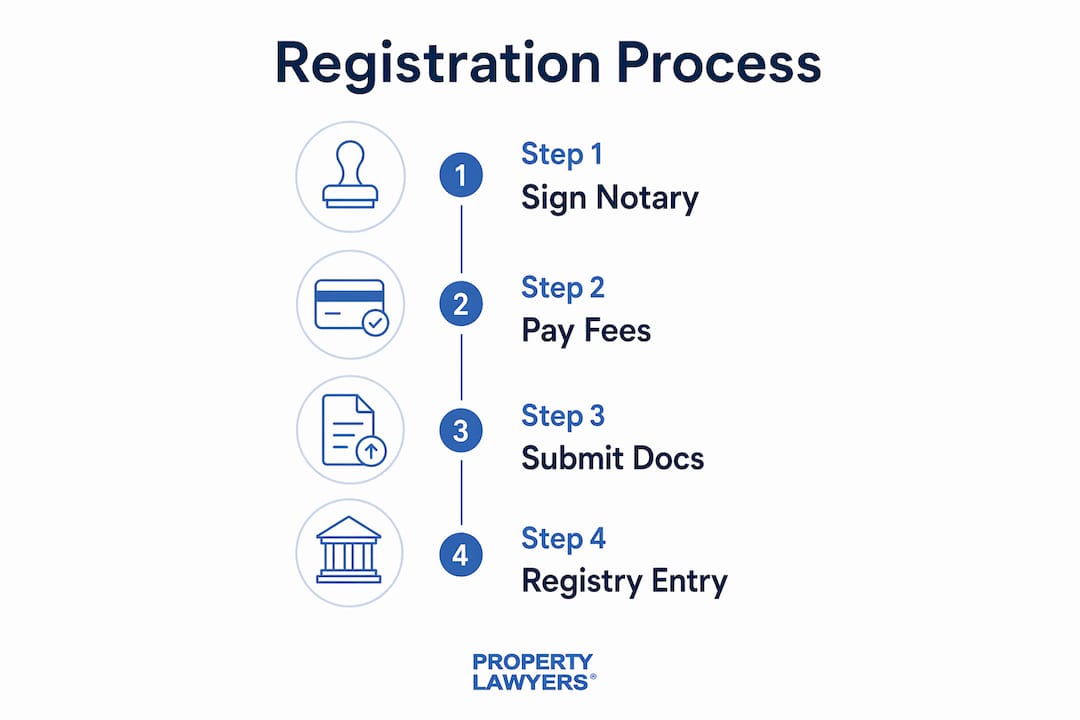
Understanding the registration process helps you avoid delays and unexpected costs. The steps below reflect standard practice for a resale purchase in Spain.
- Sign the public deed (escritura pública) before a notary. The notary verifies the identities of both parties, confirms the property details, and witnesses the transfer of ownership. This is the legally binding moment of sale.
- Pay the applicable taxes. Before registration can proceed, Transfer Tax or VAT and stamp duty must be paid to the relevant regional tax authority. This step is time-sensitive and must be completed within 30 days of signing.
- Submit documents to the Land Registry via a gestoría. In practice, buyers rarely deal directly with the registry filing. A gestoría handles submission, tracks progress, and confirms when inscription is complete.
- Await inscription confirmation. Registration generally takes 2 to 4 weeks after the notary deed is signed, though complex transactions or busy registry periods can extend this timeline.
- Receive the registered deed. Once inscription is confirmed, the gestoría returns the stamped, registered escritura to you. This document is your proof of legal ownership.
Registration finalises legal ownership and safeguards buyers from third-party claims. Until your purchase is inscribed in the Land Registry, a third party could theoretically register a competing claim against the property. Timely registration is not a formality. It is a legal protection.
One common mistake buyers make is assuming that signing before the notary completes the process. It does not. The notary deed transfers ownership contractually, but only Land Registry inscription makes that ownership enforceable against third parties under Spanish law.
Key takeaways
Property registration cost in Spain is set by a national tariff scale and typically ranges from €400 to €1,200 for residential purchases, representing 0.10% to 0.50% of the declared property value.
| Point | Details |
|---|---|
| Fee structure is fixed by law | The arancel sets registration fees nationally; no negotiation is possible with the registry. |
| Budget 10–15% above purchase price | Total acquisition costs including taxes, notary, gestoría, and legal fees regularly reach this level. |
| Gestoría is a practical necessity | A gestoría manages registry submission and follow-up, typically costing €300–€600. |
| Regional taxes vary significantly | Transfer Tax rates differ by autonomous community, affecting total costs even when registry fees are identical. |
| Registration protects legal ownership | Inscription in the Land Registry is the step that makes ownership enforceable against third-party claims. |
Why buyers consistently underestimate registration costs
Having worked with international buyers across Spain for many years, I have seen the same pattern repeat itself. Buyers research the property price carefully. They factor in Transfer Tax. They account for the notary. Then they arrive at completion and discover that the gestoría fee, the Nota Simple, the stamp duty, and the legal fees have added another €3,000 to €5,000 that they did not fully anticipate.
The 10–15% rule is not a rough estimate. It is a minimum. On a €250,000 property, that means setting aside at least €25,000 beyond the purchase price before you even begin. Buyers who treat this figure as a ceiling rather than a floor tend to face cash-flow problems at the worst possible moment.
What I find most buyers overlook is the distinction between who is legally responsible for fees and who actually pays them in practice. Article 1455 of the Spanish Civil Code allocates some costs to sellers by default, but purchase agreements routinely transfer all procedural expenses, including registration fees, to the buyer. Read your contract carefully before signing, and ask your lawyer to confirm exactly which costs you are accepting.
My consistent advice is to appoint a specialist property lawyer before you make an offer, not after. The cost of legal advice is modest relative to the purchase price. The cost of proceeding without it can be substantial.
— Sophie
How Property-lawyers can help you manage registration costs
Buying property in Spain involves regulated fees, regional tax variations, and administrative procedures that are straightforward to manage with the right support in place.

Property-lawyers connects international buyers with trusted, independent real estate lawyers in Spain who specialise in exactly this process. From reviewing your purchase contract to confirming your total acquisition costs and overseeing gestoría arrangements, a qualified lawyer sourced through Property-lawyers gives you clarity at every stage. Whether you are purchasing a resale apartment in Madrid or a new-build villa on the Costa del Sol, Property-lawyers can match you with a specialist who understands the local tax environment and registration requirements. Visit Property-lawyers to find a lawyer suited to your purchase.
FAQ
What is the minimum property registration fee in Spain?
The minimum Land Registry fee in Spain is €24.04, set by the national arancel tariff. In practice, most residential property purchases attract fees of between €400 and €1,200 depending on the declared value.
Who pays the property registration fee in Spain?
The buyer typically pays all registration fees in Spain. Although the Spanish Civil Code allocates some costs to sellers by default, purchase contracts routinely require buyers to bear all procedural expenses including notary and registry fees.
How long does property registration take in Spain?
Registration in the Land Registry generally takes 2 to 4 weeks after the notary deed is signed. A gestoría manages the submission and follows up until inscription is confirmed.
Are property registration fees the same across all regions of Spain?
Registration fees are set by a national tariff and apply uniformly across all autonomous communities. However, total acquisition costs vary significantly by region due to differing Transfer Tax rates and stamp duty levels.
Do I need a gestoría to register my property in Spain?
A gestoría is not legally required, but it is standard practice. Gestorías handle document submission to the Land Registry and follow up on inscription, typically charging between €300 and €600 for this service.
Recommended
- Land Registry Spain — Registro de la Propiedad Guide for Buyers | Property Lawyers
- Property Purchase Tax in Spain — What Buyers Must Pay | Property Lawyers

Sophie Gutenberg is a legal content specialist focused on Spanish property law, real estate transactions, conveyancing, due diligence and tax issues affecting international property buyers in Spain. She works alongside qualified Spanish property lawyers .
