

Property law in Spain: a 2026 guide for buyers
TL;DR:
- Property law in Spain governs real estate ownership and protections through laws like the Ley Hipotecaria, emphasizing the importance of land registry checks. Buyers rely on registered titles, but must also verify latent defects, community debts, and planning compliance to avoid legal risks. Thorough due diligence with cross-referenced registry, cadastre, and expert advice ensures secure property transactions for international purchasers.
Property law in Spain governs how individuals and entities acquire, hold, and transfer ownership of real estate, with registered rights conferring direct legal protection under the Ley Hipotecaria. For international buyers and expatriates, understanding Spanish property regulations is not optional. It is the foundation of a secure purchase. The Land Registry (Registro de la Propiedad), the Catastro, and the Spanish Civil Code each play distinct roles in defining what you own, what you owe, and what recourse you have if something goes wrong. This guide covers the legal framework, key risks, and practical safeguards every buyer needs to know before signing.
What is property law in Spain and how does it protect buyers?
Property law in Spain is the body of legislation that determines how real estate ownership is created, recorded, transferred, and defended. Its central pillar is the Ley Hipotecaria, Spain’s Mortgage and Land Registry Law, which establishes the legal principles governing property registration and buyer protections.
The most significant protection for buyers is found in Article 34 of the Ley Hipotecaria. Article 34 protects good-faith purchasers who acquire property for value from a registered owner. Even if the seller’s title is later annulled for reasons not visible in the registry, the buyer’s ownership is preserved. This protection is the reason why checking the Land Registry before any purchase is not merely advisable. It is legally decisive.
Alongside Article 34, Article 38 of the Ley Hipotecaria creates a legal presumption that registered rights exist and belong to the person recorded as owner. In any ownership dispute, the registered holder starts with the legal advantage. For international buyers unfamiliar with Spanish courts, this presumption provides a critical starting point for defending title.
Real estate law in Spain also draws on the Spanish Civil Code, the Ley de Propiedad Horizontal (Horizontal Property Law), and regional planning legislation. Together, these sources create a layered framework that covers everything from hidden defects to shared community expenses.
How does the Spanish Land Registry operate?
The Registro de la Propiedad is Spain’s official public record of property rights. Every property transaction, mortgage, easement, or embargo affecting a property can be recorded there. Registration is not compulsory, but the legal consequences of registering are so significant that any serious buyer treats it as mandatory.
The registry operates on several core principles:
- Principle of inscription: Rights recorded in the registry are presumed valid and enforceable against third parties.
- Principle of public faith (fe pública registral): A buyer who relies on registry information in good faith acquires protected ownership, even if the underlying title later proves defective.
- Principle of priority (prioridad): The first-registered right takes precedence over later claims to the same property.
- Principle of traceable title: The registry requires an unbroken chain of ownership, so each entry must connect logically to the previous one.
The Registrador (Registrar) plays an active qualifying role. Before recording any document, the Registrar examines it for legal compliance, checks for existing encumbrances, and verifies the chain of title. This is not a rubber-stamp process. The Registrar can reject documents that do not meet legal requirements, which adds a layer of independent scrutiny to every transaction.
For buyers, the practical implication is clear. A property with a clean, fully registered title and no noted encumbrances offers the strongest legal foundation. Any gaps, disputes, or embargoes noted in the registry are red flags that require legal advice before proceeding.
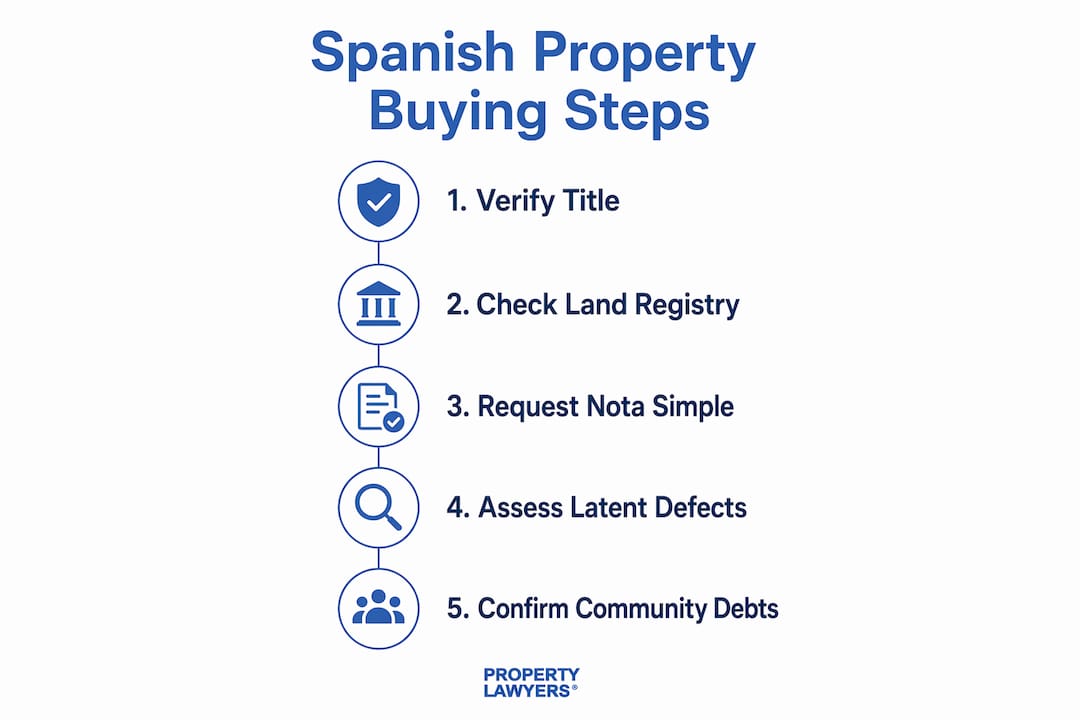
Pro Tip: Request a nota simple (a registry extract) from the Registro de la Propiedad before making any offer. This document lists the current owner, any mortgages, and any charges or embargoes on the property. It costs only a few euros and can prevent costly mistakes.
What do buyers need to know about latent defects?
Latent defects, known in Spanish law as vicios ocultos, are hidden faults in a property that were present at the time of sale but were not visible during a normal inspection. Under Article 1484 of the Spanish Civil Code, sellers are liable for latent defects that render the property unfit for its intended use or that significantly reduce its value.
For a defect claim to succeed under Spanish property ownership laws, four conditions must be met:
- The defect must have existed before the sale was completed.
- It must have been hidden, meaning not visible during a reasonable inspection.
- It must be serious enough to affect the property’s use or value materially.
- The buyer must not have known about it at the time of purchase.
The limitation period is strict. Buyers have six months from delivery to bring a claim. This clock starts from the date the keys are handed over, not from the date the defect is discovered. Missing this deadline eliminates the Civil Code remedy entirely, though some alternative claims under general contract law may still be available in limited circumstances.
The remedies available to buyers are either rescission of the contract (returning the property and recovering the price) or a proportionate reduction in the purchase price. Choosing the right remedy depends on the severity of the defect and the strength of the evidence.
New-build properties follow different rules under the Ley de Ordenación de la Edificación (LOE). This law provides separate warranty periods: one year for finishing defects, three years for habitability defects, and ten years for structural defects. The LOE applies to developers, builders, and architects, giving buyers of new properties broader and longer-lasting protection.
Pro Tip: If you discover a potential defect after completion, commission an independent expert report immediately. Latent defect claims require documented expert evidence, and the six-month window closes fast. Early assessment maximises your legal options.
How do community debts affect property buyers in Spain?
When you buy a property that forms part of a community of owners, such as an apartment block or urbanisation, you inherit more than the physical asset. Under the Ley de Propiedad Horizontal, community debt liability transfers to the new owner for the year of acquisition and the three preceding years. This means unpaid community fees from a previous owner can become your legal obligation the moment you complete the purchase.
This risk is separate from anything recorded in the Land Registry. A property can have a clean title and still carry significant community debts that will fall to you as the new owner. The Horizontal Property Law makes this liability automatic, regardless of whether you were aware of the debts at the time of purchase.
Practical steps to protect yourself before completing a purchase:
- Request a debt certificate from the community administrator (administrador de fincas). This document confirms whether the seller owes any outstanding community fees.
- Check the meeting minutes of the community for any approved but unpaid special assessments, such as roof repairs or lift replacements, which could become due shortly after you take ownership.
- Verify the community’s reserve fund to assess whether the community is financially healthy or likely to levy additional charges soon.
- Ask your lawyer to review the community statutes for any unusual rules or restrictions that could affect your use of the property.
Obtaining an official debt certificate before signing the purchase deed is not a formality. It is a legal safeguard. Sellers are required to provide this certificate at the notary, but buyers who rely solely on seller disclosure without independent verification take an unnecessary risk.
Property due diligence: how to verify legal status and avoid pitfalls
Thorough due diligence in Spain requires reconciling three separate sources of information: the Land Registry, the Catastro, and local planning records. Legal practitioners treat these as three distinct “truths” that must align before a property can be considered legally sound.

Land Registry vs Catastro: what is the difference?
| Feature | Land Registry (Registro de la Propiedad) | Catastro |
|---|---|---|
| Purpose | Records legal ownership and rights | Records physical and fiscal property data |
| Legal effect | Confers legal title and buyer protections | Used for tax assessment, not legal title |
| Information held | Owner, charges, mortgages, encumbrances | Boundaries, surface area, building description |
| Managed by | Ministry of Justice | Ministry of Finance |
| Binding for title? | Yes | No |
Cross-verifying both sources is standard practice because discrepancies between them often signal planning irregularities, undeclared extensions, or boundary disputes. The Land Registry alone will not reveal whether a garage conversion or roof terrace was built without a licence.
Irregular constructions are a particular concern in Spain, especially in rural areas and coastal regions. Some unauthorised buildings are classified as AFO (Asimilado Fuera de Ordenación), a status that allows limited utility access and registration but does not legalise the structure. An AFO classification does not eliminate demolition risk. Whether demolition is likely depends on the specific classification and whether the land is protected. Buyers of properties with any irregular construction history need specialist legal advice before proceeding.
Pro Tip: Ask your lawyer to obtain a certificado urbanístico from the local town hall (ayuntamiento). This document confirms the planning status of the property and reveals any outstanding enforcement notices or restrictions that neither the Land Registry nor the Catastro will show.
Key takeaways
Property law in Spain requires buyers to verify title through the Land Registry, check for latent defects within six months of completion, confirm community debts are clear, and cross-reference the Catastro and planning records before any purchase.
| Point | Details |
|---|---|
| Land Registry protection | Article 34 Ley Hipotecaria protects good-faith buyers who rely on registered title data. |
| Latent defect deadline | Buyers have six months from delivery to claim for hidden defects under the Spanish Civil Code. |
| Community debt liability | New owners inherit unpaid community fees for the acquisition year and the three preceding years. |
| Registry vs Catastro | Both sources must be cross-checked, as discrepancies often indicate planning or regulatory risks. |
| Irregular construction risk | AFO status allows limited registration but does not legalise a building or remove demolition risk. |
What I have learnt advising international buyers on Spanish property law
The single most common mistake I see international buyers make is treating the Land Registry as the only check that matters. It is the most important check, but it is not the only one. I have seen buyers complete on properties with clean registry titles only to discover, weeks later, that the Catastro showed a significantly different surface area, or that the local ayuntamiento had an open enforcement file for an unlicensed extension.
The registry protects your ownership. It does not protect you from planning enforcement, community debt surprises, or a seller who failed to disclose a structural problem. These risks live outside the registry, and they require separate, active investigation.
On latent defects, the six-month limitation period catches buyers off guard more often than any other rule in Spanish property law. People assume the clock starts when they find the problem. It does not. It starts when you receive the keys. I have seen buyers lose valid claims simply because they waited too long to get an expert report. The moment you suspect a hidden defect, act.
Community debts are the quiet risk. Sellers do not always volunteer this information, and buyers who skip the debt certificate step can face bills running into thousands of euros for fees they never incurred. The due diligence checklist for any Spanish property purchase must include this step without exception.
Spain property investment laws reward buyers who are thorough and penalise those who rush. The legal framework is well-structured and genuinely protective, but only for buyers who engage with it properly.
— Sophie
How Property-lawyers can help you buy with confidence in Spain
Buying property in Spain as an international buyer involves legal steps that are easy to miss without specialist support. Property-lawyers connects you with independent, bilingual real estate lawyers in Spain who handle every stage of the legal process, from Land Registry verification and Catastro cross-checks to latent defect claims and community debt reviews.

Whether you are purchasing a resale apartment in Madrid or a rural finca in Andalucía, the lawyers in the Property-lawyers directory understand the specific legal issues in Spanish real estate that affect international buyers. They provide bespoke guidance on Horizontal Property Law, planning compliance, and AFO classifications, in plain English. Use Property-lawyers to find a trusted legal adviser who will protect your interests from the first offer to the final deed.
FAQ
What does the Land Registry protect buyers from in Spain?
The Land Registry protects good-faith buyers under Article 34 of the Ley Hipotecaria. If you purchase from a registered owner and rely on registry data, your ownership is preserved even if the seller’s title is later found to be defective.
How long do buyers have to claim for hidden defects in Spain?
Buyers have six months from the date of delivery to bring a latent defect claim under Article 1484 of the Spanish Civil Code. For new-build properties, the Ley de Ordenación de la Edificación provides separate warranty periods of one, three, and ten years depending on the type of defect.
Can I inherit debts from a previous owner when buying in Spain?
Yes. Under the Ley de Propiedad Horizontal, buyers inherit unpaid community fees for the year of acquisition and the three preceding years. Requesting an official debt certificate from the community administrator before completion is the standard way to avoid this liability.
What is the difference between the Land Registry and the Catastro?
The Land Registry records legal ownership and encumbrances, conferring title protection. The Catastro records physical and fiscal data, including boundaries and surface area, and is used primarily for tax purposes. Discrepancies between the two often indicate planning irregularities or undeclared works.
What is an AFO property in Spain?
AFO (Asimilado Fuera de Ordenación) is an administrative classification applied to certain irregular constructions in Spain. It allows limited utility access and registration but does not legalise the building. Demolition risk remains and depends on the specific classification and the land’s protected status.
Recommended
- Building defects law in Spain: buyer’s guide 2026
- Property Taxes in Spain — Full Guide for Foreign Owners (2026) | Property Lawyers
- Land Registry Spain — Registro de la Propiedad Guide for Buyers | Property Lawyers
- Condominium law in Spain: a guide for buyers

Sophie Gutenberg is a legal content specialist focused on Spanish property law, real estate transactions, conveyancing, due diligence and tax issues affecting international property buyers in Spain. She works alongside qualified Spanish property lawyers .
