

Civil in spain: understanding the legal system in 2026
TL;DR:
- Civil law in Spain is a codified system based on written statutes rather than judicial precedents, primarily governed by the 1889 Civil Code. It covers private relationships such as contracts, property, family, and inheritance, with regional variations in six autonomous communities. The legal framework is maintained through continuous reforms, and understanding the structure and regional differences is essential for effective legal navigation.
Civil law in Spain is a codified legal system that governs private rights and obligations through written statutes rather than judicial precedents. Rooted in Roman law and formalised through the Spanish Civil Code of 1889, it is the foundation for how contracts, property, family matters, and inheritance are regulated across the country. For students, legal professionals, and expatriates alike, understanding what civil law means in Spain is the first step to navigating any private legal matter with confidence. This article explains the structure, operation, regional variations, and recent reforms of Spain’s civil law framework.
What is civil law in spain?
Civil law in Spain is defined as a codified system where judges apply written statutes rather than relying on case law or judicial precedent. This places Spain firmly within the continental European legal tradition, alongside France, Germany, and Italy, and distinguishes it clearly from the common law systems used in England, Wales, and the United States.
The primary source of private law is the Spanish Civil Code, enacted in 1889 and still in force today. The Code contains 1,976 articles and has undergone 45 reforms since its original publication. That volume of reform reflects a living document, not a relic.
One important clarification: the Civil Guard (Guardia Civil) is a national gendarmerie and military police force. It has no connection to civil law or the civil courts. Expatriates frequently confuse the two, which can lead to misdirected enquiries. Civil law governs private relationships between individuals. The Civil Guard enforces public order.
Pro Tip: If you are researching your legal rights in Spain as a property buyer or resident, always distinguish between civil law (private rights) and administrative law (your relationship with the state). They operate through entirely separate court systems.
How is the spanish civil code structured?
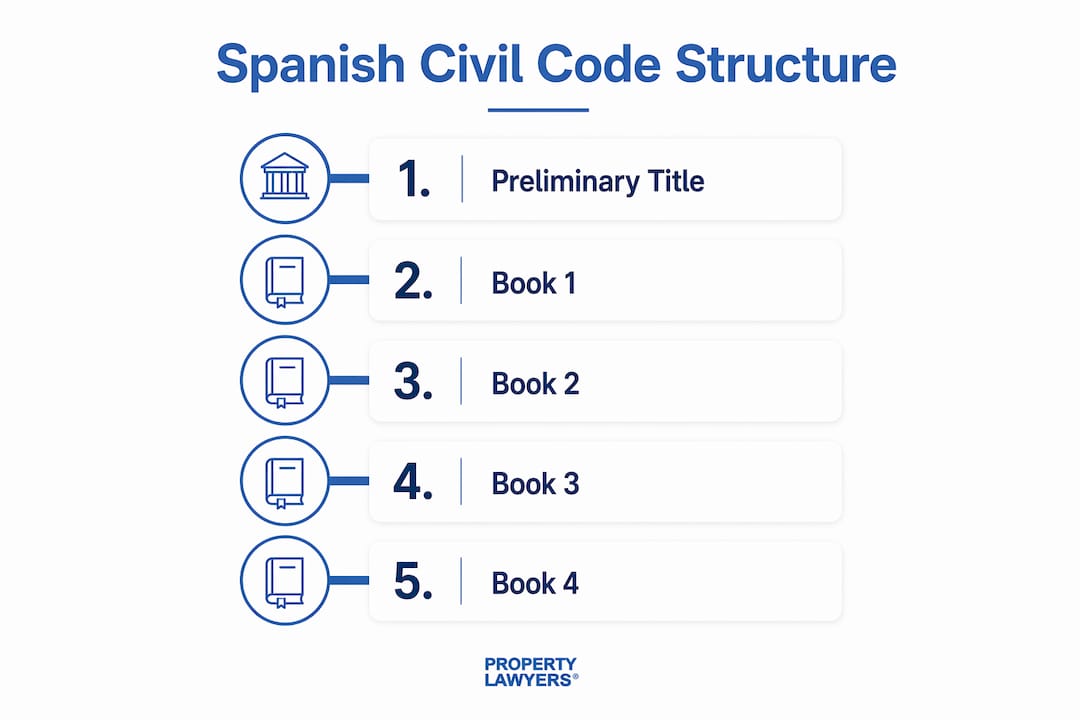
The Spanish Civil Code is organised into a Preliminary Title and four Books. Each Book addresses a distinct area of private law:
- Book One: Persons. Covers nationality, domicile, marriage, legal separation, guardianship, and family relations.
- Book Two: Property. Addresses ownership, possession, usufruct, easements, and the legal framework for real estate.
- Book Three: Successions. Governs inheritance, wills, and the distribution of estates.
- Book Four: Obligations and Contracts. Regulates the formation, performance, and breach of contracts, as well as quasi-contracts and civil liability.
The Preliminary Title is particularly significant. It sets out the sources of Spanish law, the hierarchy of legal norms, and the rules of private international law that determine which country’s law applies in cross-border disputes. For expatriates buying property or entering contracts in Spain, these conflict-of-law rules can directly affect which legal system governs their situation.
Major reforms have reshaped several Books. Law 11/1981 reformed filiation and parental authority. The 2021 overhaul of guardianship law replaced the old concept of incapacitation with a support-based model aligned with the United Nations Convention on the Rights of Persons with Disabilities. These are not minor adjustments. They represent fundamental shifts in how Spanish law treats personal autonomy.
The official gazette, the BOE, is the sole authoritative source for all legislation until updated codified versions are published. This matters in practice: if you are checking the current text of a specific article, the BOE publication date determines when that version entered into force.
Pro Tip: When researching specific articles of the Spanish Civil Code, always verify the version you are reading against the BOE. Reforms frequently renumber or replace articles, and outdated versions circulate widely online.
How does the spanish civil law system operate in practice?
Spain’s civil law system operates through a hierarchy of courts, each with defined jurisdiction. Understanding this structure helps you identify where a dispute will be heard and how decisions can be challenged.
- Courts of First Instance (Juzgados de Primera Instancia): These are the entry-level civil courts. They hear most private law disputes, including property claims, contract breaches, and family matters.
- Provincial Courts (Audiencias Provinciales): These hear appeals from the Courts of First Instance. Each Spanish province has one.
- High Courts of Justice (Tribunales Superiores de Justicia): These operate at the level of each autonomous community and hear appeals involving regional civil law.
- Supreme Court (Tribunal Supremo): The highest civil court in Spain. Its Civil Chamber hears final appeals and issues rulings that, while not binding precedent in the common law sense, carry significant persuasive authority.
The system is regulated by two key instruments. Organic Law 6/1985 governs judicial power, and Law 1/2000 governs civil procedure. Together, they define how judges investigate facts, assess evidence, and apply the written code to reach a decision.
“In Spain’s civil law system, the judge is not a passive referee between two competing arguments. The judge actively applies the relevant code provisions to the established facts, guided by the written law rather than by what previous judges have decided.”
Civil law jurisdiction is distinct from criminal and administrative law. A property dispute between two private individuals falls under civil law. A planning permission dispute with a local council falls under administrative law. A fraud prosecution falls under criminal law. These distinctions matter when you are deciding which court to approach and which lawyer to instruct.
What regional variations exist within spanish civil law?
Spain does not operate a single, uniform civil law system across all its territory. Six autonomous communities have their own foral or special civil law, which applies instead of, or alongside, the national Civil Code. This is one of the most important features of Spanish private law that expatriates and legal professionals must understand.

The six regions with special civil law are Catalonia, the Basque Country, Galicia, Aragón, Navarra, and the Balearic Islands. Each has its own civil legislation covering areas such as inheritance, matrimonial property regimes, and family law.
| Region | Key Legal Difference |
|---|---|
| Catalonia | Operates a near-complete civil code; forced heirship rules differ significantly from national law |
| Navarra | Retains extensive customary law; testamentary freedom is broader than under the national Code |
| Basque Country | Specific rules on family property and inheritance, including the troncalidad principle |
| Aragón | Distinct succession rules; community of property between spouses differs from national default |
| Balearic Islands | Separate rules for each island; Ibiza and Formentera follow different inheritance rules from Mallorca |
| Galicia | Special rules on rural property and family succession |
These differences have direct consequences for property buyers. If you purchase a property in Catalonia and later die without a will, Catalan succession law applies, not the national Civil Code. The forced heirship shares, the rights of a surviving spouse, and the process for distributing the estate all differ. Consulting a lawyer who knows the regional law of the specific area where you are buying is not optional. It is necessary.
The Spanish Constitution allocates civil law competence primarily to the state, but allows autonomous communities with existing foral law to conserve, modify, and develop their own civil legislation. This creates a layered system where national and regional codes must be read together.
How have recent reforms shaped family and personal rights?
Spain has enacted 45 successive reforms to its Civil Code since 1889. The pace of reform has accelerated in recent decades, driven by social change, European human rights obligations, and constitutional court rulings.
The most significant recent developments include:
- Disability and guardianship reform (2021): The old system of judicial incapacitation was replaced. Spanish law now requires courts to appoint support measures tailored to the individual, preserving legal capacity wherever possible. This aligns Spain with the UN Convention on the Rights of Persons with Disabilities.
- Gender identity law (2023): Spain adopted a self-determination model for legal gender recognition, removing the requirement for medical reports or surgical procedures. This reform directly amends the Civil Registry rules governing how personal data is recorded in official documents.
- Marriage and family law: Same-sex marriage has been recognised in Spain since 2005. The Civil Code was amended accordingly, and subsequent reforms have clarified adoption rights and parental authority for same-sex couples.
- Reproductive rights: A 2023 constitutional amendment addressed reproductive rights. Legal analysts have noted that framing these as guiding principles rather than fundamental rights risks weakening their enforceability in practice.
Pro Tip: If you are dealing with a Spanish inheritance, guardianship arrangement, or family law matter that was set up before 2021, the legal framework governing it may have changed materially. Always verify the current position with a qualified Spanish lawyer before taking any action.
The Civil Code’s continuous legislative adaptation reflects a deliberate policy choice. Spanish legislators have preferred to update the existing code rather than replace it entirely, which means the 1889 structure remains but the content has evolved substantially.
Key takeaways
Spain’s civil law system is a codified framework of 1,976 articles, shaped by 45 reforms since 1889, with significant regional variations in six autonomous communities that directly affect property, inheritance, and family rights.
| Point | Details |
|---|---|
| Codified, not precedent-based | Spanish judges apply written statutes; case law carries persuasive weight but does not bind future decisions. |
| Four-Book structure | The Civil Code covers persons, property, successions, and obligations, each with distinct rules for private matters. |
| Six regional exceptions | Catalonia, Navarra, Aragón, Basque Country, Galicia, and the Balearic Islands each have their own civil law provisions. |
| Continuous reform | 45 reforms since 1889 mean the current code differs substantially from its original text; always check the latest BOE version. |
| Practical impact for expatriates | Regional inheritance and property rules apply based on where you buy, not where you are from. |
Why spain’s civil law system deserves more attention than it gets
I have spent years working with international clients who arrive in Spain with a reasonable understanding of property prices and mortgage rates but almost no awareness of the legal framework governing their purchase. The civil law system is not an abstract academic topic. It determines what happens to your property if you die without a will, who can challenge a contract you have signed, and whether a guardianship arrangement you made for a family member is still legally valid.
The most common mistake I see is treating the Civil Code as a single, uniform document. It is not. If you are buying in Mallorca, Catalan-influenced Balearic law governs your succession. If you are buying in San Sebastián, Basque civil law applies to certain family property questions. The national Civil Code is the default, but in six regions it is not the primary source.
The second mistake is relying on outdated information. The 2021 guardianship reform was one of the most significant changes to Spanish private law in decades. Lawyers and notaries who trained before that reform may still be working from old assumptions. Always ask your adviser when they last updated their knowledge of the relevant area.
The BOE is freely available online and is the definitive source. If a lawyer cites a provision, you can check it yourself. That is not distrust. That is due diligence.
— Sophie
Find a specialist spanish property lawyer through Property-lawyers
Understanding Spain’s civil law framework is one thing. Applying it correctly to your specific situation requires qualified legal advice.

Property-lawyers connects international buyers and property owners with trusted, English-speaking real estate solicitors in Spain who understand both the national Civil Code and the regional variations that apply in areas like Catalonia, the Balearic Islands, and the Basque Country. Whether you are purchasing a property, dealing with an inheritance, or reviewing a contract, the right lawyer makes the difference between a transaction that completes cleanly and one that does not. You can also find specialist Madrid property lawyers if your matter is based in the capital. Property-lawyers makes it straightforward to find the right professional for your circumstances.
FAQ
What is civil law in spain?
Civil law in Spain is a codified legal system based on Roman law, where judges apply written statutes rather than judicial precedents. The Spanish Civil Code, enacted in 1889, is the primary source of private law governing contracts, property, family, and inheritance.
How many articles does the spanish civil code contain?
The Spanish Civil Code contains 1,976 articles, organised into a Preliminary Title and four Books. It has been amended 45 times since 1889 to reflect social and legislative changes.
Does civil law vary by region in spain?
Yes. Six autonomous communities, including Catalonia, Navarra, and the Basque Country, have their own foral civil law that applies instead of or alongside the national Civil Code. These regional rules can significantly affect inheritance and property rights.
What is the difference between the civil guard and civil law in spain?
The Civil Guard is a national military police force with no connection to civil law or the civil courts. Civil law governs private legal relationships between individuals. The confusion is common among expatriates but the two are entirely separate.
Where can i find the official text of spanish civil legislation?
The BOE (Boletín Oficial del Estado) is the official state gazette and the sole authoritative source for Spanish legislation. Laws enter into force on the date of their BOE publication, and the current text of any statute can be verified there.
Recommended
- Spanish real estate law: a buyer’s guide for 2026
- Property law in Spain: a 2026 guide for buyers
- Why property boundaries matter in Spain: 2026 guide
- Benefits of bilingual legal services in Spain

Sophie Gutenberg is a legal content specialist focused on Spanish property law, real estate transactions, conveyancing, due diligence and tax issues affecting international property buyers in Spain. She works alongside qualified Spanish property lawyers .
