
Why probate delays hit spain property buyers hard
TL;DR:
- Probate delays in Spain significantly impact international property transactions, often causing assets to remain frozen for up to two years.
- Proper legal planning, including drafting a Spanish will with a Brussels IV clause and timely inheritance tax compliance, can greatly reduce these delays.
Probate delay in Spain is defined as the legal process of validating a deceased person’s estate before inherited property can be transferred, and it is the single most disruptive force in the Spain property buying process for international heirs. When a property you intend to purchase is caught in an active Spanish inheritance dispute, or when you are the heir attempting to sell before completing probate, transactions can stall for one to two years. Understanding why probate delays affect Spain property buyers requires knowing exactly how Spanish inheritance law works, where the bottlenecks occur, and what practical steps prevent them.
Why probate delays spain property buyers: the core process

Spanish probate, known formally as the succession procedure, follows a fixed sequence of legal steps that cannot be shortened without proper advance planning. Each stage introduces its own waiting period, and those periods compound quickly.
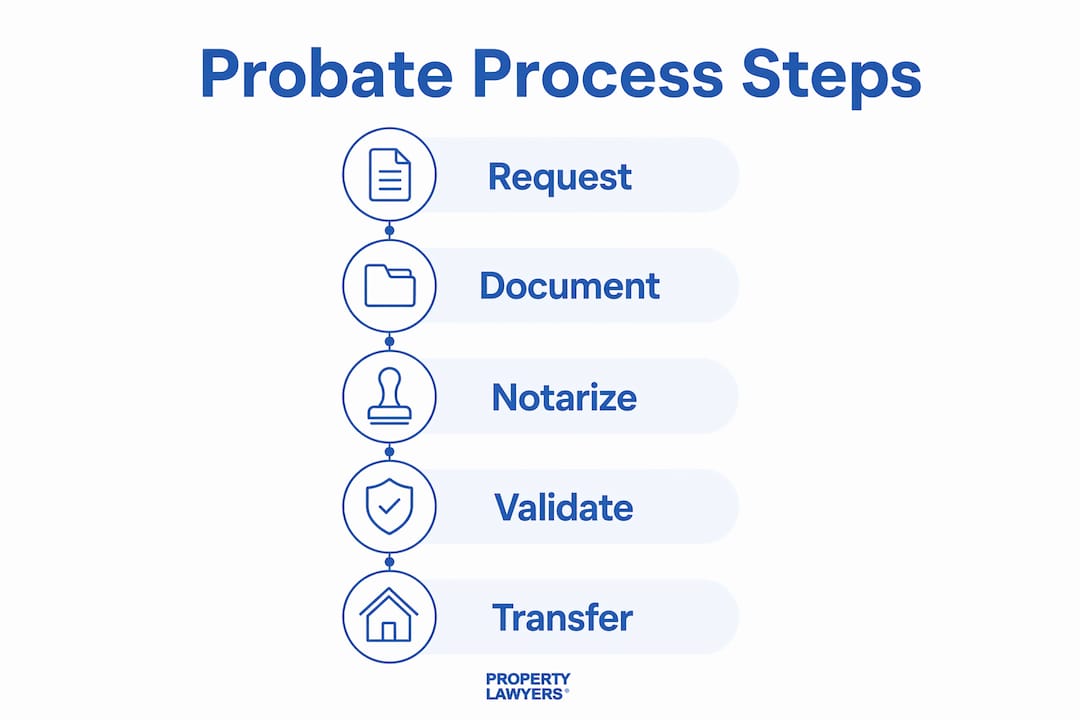
The process runs in this order:
- Obtain the death certificate from the Civil Registry, which takes several working days.
- Request the Certificado de Últimas Voluntades (Certificate of Last Wills). This document confirms whether a Spanish will exists. Critically, it cannot be requested until 15 working days after the date of death, creating a mandatory built-in wait that surprises most international families.
- Appoint a notary to formalise the deed of inheritance (escritura de aceptación de herencia).
- Pay inheritance tax and register the property in the new owner’s name at the Land Registry.
The total duration depends heavily on whether a Spanish will exists. Spanish probate takes 6–18 months when a valid Spanish will is in place, but stretches to 12–24 months when heirs rely solely on a foreign will. That difference of up to six additional months translates directly into frozen assets, delayed sales, and mounting costs.
| Scenario | Typical Duration | Estimated Extra Cost |
|---|---|---|
| Valid Spanish will in place | 6–18 months | Minimal additional fees |
| Foreign will only (e.g. UK Grant of Probate) | 12–24 months | €5,000–€15,000 extra |
| No will at all (intestacy) | 18–36 months | Significant legal and court fees |
Pro Tip: Request the Certificado de Últimas Voluntades as soon as the 15-day window opens. Waiting even a few extra weeks at this stage delays every subsequent step.
Document translation and apostilles add further time. Every foreign document submitted to a Spanish notary must carry an apostille stamp and a sworn translation into Spanish. A single UK Grant of Probate, for example, requires both steps before a Spanish notary will accept it. Validating a foreign will requires apostilles, sworn translations for each document, and legal approval, causing delays and added expenses that most buyers do not anticipate.
How do foreign wills affect probate timelines in spain?
Foreign wills are the most common source of extended property purchase delays in Spain. Many British, Irish, and Northern European buyers assume that a valid will in their home country automatically covers their Spanish property. It does not.
Foreign Grants of Probate do not automatically confer rights over Spanish property. Spanish bank accounts and property remain frozen during the 12–24 month validation process if no local planning exists. That freeze applies even when the foreign will is legally sound and uncontested.
The comparison below illustrates the practical difference:
| Factor | Spanish Will | Foreign Will Only |
|---|---|---|
| Notary acceptance | Immediate | Requires apostille and sworn translation |
| Forced heirship risk | Manageable with Brussels IV clause | High risk of conflict |
| Professional fees | Standard notary and legal fees | €5,000–€15,000 extra |
| Asset freeze duration | Weeks to months | 12–24 months |
There is also a forced heirship issue. Spanish law reserves fixed shares of an estate for certain relatives, known as legitimarios. When no Spanish will exists, failure to elect choice of law under the EU’s Brussels IV regulation causes Spanish forced heirship rules to apply automatically. This frequently conflicts with the deceased’s foreign estate plan and triggers disputes that extend probate further.
The solution is straightforward in principle. A Spanish will for property buyers should be drafted to cover only Spanish assets and must explicitly state that it does not revoke any existing foreign will. A properly drafted Spanish will avoids revoking foreign wills and prevents probate delays of 12–24 months. One document, drafted correctly, removes the single largest cause of delay.
What role do inheritance tax deadlines play in delaying transactions?
Spanish inheritance tax is one of the most misunderstood obligations in the entire Spain property buying process for international heirs. Missing the deadline does not simply result in a fine. It can freeze the entire transaction and wipe out regional tax reductions worth thousands of euros.
The key facts every international heir must know:
- The inheritance tax filing deadline is six months from the date of death, not from the date of notification or the date you become aware of the inheritance.
- The six-month clock starts at death, not at notification. International heirs living abroad frequently miss this deadline simply because they were not informed promptly.
- Surcharges escalate in tiers: 5% for payments 0–3 months late, 10% for 3–6 months late, 15% for 6–12 months late, and 20% plus interest for delays exceeding 12 months.
- Missing the deadline also risks losing favourable regional tax reductions, which in some autonomous communities can reduce the tax bill by 99%.
Families without a local Spanish gestor or lawyer are particularly exposed. Families without a local Spanish gestor often miss inheritance tax deadlines, leading to asset freezes and surcharges that compound the original liability.
Extensions are available. Heirs can apply for a six-month extension before the original deadline expires. The extension does not suspend interest, but it does prevent the higher surcharge tiers from applying. You must apply proactively; the Spanish tax authority does not grant extensions automatically.
Understanding the impact of probate on real estate transactions in Spain means recognising that tax timing is as important as the legal process itself.
What practical steps minimise probate delays for international buyers?
The good news is that most Spanish property buying challenges related to probate are preventable with the right preparation. The steps below apply whether you are purchasing a property currently in probate or planning your own estate to protect future heirs.
- Draft a Spanish will immediately after purchasing Spanish property. Scope it tightly to Spanish assets and include a Brussels IV choice-of-law clause electing your nationality’s law. A Spanish will with a Brussels IV clause ensures probate takes months rather than years.
- Obtain your NIE (Número de Identificación de Extranjero) without delay. Heirs cannot begin inheritance procedures in Spain without a NIE. Applying from abroad takes time, so start early.
- Engage a Spanish property lawyer or gestor before any deadline approaches. Professionals familiar with succession and inheritance in Spain track deadlines, prepare documents, and liaise with notaries on your behalf.
- Prepare all documents in advance. Gather death certificates, foreign wills, property deeds, and identification documents. Have apostilles and sworn translations arranged before they are urgently needed.
- Grant a power of attorney to a trusted representative in Spain. If you cannot travel to Spain to manage the process in person, a power of attorney for property allows a Spanish lawyer to act on your behalf at every stage, from notary appointments to tax filings.
Pro Tip: When buying a property currently in probate, ask your lawyer to confirm the inheritance tax has been paid and the deed of inheritance has been registered before you exchange contracts. An unresolved tax liability can attach to the property itself.
Common pitfalls to avoid include assuming a foreign will covers Spanish assets, waiting for official notification before starting the tax clock, and attempting to manage the process remotely without a local representative.
How do regional variations and cross-border rules add complexity?
Spain’s 17 autonomous communities each set their own inheritance tax rates and reductions. The difference between regions is substantial. Heirs in Madrid or the Canary Islands may pay close to zero inheritance tax on a residential property, while heirs in other regions face rates of 7%–34% on the same asset.
Key cross-border complications include:
- Brussels IV (EU Succession Regulation 650/2012): This regulation allows EU residents to elect the law of their nationality to govern their estate. Without this election in a Spanish will, Spanish law applies by default, triggering forced heirship rules that may conflict with your home-country estate plan.
- Double taxation risk: Spain has double taxation treaties with several countries, including the UK, but the interaction between Spanish inheritance tax and UK inheritance tax requires careful planning. Paying tax in both jurisdictions without claiming relief is a common and costly oversight.
- Multiple heirs residing abroad: When several heirs live in different countries, coordinating documents, translations, and signatures across jurisdictions multiplies the administrative burden and extends timelines significantly.
| Regional Factor | Low-Tax Regions (e.g. Madrid) | Higher-Tax Regions |
|---|---|---|
| Effective inheritance tax rate | Near 0% for direct heirs | Up to 34% |
| Regional reductions available | Extensive | Limited |
| Risk of missing regional deadline | High cost of losing reductions | High cost of losing reductions |
Missing the six-month deadline means paying surcharges plus losing regional tax breaks, and regional deadlines and rules vary significantly across Spain. This makes local legal advice not optional but necessary.
Key takeaways
Probate delays in Spain are predictable and largely preventable when international buyers act before a death occurs rather than after.
| Point | Details |
|---|---|
| Spanish will is non-negotiable | A properly drafted Spanish will reduces probate from 24 months to under 18 months and cuts extra costs significantly. |
| Tax clock starts at death | The six-month inheritance tax deadline runs from the date of death, not notification; missing it triggers surcharges of 5%–20%. |
| Foreign wills do not cover Spain | A UK or foreign Grant of Probate freezes Spanish assets for 12–24 months without local legal planning in place. |
| Regional rules vary widely | Inheritance tax rates and reductions differ by autonomous community; local legal advice is required to protect regional benefits. |
| Power of attorney enables remote management | Granting power of attorney to a Spanish lawyer allows heirs abroad to manage the full probate process without travelling to Spain. |
The part of spanish probate that most buyers overlook
Having worked with international buyers on Spanish property transactions for many years, I find the same pattern repeating. Buyers spend months researching mortgage rates, location, and property prices. They spend almost no time thinking about what happens to that property if they die before their heirs are ready to receive it.
The most overlooked issue is not the length of probate. It is the Brussels IV choice-of-law clause. I have seen estates where a perfectly valid UK will was in place, the family was cooperative, and the property was unencumbered. The probate still took 22 months because no one had elected UK law to govern the Spanish estate. Spanish forced heirship rules applied instead, and a distant relative had a legal claim that had to be resolved before the property could transfer.
A single clause in a Spanish will, drafted at the time of purchase, would have prevented the entire dispute. The cost of that will is typically €200–€500. The cost of not having it can exceed €15,000 in legal fees alone, plus two years of frozen assets.
My recommendation is direct: treat a Spanish will as part of the purchase transaction, not as an afterthought. The benefits of specialised property law advice in Spain are most visible precisely in these situations, where a small upfront investment prevents a large downstream problem.
— Sophie
How Property-lawyers helps you avoid costly probate delays
Probate delays are manageable when you have the right legal support from the outset. Property-lawyers connects international buyers with trusted, independent real estate lawyers across Spain who specialise in inheritance, succession, and property transactions.

Whether you need a Spanish will drafted before completing your purchase, guidance on inheritance tax deadlines, or a lawyer to manage the full probate process remotely through a power of attorney, Property-lawyers can connect you with a specialist who knows your region’s rules. The directory covers all major Spanish regions, from Madrid to the Costa del Sol, giving you access to lawyers who understand both local tax regimes and the cross-border complexities that affect international buyers. Start by finding your regional specialist today.
FAQ
What is probate in spain and how long does it take?
Probate in Spain is the legal process of validating a deceased person’s estate and transferring property to heirs. It takes 6–18 months with a valid Spanish will and 12–24 months when relying on a foreign will alone.
Does a UK will cover property owned in spain?
A UK will does not automatically cover Spanish property. Spanish assets require a separate local validation process, and without a Spanish will, property and bank accounts can remain frozen for up to 24 months.
What happens if you miss the spanish inheritance tax deadline?
Missing the six-month inheritance tax deadline triggers surcharges starting at 5% and rising to 20% plus interest for delays over 12 months. It also risks losing regional tax reductions that can be worth thousands of euros.
Can heirs manage spanish probate from abroad?
Yes. Heirs can grant a power of attorney to a Spanish lawyer, authorising them to handle notary appointments, tax filings, and Land Registry registration without the heir travelling to Spain.
What is the brussels IV regulation and why does it matter for spanish property?
Brussels IV is an EU succession regulation that allows non-Spanish residents to elect their home country’s law to govern their Spanish estate. Without this election in a Spanish will, Spanish forced heirship rules apply automatically, frequently causing disputes and extending probate timelines.
Recommended
- How Spanish wills protect property buyers
- Power of Attorney in Spain — Buying Property Remotely | Property Lawyers
- Property law in Spain: a 2026 guide for buyers
- Benefits of property law specialisation in Spain

Sophie Gutenberg is a legal content specialist focused on Spanish property law, real estate transactions, conveyancing, due diligence and tax issues affecting international property buyers in Spain. She works alongside qualified Spanish property lawyers .
