

Shared pool liability in Spain: property owners’ guide
TL;DR:
- Shared pool liability in Spain is a collective obligation requiring all owners to maintain insurance, pay fees, and accept civil liability. Non-compliance can lead to legal, financial, and regulatory penalties regardless of negligence, with community insurance covering only shared damage and liability. Owners must review their insurance policies, participate in community decisions, and ensure individual coverage to fully protect themselves.
Shared pool liability in Spanish property is the collective legal obligation of all owners within a community to maintain, insure, and accept financial responsibility for their communal swimming pool. This obligation is not optional. The Horizontal Property Law (Ley de Propiedad Horizontal, or LPH) and Royal Decree 742/2013 together establish a clear framework that governs every aspect of pool safety, water quality, and civil liability. If you own a flat or villa in a Spanish urbanisation with a shared pool, you share both the benefits and the legal exposure. Understanding what is shared pool liability in Spain property terms means knowing exactly where community responsibility ends and your personal liability begins.
How is shared pool liability regulated under Spanish law?
Spanish law governs shared pool liability through two primary instruments. The Horizontal Property Law requires all buildings with two or more floors to hold mandatory community insurance, which must include civil liability cover for shared elements such as swimming pools. Royal Decree 742/2013 adds a second layer, setting binding standards for pool water quality, safety signage, and maintenance records.
Compliance with Royal Decree 742/2013 is not discretionary. Communities must maintain water quality logs, display appropriate safety notices, and meet hygiene standards set by regional health authorities. Failure to meet these standards can trigger sanctions and significantly increases the community’s exposure to civil liability claims.
Regulation does not stop at national level. Municipal and regional authorities in Spain each apply their own rules on pool fencing, opening hours, and lifeguard requirements. The community’s own bylaws, agreed at annual general meetings, add a further layer of internal governance. These bylaws can restrict pool use, set maintenance schedules, and define how costs are distributed among owners.
The community administrator plays a central role in day-to-day compliance. This person manages maintenance contracts, coordinates with insurers, and represents the community in legal disputes. Owners who ignore community decisions on pool matters do not escape liability. Spanish law binds all co-owners to collective decisions made at properly convened meetings.
What costs and insurance do property owners share for communal pools?
Every owner in a Spanish community contributes to pool costs through monthly community fees, known as cuotas de comunidad. These fees cover water treatment chemicals, utilities, routine maintenance, and the community’s insurance premium. Pool maintenance costs in Spain typically range from €600 to €1,200 annually, covering chemicals, utilities, insurance, and potential repair assessments. Each owner’s share is calculated according to their ownership coefficient, a percentage figure set in the property’s title deeds.
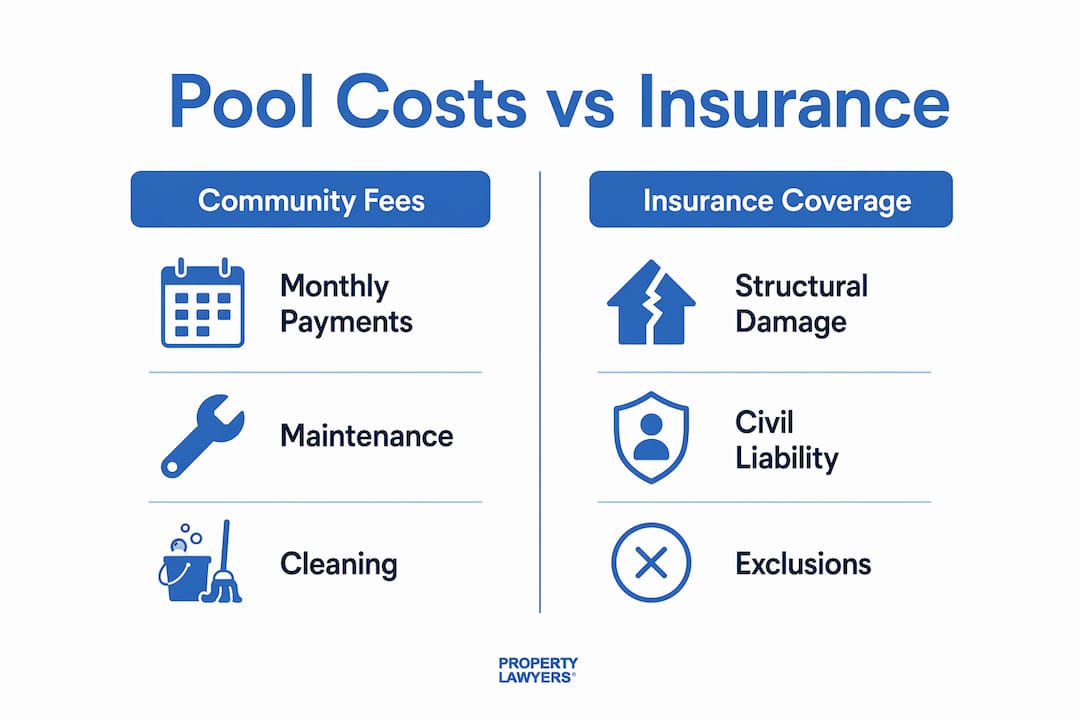
The table below summarises what community insurance typically covers and what it does not.
| Coverage area | Included in community insurance |
|---|---|
| Structural damage to pool and communal areas | Yes |
| Civil liability for accidents in pool area | Yes |
| Personal injury claims from pool accidents | Yes |
| Contents and fixtures inside individual flats | No |
| Personal liability for incidents inside your flat | No |
| Water damage originating from inside your flat | No |
Community insurance covers shared infrastructure and civil liability but excludes coverage for individual unit interiors and personal liability. This distinction matters enormously in practice. If a guest slips on the pool terrace, the community’s civil liability policy responds. If a pipe inside your flat leaks and damages your neighbour’s ceiling, your individual home insurance must cover it.
Pool-related community fees are legally binding for all co-owners. Failure to pay them can lead to legal action and loss of voting rights at community meetings. Many owners treat these fees as optional or negotiable. They are neither.
Pro Tip: Review your community’s insurance policy document at least once a year. Ask the administrator for a copy of the civil liability schedule and check the indemnity limit. A limit that was adequate five years ago may no longer reflect current repair or compensation costs.
What are the liabilities and risks if pool standards are not met?
Non-compliance with pool safety and water quality standards carries serious legal and financial consequences. Spanish law applies strict liability principles to communal property. This means a community can be held automatically responsible for damages or injuries in shared areas, regardless of direct negligence. You do not need to have been careless to face a claim. Ownership of a share in the community is sufficient to create exposure.
The risks of non-compliance fall into three main categories:
-
Civil liability claims. If a person is injured or drowns in the communal pool, the community faces a civil claim. Compensation awards in Spain for serious injury or death can be substantial. The community’s civil liability insurance is the first line of defence, but if the policy limit is insufficient, individual owners may face personal exposure.
-
Regulatory sanctions. Regional health authorities inspect pools and issue fines for breaches of Royal Decree 742/2013. Penalties increase significantly when communities fail to maintain water quality logs or safety signage. Repeat violations can result in pool closure orders.
-
Liability without a lifeguard. Many communities assume that operating a pool without a lifeguard removes their liability for accidents. This is incorrect. The absence of a lifeguard does not exempt a community from responsibility for accidents in the pool area. Spanish law does not require a lifeguard in most residential communities, but it does require adequate safety measures regardless.
Key legal principle: Under Spanish strict liability rules, a community of owners can be held responsible for pool accidents even when no individual owner acted negligently. The obligation to maintain safe communal spaces is collective and automatic.
Community administrators manage claims and legal disputes on behalf of all owners. If an incident occurs, the administrator opens the insurance claim and coordinates with the insurer. Owners who are directly affected must communicate promptly through the administrator. Delays in reporting incidents can jeopardise the claim and leave the community exposed.
How can property owners protect themselves from shared pool liability risks?
Protecting yourself from shared pool liability in Spain requires action at both community and individual level. Relying solely on community insurance leaves significant gaps in your protection. Individual home insurance supplements community coverage to protect your personal property and liabilities. Many owners underestimate this difference, which leads to unexpected out-of-pocket costs when a claim arises.
Practical steps every owner should take:
- Attend community meetings. Annual general meetings are where pool budgets, maintenance contracts, and insurance renewals are approved. Owners who do not attend lose their voice on decisions that directly affect their liability.
- Check the community insurance annually. Confirm that the civil liability limit is adequate and that the policy is current. Ask the administrator for written confirmation before each pool season opens.
- Hold a separate home insurance policy. Your individual policy should include personal civil liability cover and contents protection. This fills the gaps that community insurance does not cover.
- Pay community fees on time. Unpaid fees can result in legal proceedings and the loss of voting rights. Experts advise treating pool maintenance fees as mandatory legal obligations, not optional contributions.
- Report safety concerns in writing. If you notice a broken pool gate, missing safety signage, or poor water quality, report it to the administrator in writing. A written record protects you if a subsequent incident leads to a claim.
- Understand the claims process. Insurance claims are initiated by community administrators or presidents. If an incident affects you, contact the administrator immediately and follow up in writing to avoid delays.
Pro Tip: Non-resident owners in particular should appoint a local representative or property manager who can attend community meetings and liaise with the administrator on their behalf. Missing meetings due to absence abroad is one of the most common reasons owners find themselves unaware of insurance gaps.
Key takeaways
Shared pool liability in Spain is a collective legal obligation governed by the Horizontal Property Law and Royal Decree 742/2013, requiring all community owners to maintain insurance, pay mandatory fees, and accept automatic civil liability for pool accidents.
| Point | Details |
|---|---|
| Legal framework | The Horizontal Property Law and Royal Decree 742/2013 together govern all communal pool obligations in Spain. |
| Mandatory insurance | Community insurance must include civil liability cover for shared pool areas; this is not optional. |
| Cost sharing | Pool maintenance costs of €600–€1,200 annually are split among owners by ownership coefficient. |
| Individual cover gap | Community insurance does not cover interior damage or personal liability; a separate home policy is required. |
| Strict liability | Spanish law holds communities automatically responsible for pool accidents, regardless of individual negligence. |
Why shared pool liability surprises even experienced property owners
Having worked with international property buyers across Spain for many years, I find that shared pool liability is the issue that catches even experienced investors off guard. The assumption is almost universal: “The community handles it.” That assumption is correct, but only up to a point.
What owners consistently miss is the gap between what community insurance covers and what it does not. I have seen cases where an owner assumed the community policy covered a personal injury claim arising from a pool incident on their private terrace adjacent to the communal area. It did not. The community policy covered the pool deck itself. The private terrace fell under the individual policy, which the owner had not updated in years.
The other misconception I encounter regularly concerns the lifeguard question. Owners genuinely believe that because Spanish law does not require a residential community to employ a lifeguard, the community bears no liability if someone is injured. The law is clear on this point. No lifeguard requirement does not mean no liability. The obligation to maintain safe conditions is absolute.
My practical advice is this: treat your community insurance review as seriously as you treat your own home insurance renewal. Read the civil liability schedule. Know the limit. And if you are a non-resident owner, appoint someone locally who can attend meetings and flag problems before they become claims. The building defects law in Spain follows similar strict liability principles, and the pattern is consistent across Spanish property law. Proactive engagement protects you far more effectively than any insurance policy alone.
— Sophie
Get expert legal advice on shared pool liability in Spain
Shared pool liability in Spanish property law is detailed, and the consequences of misunderstanding it are real. Property-lawyers connects international property owners and investors with experienced, English-speaking property lawyers in Spain who specialise in communal property law, insurance disputes, and community obligations.

Whether you are buying into a community with a shared pool, reviewing your current insurance arrangements, or dealing with a liability dispute, a specialist lawyer can clarify your obligations and protect your position. Property-lawyers works with trusted Spanish property solicitors across every major region. Find the right legal support for your situation today.
FAQ
What is shared pool liability in Spanish property law?
Shared pool liability is the collective legal responsibility of all owners in a community to maintain, insure, and accept civil liability for their communal swimming pool. It is governed by the Horizontal Property Law and Royal Decree 742/2013.
Is community insurance for a shared pool mandatory in Spain?
The Horizontal Property Law requires all multi-floor buildings to hold community insurance that includes civil liability cover for shared elements, including swimming pools. This cover is mandatory, not optional.
Does community insurance cover all pool-related claims?
Community insurance covers civil liability and structural damage in shared areas but does not cover personal liability or interior damage within individual flats. Owners need a separate home insurance policy to fill these gaps.
Can a community be liable for a pool accident without a lifeguard?
The absence of a lifeguard does not exempt a community from liability for pool accidents. Spanish law requires communities to maintain safe conditions regardless of whether a lifeguard is present.
What happens if I do not pay my community pool fees?
Failure to pay community fees for pool maintenance can result in legal action and the loss of voting rights at community meetings. These fees are legally binding obligations for all co-owners under Spanish law.
Recommended
- Property Taxes in Spain — Full Guide for Foreign Owners (2026) | Property Lawyers
- Non-Resident Tax in Spain — Property Owners Guide | Property Lawyers
- Property law in Spain: a 2026 guide for buyers
- Non-Resident Property Tax Spain — Annual Obligations Explained | Property Lawyers

Sophie Gutenberg is a legal content specialist focused on Spanish property law, real estate transactions, conveyancing, due diligence and tax issues affecting international property buyers in Spain. She works alongside qualified Spanish property lawyers .
