
Spanish property title deed: a buyer’s guide
TL;DR:
- The Spanish property title deed, or escritura publica de compraventa, is a notarised document that transfers ownership and is essential for registration. Registration at the land registry transforms the signed deed into full legal protection, with only registered owners protected under Spanish law. Buyers must understand that the nota simple is only informational and cannot replace the deed or registration, which is critical for securing legal ownership.
The Spanish property title deed, formally known as the escritura pública de compraventa, is the notarised document that legally transfers ownership of real estate and forms the basis for registration in Spain’s land registry. Without it, legal proof of ownership is absent, leaving buyers exposed to third-party claims and disputes. For international buyers, learning to understand a Spanish property title deed is not optional. It is the single most important step in securing your investment legally.
What does a Spanish property title deed actually mean?
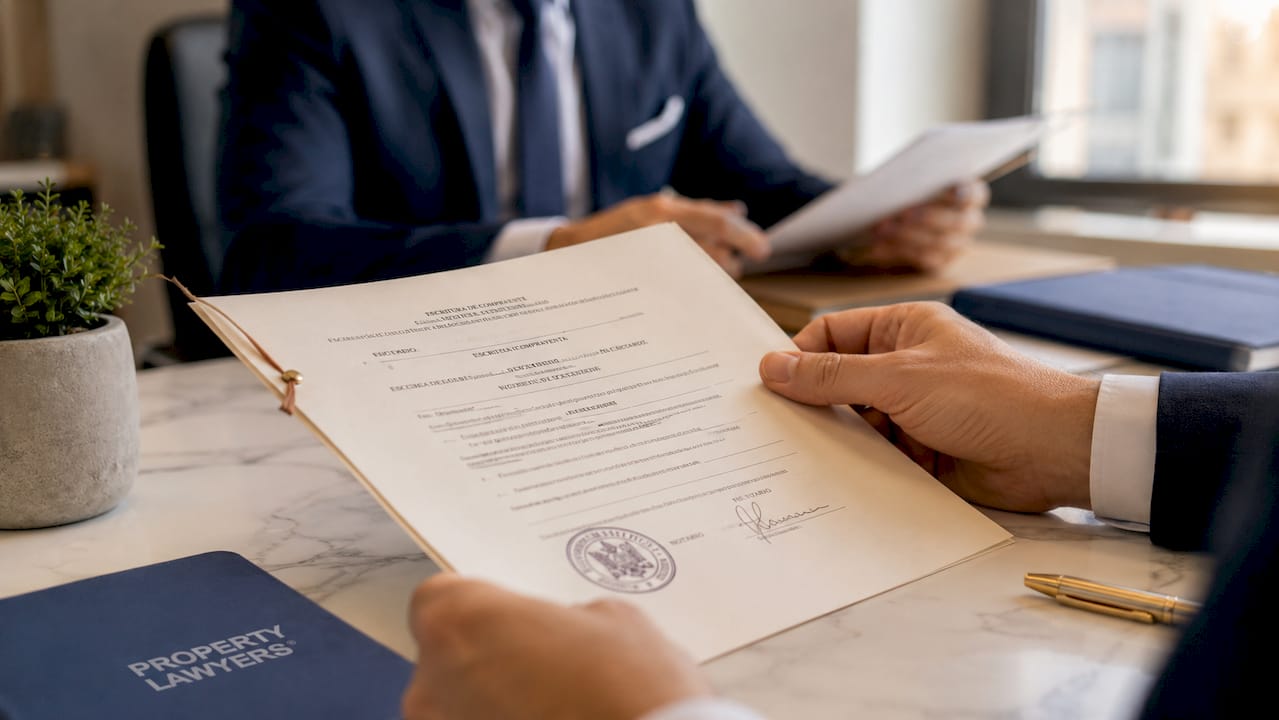
The escritura pública de compraventa is Spain’s single most important document in a property purchase. Unlike many other jurisdictions where the purchase contract, title deed, and registration basis are separate instruments, Spain combines all three into one notarised document. That distinction matters enormously for buyers accustomed to legal systems in the UK, Ireland, or the United States.
The escritura formalises the transfer of ownership from seller to buyer. It records the agreed price, the property description, the identities of both parties, and any mortgage conditions. Once signed before a Spanish notary, it triggers the buyer’s right to register the property in the Registro de la Propiedad, Spain’s official land registry. Registration is what converts a signed deed into fully protected legal ownership.
Spanish property ownership therefore rests on two pillars: the signed escritura and its subsequent registration. Buyers who complete the signing but delay or skip registration remain legally vulnerable. The escritura alone, without registration, does not provide the full protection that Spanish law offers.
What documents are involved in Spanish property ownership?
International buyers encounter several documents during a Spanish property purchase. Understanding which carries legal weight prevents costly misunderstandings.
The escritura pública de compraventa is the notarised public deed. It is the operative title document and the foundation for all legal rights over the property.
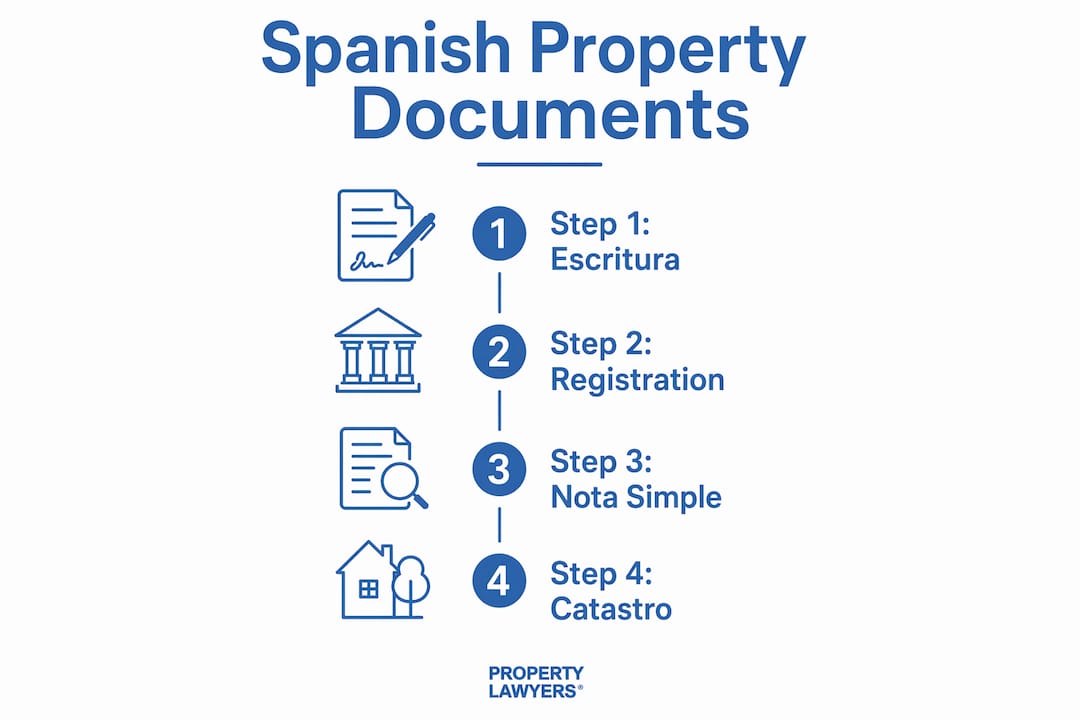
The nota simple is an extract from the Registro de la Propiedad. It summarises current ownership and registered charges, including mortgages, easements, and embargoes. Buyers use it during due diligence to check what encumbrances exist before committing to a purchase. Critically, the nota simple is an informational extract only. It cannot replace the escritura or serve as proof of ownership.
The Catastro is a separate administrative register maintained by the Spanish tax authority. It records the physical and fiscal characteristics of the property, including its surface area and cadastral value. The Catastro does not confer ownership rights. Discrepancies between the Catastro and the land registry are common and must be resolved before or during the purchase process.
| Document | Purpose | Legal weight |
|---|---|---|
| Escritura pública de compraventa | Notarised deed transferring ownership | Highest: basis for registration and legal title |
| Nota simple | Registry extract showing ownership and charges | Informational only: not proof of ownership |
| Catastro certificate | Physical and fiscal property description | Administrative: no ownership rights conferred |
Many buyers mistakenly treat the nota simple as proof of ownership. It is strictly an informational extract and cannot replace the escritura or the land registry entry. Relying on it alone during a purchase is a significant legal risk.
How does the notary’s role establish legal ownership?
The notary is a public official appointed by the Spanish state. Their role is impartial: they authenticate the deed, verify the identities of all parties, and certify that the transaction complies with Spanish law. The notary does not represent the buyer or the seller.
The signing process on completion day follows a defined sequence:
- The notary reads the escritura aloud in full. If you do not speak Spanish, a sworn interpreter must be present or the deed must be translated.
- The notary verifies the property’s legal status, confirms payment of the agreed price, and checks that all charges and conditions are accurately recorded.
- The buyer, seller, and bank representative (if a mortgage applies) each sign the deed in the notary’s presence.
- The notary witnesses and certifies all signatures, formally authenticating the document.
- The notary issues copies of the deed. The primera copia (first copy) functions as the operative original immediately after signing and is the document used for land registry submission.
The legal effect of signing is immediate in one sense: the buyer acquires the right to register the property. However, full legal protection under Spanish law only materialises once registration is complete.
Pro Tip: Request a certified translation of the escritura before signing day, not on the day itself. Reviewing the full document in advance gives you time to raise questions with your lawyer without the pressure of a notary appointment.
Why is registration at the Registro de la Propiedad essential?
Registration at the Registro de la Propiedad is the step that converts a signed deed into fully protected Spanish property ownership. Once the deed is signed and applicable taxes are paid, the sale must be entered in the land registry. Registered owners are regarded as the sole and real owners legally, gaining protection from third-party claims.
Spanish law protects good-faith purchasers through the principle of fe pública registral, or public faith of the registry. This principle means that buyers who rely on registry information in good faith are protected even if hidden defects exist outside the registry. The risk of those defects falls on the party who failed to register them correctly.
The practical benefits of registration include:
- Protection from third-party claims. Unregistered interests cannot be enforced against a registered owner.
- Mortgage enforceability. Only mortgages recorded in the Registro de la Propiedad are legally binding and enforceable. An unregistered mortgage does not legally exist.
- Clear title for future sales. A registered title is far simpler to transfer when you come to sell.
- Access to mortgage finance. Spanish banks require a registered title before granting a mortgage to a buyer.
Security in Spanish property purchase relies on the accuracy and acceptance of the escritura at registration. Buyers should demand evidence not only of the signed deed but also that it is properly inscribed and accepted by the land registry.
Registration typically takes several weeks after submission. Your lawyer or the notary’s office will submit the primera copia to the relevant land registry on your behalf. You can verify the status of registration by requesting an updated nota simple once the process is complete.
Pro Tip: Ask your lawyer to obtain a nota simple from the Registro de la Propiedad approximately six to eight weeks after signing. This confirms that your title is correctly registered and that no unexpected charges have appeared.
Common mistakes international buyers make with title deeds
International buyers unfamiliar with Spanish real estate documents make a predictable set of errors. Each one carries real legal and financial risk.
- Treating the nota simple as the title deed. The nota simple shows what the registry records at a given moment. It is not the deed itself and confers no ownership rights.
- Failing to verify registered charges. A seller may have an outstanding mortgage or embargo that does not appear on an outdated nota simple. Always request a fresh nota simple immediately before signing.
- Not confirming the seller’s identity and authority. The notary checks identity documents, but your lawyer should independently verify that the seller is the registered owner and has the legal authority to sell.
- Skipping independent legal advice. The notary is impartial. They do not advise you on whether the transaction is in your best interests. A specialist property lawyer reviews the escritura, checks for encumbrances, and protects your position throughout.
- Delaying registration after signing. The period between signing and registration carries risk. Another creditor could register a claim against the seller during that window, potentially affecting your title.
A practical verification checklist before signing the escritura:
- Obtain a fresh nota simple no more than 48 hours before signing
- Confirm the property’s Catastro reference matches the escritura description
- Verify that all declared charges will be cancelled on or before completion
- Confirm the seller’s NIE (Spanish tax identification number) and identity
- Instruct your lawyer to review the full draft escritura before signing day
Pro Tip: Never sign the escritura without having a qualified Spanish property lawyer review the draft first. The legal checks before purchase are far less expensive than resolving a title dispute after completion.
Key takeaways
The escritura pública de compraventa and its registration at the Registro de la Propiedad together form the complete legal foundation for secure property ownership in Spain.
| Point | Details |
|---|---|
| Escritura is the core document | The notarised escritura formalises ownership transfer and is the basis for all legal title rights. |
| Nota simple is not proof of ownership | The nota simple is an informational extract only; it cannot replace the escritura or land registry entry. |
| Registration completes legal protection | Only registered owners gain full protection under Spain’s public faith of the registry principle. |
| Unregistered mortgages do not legally exist | Buyers must verify the registry to understand all real encumbrances affecting the property. |
| Independent legal advice is non-negotiable | A specialist lawyer reviews the deed, checks charges, and protects your interests throughout the process. |
What I have learned from watching buyers navigate the escritura
Working alongside international buyers purchasing property in Spain, I have seen the same misunderstanding arise repeatedly. Buyers arrive at the notary’s office having read the nota simple and feeling confident they understand the property’s legal status. They do not realise that the nota simple is a snapshot, not a guarantee, and that the real protection comes only after registration.
The escritura and the land registry entry are a single protection mechanism. Treating them as separate steps is where buyers go wrong. The signing is the visible moment, but registration is the legal moment that matters.
I have also seen buyers underestimate the value of reviewing the draft escritura in advance. Spanish notaries read the deed aloud, but a complex document read in Spanish under time pressure is not the moment to spot a discrepancy in the property description or an undisclosed charge. Your lawyer should have reviewed every line before you walk through the notary’s door.
Store your primera copia in a secure location, ideally with a digital copy held separately. It is the document you will need for any future sale, inheritance, or mortgage application. Losing it creates administrative complications that are entirely avoidable.
— Sophie
How Property-lawyers can help you secure your title
Buying property in Spain as an international buyer carries real legal complexity, and the escritura process is where errors are most costly.

Property-lawyers connects buyers with independent, English-speaking property lawyers across Spain who specialise in deed review, registration assistance, and full due diligence checks. Whether you are purchasing in Madrid, the Costa del Sol, or the Balearic Islands, a specialist lawyer from the Property-lawyers directory will review your escritura before signing, verify the land registry status, and confirm that your title is clean. For a clear overview of your legal obligations and protections as a buyer, the Spanish real estate law guide covers the full picture for 2026. To find a qualified property lawyer in Spain who can guide you through the escritura and registration process, use the Property-lawyers directory today.
FAQ
What is the escritura pública de compraventa?
The escritura pública de compraventa is the notarised public deed that legally transfers property ownership in Spain. It combines the purchase contract, title deed, and registration basis into one document, making it the single most important instrument in a Spanish property transaction.
Is the nota simple the same as the title deed?
The nota simple is not the title deed. It is an extract from the Registro de la Propiedad that shows current ownership and registered charges, used for due diligence purposes only.
What does registration at the Registro de la Propiedad do?
Registration converts a signed escritura into fully protected legal ownership. Registered owners gain protection from third-party claims under Spain’s principle of public faith of the registry, and only registered mortgages are legally enforceable.
How long does registration take after signing?
Registration typically takes several weeks after the primera copia is submitted to the land registry. Your lawyer or the notary’s office handles the submission, and you can verify completion by requesting an updated nota simple.
Do I need a lawyer to understand the title deed?
A specialist property lawyer is the most reliable way to review the escritura, verify registered charges, and confirm the seller’s legal authority to sell. The notary is impartial and does not advise buyers on their specific legal interests.
Recommended
- Escritura Spain — The Spanish Property Title Deed Explained | Property Lawyers
- Spanish real estate law: a buyer’s guide for 2026
- Property law in Spain: a 2026 guide for buyers
- Spanish property contracts explained: a buyer’s guide

Sophie Gutenberg is a legal content specialist focused on Spanish property law, real estate transactions, conveyancing, due diligence and tax issues affecting international property buyers in Spain. She works alongside qualified Spanish property lawyers .
