

Spanish property purchase process: a guide for buyers
TL;DR:
- The Spanish property purchase process involves a structured legal and financial sequence managed by independent lawyers. Buyers must conduct thorough due diligence, secure necessary documents, and complete specific contracts to protect their investment. Skipping essential steps increases the risk of inheriting debts, planning infractions, or losing deposits.
The Spanish property purchase process is defined as a structured sequence of legal and financial steps that transfers ownership from seller to buyer under Spanish law. For international buyers, this means securing a Número de Identificación de Extranjero (NIE), conducting thorough due diligence, signing deposit contracts, completing a notarial deed, and registering ownership at the Land Registry. Each stage carries specific legal obligations. Skipping any one of them creates real financial risk. This guide explains every step clearly, so you can buy property in Spain with confidence, whether your target is Marbella, Mallorca, Ibiza, Málaga, or Barcelona.
What does the Spanish property purchase process involve?
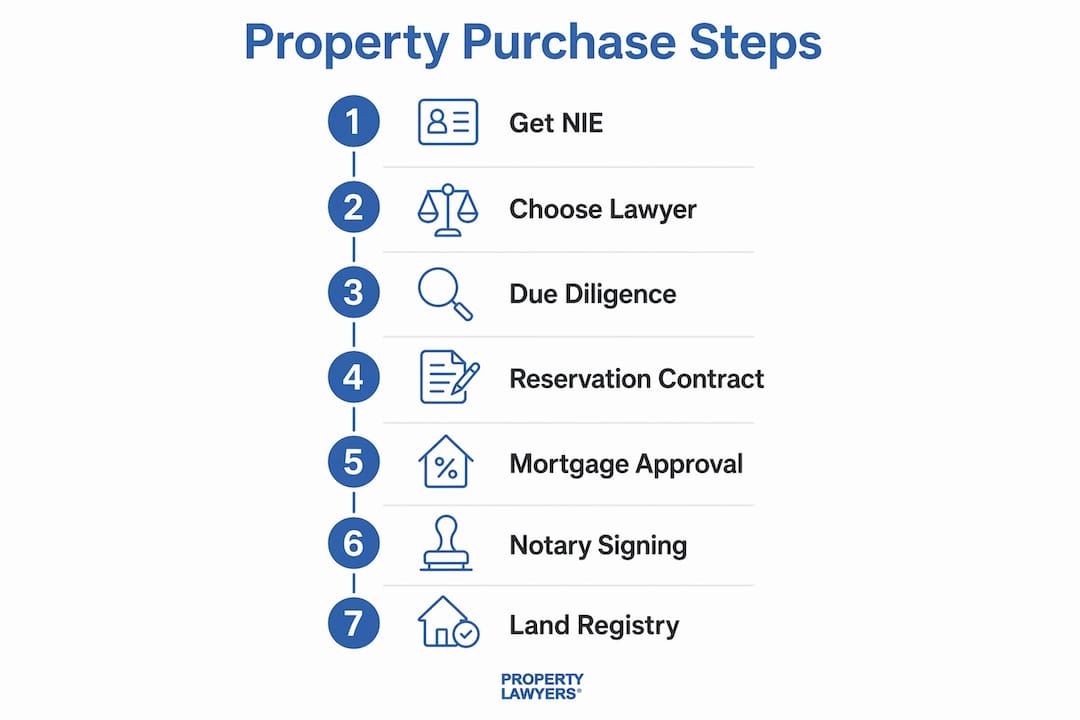
The Spanish property conveyancing process follows a fixed sequence. Understanding that sequence before you make an offer is the single most important thing you can do as an international buyer.
The main stages are:
- Obtain your NIE (foreign identification number)
- Instruct an independent property lawyer
- Sign a reservation contract and pay a holding deposit
- Conduct full legal and financial due diligence
- Sign the private purchase contract (contrato de arras) and pay the main deposit
- Complete the Escritura Pública (public deed) before a notary
- Register ownership at the Land Registry
The notary and the Land Registry are the two official bodies that formalise ownership in Spain. The notary certifies the deed; the Land Registry records it. Neither body protects your commercial interests. That protection comes from your independent lawyer.
What are the legal and financial prerequisites for buying in Spain?

Getting your NIE number
The NIE is a tax identification number issued to foreign nationals by the Spanish authorities. Every buyer needs one before signing any contract or paying any tax. The NIE application process typically takes 2–4 weeks, so apply as early as possible. You can apply in person at a Spanish consulate in your home country or at a police station in Spain.
Financial planning: deposits, taxes, and fees
Buying property in Spain costs more than the headline price. Budget for the following:
- Transfer tax (ITP): Applies to resale properties and varies by region, typically 6–10% of the purchase price
- VAT (IVA) and stamp duty: Apply to new-build properties
- Notary and Land Registry fees: Usually 0.5–1% of the purchase price combined
- Legal fees: Typically 1% of the purchase price plus VAT
- Mortgage arrangement fees: If applicable
A full breakdown of property purchase taxes in Spain is worth reviewing before you set your budget. Many buyers underestimate total acquisition costs by 10–15%.
Choosing an independent lawyer
Your lawyer is your most important appointment. An independent property lawyer reviews contracts, conducts due diligence, liaises with the notary, and protects your interests throughout. The notary does not do this. The estate agent does not do this. Only an independent lawyer works exclusively for you. Property-lawyers connects international buyers with trusted, English-speaking property lawyers across Spain.
Pro Tip: Instruct your lawyer before you sign anything, including the reservation contract. Many buyers lose deposits because they signed before getting legal advice.
Mortgage options for foreign buyers
Spanish banks do offer mortgages to non-residents, though the loan-to-value ratio is typically lower than for residents. Most lenders offer non-residents up to 60–70% of the purchase price. Arrange a mortgage agreement in principle before you make an offer, so you know your budget is confirmed.
How do you conduct due diligence on a Spanish property?
Spanish property due diligence is the process of verifying that a property is legally clean, financially clear, and physically as described before you commit to buying it. Skipping this step is the most common and most costly mistake international buyers make.
The nota simple and Land Registry check
The nota simple is an official extract from the Land Registry showing ownership, boundaries, and any charges or mortgages registered against the property. Your lawyer must obtain a nota simple no older than 30 days before the notary signing. This document confirms who legally owns the property and whether any debts or embargoes are registered against it.
Cross-checking the Cadastre
The Cadastre (Catastro) is Spain’s property mapping and valuation database. Discrepancies between Land Registry and Cadastre records are common and signal possible undeclared extensions or illegal constructions. These irregularities can result in fines, loss of mortgage financing, or problems reselling the property later. Your lawyer should cross-reference both registers and arrange a physical inspection.
- Obtain the nota simple from the Land Registry
- Request the Cadastre reference and compare the recorded surface area with the physical property
- Commission an independent survey if discrepancies exist
- Check the town hall’s urban planning records for any outstanding infractions
- Verify that the property holds a valid habitation licence (cédula de habitabilidad)
- Confirm all building work has the required planning permission
Checking debts and unpaid bills
A property in Spain can carry debts that transfer to the new owner. Your due diligence checklist must include:
- IBI (local property tax): Confirm all annual payments are up to date
- Community fees: Under the Ley de Propiedad Horizontal, community fee debts transfer with the property for the current year plus the previous three calendar years. Always obtain a signed certificate from the community administrator confirming zero debt.
- Utility bills: Water, electricity, and gas accounts should be clear before completion
- Mortgage or charge cancellations: Any registered mortgage must be formally cancelled at the Land Registry before or at completion
| Document | Purpose | Who provides it |
|---|---|---|
| Nota simple | Confirms ownership and charges | Land Registry |
| Cadastre certificate | Confirms size and planning status | Catastro office |
| Community debt certificate | Confirms no outstanding fees | Community administrator |
| IBI receipts (last 5 years) | Confirms local tax payments | Seller or town hall |
| Habitation licence | Confirms property is legally habitable | Town hall |
Pro Tip: Ask your lawyer to verify the community debt certificate independently. Sellers occasionally present outdated or incorrect certificates.
What contracts, payments, and timelines should buyers expect?
The reservation contract
The reservation contract (contrato de reserva) is a short agreement that takes the property off the market while due diligence proceeds. Reservation deposits typically range from €3,000 to €10,000 and hold the property for approximately 30 days. This deposit is usually non-refundable if you withdraw without legal grounds, so instruct your lawyer before signing.
The private purchase contract (contrato de arras)
The contrato de arras is the main pre-completion agreement. There are two principal types:
- Arras penitenciales: The most common type. If the buyer withdraws, the deposit is forfeited. If the seller withdraws, the seller must pay double the deposit to the buyer. This creates a strong financial incentive for both parties to complete.
- Arras confirmatorias: A confirmed contract where either party can be sued for specific performance rather than simply losing the deposit.
The standard deposit at this stage is 10% of the agreed purchase price. A well-drafted deposit contract must state the type of arras clearly, include accurate property descriptions, set firm deadlines, and specify conditions under which the buyer can recover funds if legal problems emerge.
Timeline from offer to completion
International buyers should plan for a 2–4 month timeline from accepted offer to notary completion on a resale property. New builds can take considerably longer depending on construction stage.
- Weeks 1–2: NIE application, lawyer instructed, reservation contract signed
- Weeks 2–6: Full due diligence conducted, mortgage arranged if needed
- Weeks 6–10: Contrato de arras signed, 10% deposit paid
- Weeks 10–16: Final checks, notary appointment confirmed, balance funds arranged
- Completion day: Escritura Pública signed, keys handed over
- Post-completion: Land Registry registration completed within 2–4 weeks
If your purchase depends on mortgage financing, build in extra time. Lenders can delay valuations and approvals, and a missed completion deadline under arras penitenciales terms means losing your deposit.
How does the notarial and registration process formalise ownership?
What happens at the Escritura Pública signing
The Escritura Pública de Compraventa is the public deed of sale. It must be signed before a Spanish notary, with both buyer and seller present or represented by a valid power of attorney. On completion day, the buyer pays the balance of the purchase price, the notary reads the deed aloud, both parties sign, and the keys are handed over.
The notary’s role is administrative. The notary verifies identities, confirms the deed is correctly executed, and certifies the transaction. The notary does not check for title defects or planning infractions. That work belongs to your independent lawyer, completed during due diligence.
Remote buying with power of attorney
If you cannot attend the signing in person, a power of attorney allows your lawyer to sign on your behalf. This is a practical and legally sound option for buyers based outside Spain. Property-lawyers can explain the power of attorney process and ensure the document is correctly drafted and notarised.
Land Registry registration
Land Registry registration protects your ownership rights against third parties and should be completed promptly after the notary signing. Registration typically takes 2–4 weeks. Until registration is complete, your ownership is not fully protected under Spanish law. Your lawyer should submit the deed for registration immediately after completion.
Pro Tip: Do not delay registration. A gap between notary signing and Land Registry registration leaves a window during which a dishonest seller could theoretically create new charges against the property.
What risks and pitfalls should international buyers avoid?
International buyers face specific risks in the Spanish market that domestic buyers often navigate instinctively. Awareness of these risks is the first line of defence.
The most common mistakes include:
- Relying on the estate agent for legal protection. Agents represent the seller. Their job is to close the sale, not to protect your interests.
- Assuming the notary has checked everything. The notary’s role is administrative, not advisory. Title defects, planning infractions, and unpaid debts are not the notary’s concern.
- Ignoring community fee liabilities. Under the Ley de Propiedad Horizontal, community fee debts transfer with the property for the current year plus three prior years. A certificate of zero debt from the community administrator is not optional.
- Failing to check urban planning compliance. Properties in some coastal and rural areas have been built without proper licences. Buying such a property can mean fines, demolition orders, or inability to connect utilities.
- Signing a poorly drafted deposit contract. A vague arras contract without clear conditions for refund leaves you exposed if problems emerge during due diligence.
Buyers who trust estate agents or notaries to protect their legal interests, rather than retaining an independent lawyer, are the most likely to lose deposits, inherit debts, or purchase properties with planning irregularities that cannot be resolved after completion.
The legal checks before buying that your lawyer conducts are not a formality. They are the mechanism that keeps your money safe.
Key takeaways
The Spanish property purchase process requires independent legal advice, thorough due diligence, and correctly drafted contracts at every stage to protect your investment.
| Point | Details |
|---|---|
| Get your NIE early | Apply 2–4 weeks before you need it; no contract or tax payment is possible without it. |
| Instruct a lawyer before signing | Your lawyer must review the reservation contract before you pay any deposit. |
| Due diligence is non-negotiable | Cross-check the nota simple, Cadastre, community fees, and planning records before committing. |
| Understand your deposit contract | Arras penitenciales means you forfeit the deposit if you withdraw; the seller pays double if they pull out. |
| Register promptly after completion | Land Registry registration takes 2–4 weeks and protects your ownership against third parties. |
Why I always say: slow down before you sign
After years of working with international buyers across Spain, the pattern I see most often is the same. A buyer falls in love with a villa in Mallorca or an apartment in Marbella, feels pressure from the agent to sign quickly, and pays a deposit before a lawyer has reviewed anything. Sometimes it works out. Often it does not.
The Spanish property market moves at its own pace, and that pace is rarely as urgent as agents suggest. I have seen buyers lose €10,000 deposits because they signed a reservation contract with no legal grounds for refund, only to discover a planning infraction during due diligence. I have seen buyers inherit community fee debts running to several thousand euros because no one requested the certificate before completion.
Regional regulations add another layer of complexity. Mallorca and Ibiza have specific rules around tourist rental licences that affect investment value significantly. Coastal properties in Málaga and Marbella sometimes fall within protected maritime zones. Barcelona has its own urban planning restrictions. A lawyer who specialises in the specific region where you are buying is worth considerably more than a generalist.
My honest advice: budget for proper legal fees, instruct your lawyer on day one, and treat the 2–4 month timeline as a minimum, not a target to beat. The buyers who take their time and follow the process correctly are the ones who complete without regrets.
— Sophie
How Property-lawyers supports your Spanish purchase
Buying property in Spain as an international buyer is straightforward when you have the right legal team beside you. Property-lawyers connects buyers with independent, English-speaking property lawyers across Spain’s most popular regions, including Mallorca, Marbella, Ibiza, Málaga, and Barcelona.

The lawyers in the Property-lawyers network handle due diligence, contract review, NIE applications, notary coordination, and Land Registry registration. They work exclusively for the buyer, not the seller or the agent. Whether you are purchasing a resale apartment or a new-build villa, the Property-lawyers buying guide gives you a clear starting point. For buyers considering the Balearic Islands specifically, the Mallorca real estate guide covers investment considerations in detail.
FAQ
What is the NIE and why do I need it?
The NIE is a tax identification number required by all foreign buyers in Spain. Without it, you cannot sign contracts, pay taxes, or complete a property purchase.
How long does the Spanish property purchase process take?
A resale property typically takes 2–4 months from accepted offer to notary completion. New builds take longer depending on the construction stage.
What is the difference between arras penitenciales and arras confirmatorias?
Arras penitenciales allows either party to exit the contract by forfeiting the deposit or paying double; arras confirmatorias allows either party to sue for specific performance instead.
Does the Spanish notary protect the buyer’s interests?
The notary verifies identities and certifies the deed but does not conduct due diligence. Buyers need an independent lawyer to check title, debts, and planning compliance.
What debts can transfer to the buyer at completion?
Community fees under the Ley de Propiedad Horizontal transfer for the current year plus three prior years. Unpaid IBI, utility bills, and registered mortgages can also transfer if not cleared before completion.
Recommended
- Spanish real estate law: a buyer’s guide for 2026
- Property Buying Guide Spain: Legal Advice for Foreign Buyers
- Spanish property contracts explained: a buyer’s guide
- Property law in Spain: a 2026 guide for buyers

Sophie Gutenberg is a legal content specialist focused on Spanish property law, real estate transactions, conveyancing, due diligence and tax issues affecting international property buyers in Spain. She works alongside qualified Spanish property lawyers .
