

Spanish foreign investment property rules explained
TL;DR:
- Foreign buyers in Spain have nearly equal property rights as nationals and can purchase freely across regions.
- They must follow specific legal steps, pay transaction fees of 10-15%, and obtain an NIE number before buying.
Spain is one of the few countries in Europe where foreign buyers enjoy almost identical property ownership rights to Spanish nationals. Whether you are based in London, New York, or Sydney, you can purchase a villa in Marbella, an apartment in Barcelona, or a finca in Mallorca with no general restrictions on foreign ownership. The Spanish foreign investment property rules explained in this guide cover everything you need to know: the legal framework, the step-by-step purchase process, tax obligations, and the regulatory nuances that catch buyers off guard. Spain’s Land Registry and notarial system provide a level of legal security that few other markets can match, making it a genuinely safe environment for international investment when you follow the correct process.
What are the legal requirements for foreign investors buying property in Spain?

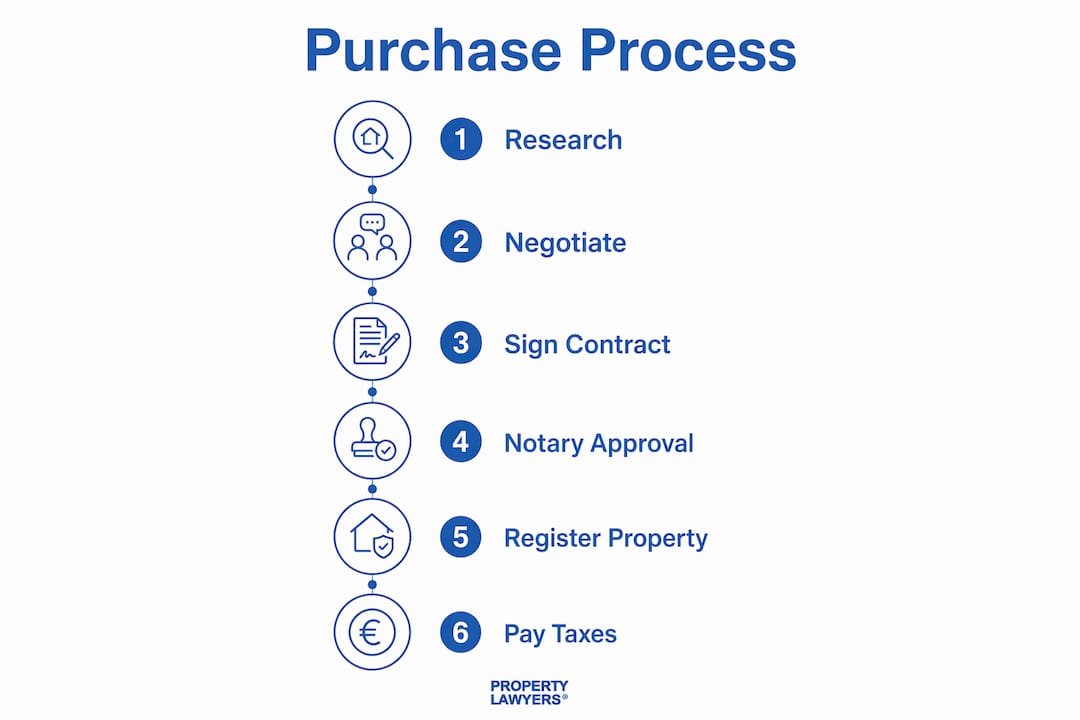
Foreign buyers must follow a clear sequence of steps to purchase property legally in Spain. Skipping any stage creates risk, delays, or financial loss. The process is well-established, but it requires preparation well before you sign anything.
The step-by-step purchase process
- Obtain your NIE number. The NIE (Número de Identificación de Extranjero) is your Spanish tax identification number. NIE applications can take 2–6 weeks, so apply before you begin viewing properties seriously. Every property transaction, tax payment, and bank account in Spain requires one.
- Open a Spanish bank account. You need a local account to pay taxes, utility bills, and purchase funds. Most banks require your NIE, passport, and proof of address. Some lenders also require a Spanish account before approving a mortgage.
- Get mortgage pre-approval if needed. Mortgage pre-approval takes 2–3 weeks and is valid for up to 90 days. Without it, you are less competitive against cash buyers, who can complete a purchase in as little as four weeks. Lender requirements vary by nationality, so check early.
- Hire an independent lawyer. This is the most important decision you will make. Your lawyer verifies the title, checks for debts, embargoes, and unpaid community charges, confirms planning licences, and reviews all contracts. Independent legal counsel is the single most effective protection against disputes and title problems.
- Sign the reservation contract and pay the deposit. The reservation contract (often called an arras contract) secures the property and sets the purchase timeline. If you withdraw, you lose your deposit. If the seller withdraws, they must return double the amount. Read every clause before signing.
- Complete due diligence. Your lawyer obtains a nota simple from the Land Registry, confirming the property’s legal status, ownership, and any charges. For off-plan properties, confirm that bank guarantees protect your stage payments if the developer fails to complete.
- Sign at the notary and register the deed. The notary authenticates the purchase deed (escritura). If you cannot attend in person, your lawyer can act under a power of attorney. The deed is then registered at the Land Registry, which gives you full legal protection as the new owner.
Pro Tip: Never use a notary recommended solely by the seller or their agent. You have the right to choose your own notary, and doing so removes a common conflict of interest.
What taxes and costs do foreign investors pay on Spanish property?
Foreign buyers should budget 10–15% above the purchase price to cover all transaction costs. That figure covers taxes, legal fees, notary charges, and registry costs. It is not optional: failing to budget for it leaves buyers short at completion.
Transaction taxes at a glance
| Tax or fee | When it applies | Typical rate |
|---|---|---|
| ITP (Transfer Tax) | Resale properties | 6–10% depending on region |
| IVA (VAT) | New build properties | 10% (general rate) |
| AJD (Stamp Duty) | New builds alongside IVA | 0.5–1.5% depending on region |
| Legal fees | All purchases | 1–1.5% of purchase price |
| Notary and registry | All purchases | 0.5–1% combined |
Regional variation is significant. Andalucía, which covers Marbella and Málaga, applies ITP at 7%. The Balearic Islands, covering Mallorca and Ibiza, apply a sliding scale that rises with the purchase price. Always confirm the rate for your specific region before budgeting.
Ongoing annual taxes for property owners
Once you own the property, several annual taxes apply regardless of whether you use it or rent it out:
- IBI (Impuesto sobre Bienes Inmuebles): The local property tax, paid annually to the town hall. Rates vary by municipality but are generally modest.
- IRNR (Non-Resident Income Tax): Applies to all non-resident owners. If the property sits empty, you pay tax on imputed income based on the cadastral value. If you rent it out, you pay tax on actual rental income.
- Wealth tax: Spain levies wealth tax on assets above a regional threshold. Rates and exemptions vary by autonomous community.
Non-resident income tax rates are 19% for EU and EEA residents, and 24% for non-EU owners. Following recent legal rulings, non-EU owners can now deduct certain expenses against rental income, which was previously not permitted.
Reporting obligations and selling costs
Non-resident owners must file Modelo 210 annually to declare either imputed or actual rental income. The deadline for imputed income is 31 December each year. Rental income is declared quarterly or annually depending on your situation.
When you sell, capital gains tax applies to the profit at the same IRNR rates. The buyer is also legally required to withhold 3% of the purchase price and pay it directly to the Spanish tax authority on your behalf as a security deposit against your capital gains liability. Plusvalía Municipal, a local tax on the increase in land value, is also payable by the seller on completion.
Pro Tip: Engage a Spanish tax adviser before you complete your purchase, not after. Setting up the correct tax structure from day one avoids penalties and simplifies annual filings.
Are there restrictions foreign investors need to know about?
Spain imposes no general restrictions on foreign ownership of residential or commercial property. The exception is a small number of military and strategic zones where government authorisation is required before purchase. This does not block the transaction, but it can delay completion by several months. Your lawyer must identify and manage this requirement before you sign.
Beyond ownership restrictions, several other regulatory areas affect foreign investors directly.
Licences and habitability certificates
Every property sold for residential use must hold a valid habitability certificate (cédula de habitabilidad). Without one, you cannot connect utilities or legally occupy the property. Your lawyer must confirm this certificate exists and is current before you exchange contracts. Rural properties and older village homes are the most common cases where this document is missing or expired.
If you plan to let the property to tourists, you need a tourism rental licence. These are issued by regional governments, and the rules differ significantly between Andalucía, the Balearic Islands, Catalonia, and Valencia. In some areas, new licences are suspended entirely. Buying a property with the intention of short-term letting without first confirming licence availability is a serious financial risk.
The Ley de Vivienda and rental caps
Spain’s Housing Law (Ley de Vivienda), introduced in 2023, allows regional governments to designate “stressed zones” where residential rents can be capped. This affects long-term rental yields in cities such as Barcelona and parts of Madrid. Investors targeting rental income must research whether their target area carries this designation before committing.
Buying a property in a stressed rental zone without understanding the Ley de Vivienda can reduce your projected rental yield significantly. The cap applies to new contracts, so existing leases may not be affected immediately, but your exit strategy and income projections must account for it.
The Golden Visa and anti-money laundering rules
Spain abolished its Golden Visa programme for property investment in april 2025. Purchasing property no longer grants residency rights. Residency and property ownership are now entirely separate matters, and buyers seeking the right to live in Spain must apply through a different visa route.
Anti-money laundering checks apply to all buyers, but non-EU purchasers face enhanced scrutiny. You must provide proof of the source of funds, bank statements, and in some cases a declaration of wealth. Using foreign corporate structures to hold Spanish property does not avoid these obligations. Since 2010, Spanish authorities require disclosure of all beneficial owners holding more than 25% of any company that owns Spanish property.
How do resident and non-resident investors differ in rights and tax?
Ownership rights in Spain are equal regardless of residency status. A non-resident buyer in London holds the same title and legal protections as a Spanish resident. The differences lie entirely in taxation and reporting obligations.
Resident versus non-resident: key distinctions
| Area | Non-resident owner | Resident owner |
|---|---|---|
| Income tax on rental income | 19% (EU/EEA) or 24% (non-EU) via IRNR | Taxed under general income tax scale |
| Expense deductions | Limited; EU/EEA owners can deduct some costs | Full deductions available |
| Wealth tax | Applies above regional threshold | Exemptions and allowances differ by region |
| Capital gains on sale | 19–24% depending on nationality | General income tax scale with exemptions |
| Annual filing | Modelo 210 required | Annual income tax return (IRPF) |
Non-resident owners must file Modelo 210 every year, even if the property sits empty and generates no rental income. The imputed income calculation is based on a percentage of the cadastral value. Missing this filing triggers automatic penalties from the Spanish tax authority.
Residents benefit from a broader range of deductions and may qualify for capital gains exemptions, particularly on the sale of a primary residence. However, becoming a Spanish tax resident carries its own obligations, including declaring worldwide income and assets. Residency is not a tax advantage for everyone.
Non-resident property tax obligations are manageable with the right adviser in place. The key is understanding your status before you buy, not after your first tax deadline passes.
Key takeaways
Foreign buyers in Spain enjoy equal ownership rights to Spanish nationals, but must meet specific legal, tax, and licensing requirements to protect their investment and stay compliant.
| Point | Details |
|---|---|
| Equal ownership rights | Foreigners can buy and own Spanish property with the same legal rights as nationals, with limited exceptions. |
| Budget 10–15% above purchase price | Transaction taxes and professional fees add significantly to the headline price in every region. |
| NIE number is non-negotiable | Apply 2–6 weeks before you need it; every transaction, tax payment, and bank account requires one. |
| Non-residents file Modelo 210 annually | Both imputed income and rental income must be declared, even if the property sits empty. |
| Licences vary by region | Tourism rental licences and habitability certificates must be confirmed before exchange, not after. |
What I have learned from watching investors get Spain wrong
Over the years, I have seen the same mistakes repeated by otherwise well-prepared international buyers. The most common is treating the NIE application as an afterthought. Buyers find their ideal property, agree a price, and then discover they cannot sign anything for six weeks because they have not started the NIE process. That delay costs them the property in a competitive market.
The second mistake is skipping independent legal advice to save money. A lawyer’s fee on a €400,000 purchase is typically €4,000–6,000. The cost of resolving a title dispute, an undisclosed debt, or a missing habitability certificate is multiples of that figure. I have never met an investor who regretted hiring a good lawyer. I have met several who regretted not hiring one.
The third issue is underestimating regional variation. Spain is not one market. The tax rates in Andalucía differ from those in the Balearic Islands. Tourism licence availability in Mallorca differs from Ibiza. Rental cap rules in Barcelona do not apply in Marbella. Buyers who treat Spain as a single uniform market consistently make poor decisions on yield projections and exit strategies.
My honest advice: treat the legal and tax process with the same seriousness as the property search itself. The lifestyle appeal of Spain is real. The investment fundamentals are strong. But the buyers who succeed long-term are those who understand the rules before they sign, not those who learn them afterwards.
— Sophie
How Property-lawyers can help you buy with confidence in Spain
Buying property in Spain as a foreign investor is straightforward when you have the right legal team behind you. Property-lawyers connects international buyers with trusted, independent English-speaking property lawyers across Spain’s most popular regions, from Marbella and Málaga to Mallorca, Ibiza, and Barcelona.

Every lawyer in the Property-lawyers directory specialises in foreign buyer transactions. They handle due diligence, title checks, contract review, tax registration, and notary coordination. If you are considering investing in Mallorca’s property market or any other Spanish region, the right legal adviser makes the difference between a smooth purchase and a costly dispute. Use Property-lawyers to find a specialist who understands your situation, speaks your language, and knows the local market inside out.
FAQ
Do foreigners have the right to buy property in Spain?
Yes. Foreign nationals can buy and own property in Spain with almost identical rights to Spanish citizens. The only exceptions are certain military or strategic zones where government authorisation is required.
What is an NIE number and why do I need one?
An NIE is Spain’s tax identification number for foreigners. Every property purchase, tax payment, and Spanish bank account requires one. Apply at least 2–6 weeks before you plan to sign any contract.
How much tax do I pay when buying property in Spain?
Resale properties attract ITP (transfer tax) at 6–10% depending on the region. New builds attract IVA at 10% plus AJD stamp duty. Total purchase costs typically run 10–15% above the agreed price.
Do non-residents have to file tax returns in Spain?
Yes. Non-resident property owners must file Modelo 210 annually to declare either imputed income on empty properties or actual rental income. Rates are 19% for EU/EEA residents and 24% for non-EU owners.
Can I get Spanish residency by buying property?
No. Spain abolished its property-linked Golden Visa in april 2025. Property ownership and residency rights are now entirely separate. Buyers seeking the right to live in Spain must apply through a separate visa route.
Recommended
- Spanish Inheritance Tax and Wills for Foreign Property Owners | Property Lawyers
- Spanish real estate law: a buyer’s guide for 2026
- Spanish off-plan property law explained for buyers
- Non-Resident Property Tax Spain — Annual Obligations Explained | Property Lawyers

Sophie Gutenberg is a legal content specialist focused on Spanish property law, real estate transactions, conveyancing, due diligence and tax issues affecting international property buyers in Spain. She works alongside qualified Spanish property lawyers .
