
Buyer due diligence in Spain: your 2026 guide
TL;DR:
- Buyer due diligence in Spain verifies ownership, debts, and planning compliance before contract signing. It is essential for international buyers to prevent inheriting liabilities and must be completed by an independent lawyer. Rushing or skipping these checks risks significant legal and financial consequences.
Buyer due diligence in Spain is the legal and technical verification process completed before signing any contract or paying a deposit on a property. It covers ownership confirmation, clear title, unpaid taxes, community fee debts, and planning or building licence compliance. Spanish real estate law places the burden of proof on the buyer, meaning you must actively uncover any problems before committing funds. Skipping this process is the single most common reason international buyers inherit costly liabilities. Whether you are buying a resale villa in Marbella, an apartment in Barcelona, or an off-plan property in Mallorca, understanding what is buyer due diligence Spain means is the first step to a secure purchase.
What is buyer due diligence in Spain and why does it matter?
Buyer due diligence is defined as the structured legal and technical investigation a buyer conducts before exchanging contracts or paying any deposit on a Spanish property. The process confirms that the seller has legal title, that no debts or encumbrances are attached to the property, and that all planning and building licences are in order. Spanish real estate law places the burden of proof on the buyer, not the seller. That means if you purchase a property with hidden debts or unlicensed construction, those problems become yours.

The importance of buyer due diligence cannot be overstated for international buyers. Spain attracts buyers from the UK, Germany, Scandinavia, and beyond, many of whom are unfamiliar with Spanish legal procedures. Key legal frameworks governing property transactions include the Ley de Propiedad Horizontal, which regulates community ownership and fee liability, and Ley 57/1968, which protects buyers of off-plan properties. Both laws create specific obligations that only a thorough due diligence process can verify. Without this verification, buyers risk inheriting debts, facing demolition orders, or losing deposits entirely.
Real estate due diligence in Spain is not a single document check. It is a coordinated process involving the Land Registry, the Cadastre, the local Town Hall, and the community of owners. Each source provides a different piece of the picture. A property may appear clean on paper at the Land Registry but carry unpaid community fees or an unresolved planning infringement at the Town Hall. Only a complete investigation across all these sources gives you a reliable picture of what you are buying.
What are the key components of buyer due diligence on resale properties?
Resale properties in Spain require a specific set of checks before any binding commitment is made. The due diligence process for existing properties covers the following core areas:
- Nota Simple: The Nota Simple is the official Land Registry extract confirming legal ownership, the property’s registered description, and any encumbrances such as mortgages or embargoes. It costs a few euros and must be obtained by your lawyer before any contract is signed.
- Community fee certificate: Under Article 9.1.e) of the Ley de Propiedad Horizontal, community fee liability follows the property for the current year and the three preceding years. Buyers must request an official certificate from the community administrator confirming no outstanding debts.
- IBI property tax receipts: The annual property tax, known as IBI, is calculated at 0.4%–1.1% of the cadastral value. Unpaid IBI creates a charge against the property that transfers to the new owner. Your lawyer should verify at least the last four years of payments.
- Building and planning licences: The property must have a valid building licence and a First Occupancy Licence (licencia de primera ocupación). Without the First Occupancy Licence, utility companies may refuse connection, and resale becomes legally complicated.
- Cadastral records: The Cadastre holds the official physical description of the property, including its size and boundaries. Comparing Cadastre records with the Land Registry entry confirms there are no discrepancies in the registered size or plot boundaries.
- Community statutes and minutes: Reviewing the community’s statutes and recent meeting minutes reveals any planned major works, special levies, or restrictions on short-term rental activity. This is particularly relevant for buyers in tourist areas such as Ibiza or the Costa del Sol.
Pro Tip: Request the community administrator’s certificate in writing and ask specifically whether any special assessments or extraordinary charges are pending. These are not always visible in standard fee statements.
The table below summarises the key documents, their source, and what each one confirms.
| Document | Source | What it confirms |
|---|---|---|
| Nota Simple | Land Registry | Ownership, description, encumbrances |
| Community fee certificate | Community administrator | Debt-free status for current year plus 3 prior years |
| IBI receipts | Town Hall / seller | Property tax payments up to date |
| First Occupancy Licence | Town Hall | Property is legally habitable |
| Cadastral record | Cadastre | Physical description and boundary accuracy |
What additional due diligence is needed when buying off-plan in Spain?
Off-plan purchases carry a distinct set of risks that resale properties do not. When you buy off-plan, you are committing funds to a property that does not yet exist. The buyer due diligence process for new-build and off-plan properties therefore focuses heavily on protecting your deposit and confirming the developer’s legal standing.
The following steps are required before making any stage payment on an off-plan purchase:
- Verify the bank guarantee or insurance policy. Under Ley 57/1968, developers must provide a bank guarantee or approved insurance policy covering all stage payments made by the buyer. No bank guarantee means no legally authorised deposit. If the developer cannot produce this document, do not proceed.
- Confirm the building licence. The developer must hold a valid licencia de obra (building licence) before construction begins. Ask your lawyer to verify this directly with the local Town Hall. A project without a building licence has no legal basis to proceed.
- Check the developer’s track record. Research the developer’s previous projects, completion history, and any legal disputes. A developer with a history of delays or insolvency proceedings represents a significant risk.
- Assess project status and planning permissions. Confirm that the project has full planning approval and that no objections or appeals are outstanding. Planning disputes can delay or cancel projects entirely.
- Confirm the First Occupancy Licence at handover. The First Occupancy Licence must be in place before you complete the purchase. Without it, you cannot legally connect utilities or occupy the property.
- Review the purchase contract carefully. Off-plan contracts often contain clauses that favour the developer. Your lawyer must review payment schedules, completion dates, penalty provisions, and what happens if the developer fails to deliver.
Pro Tip: Always insist that the bank guarantee is issued in your name for each stage payment individually. A single guarantee covering the total purchase price is not sufficient protection if payments are made in instalments.
The differences between resale and off-plan due diligence are significant. Resale checks focus on what exists now. Off-plan checks focus on what has been promised and whether the legal framework to deliver it is in place.
How does the buyer due diligence process unfold in practice?
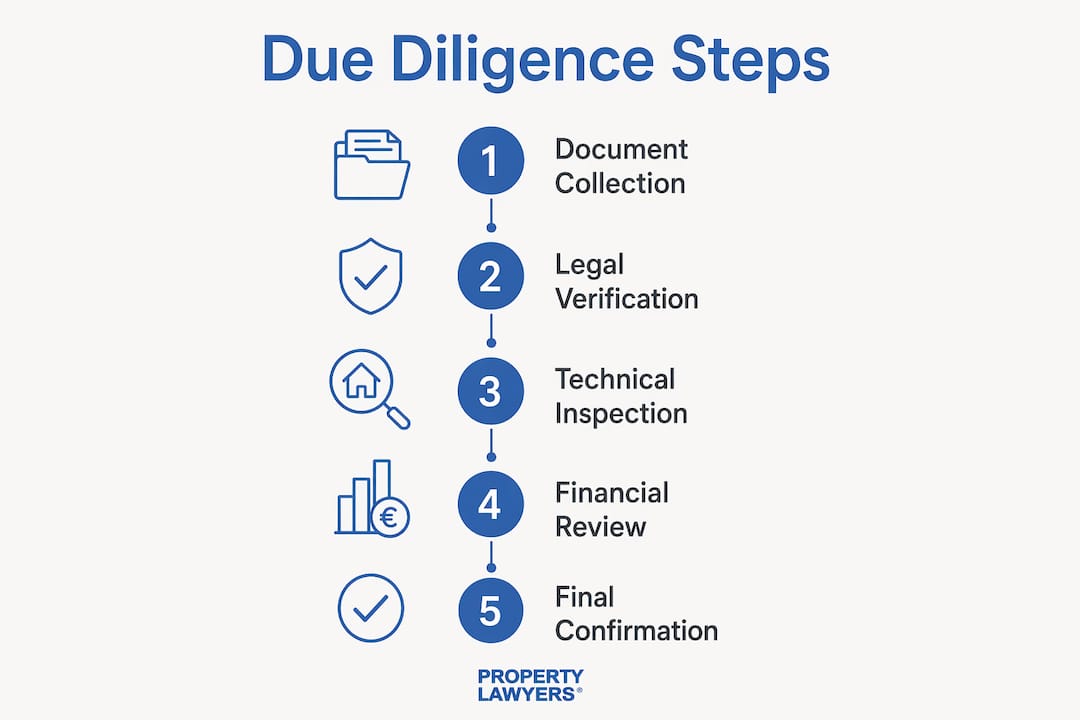
The buyer due diligence process follows a clear sequence of steps. Understanding this sequence helps you avoid the most common pitfall: paying a deposit before checks are complete.
- Step 1: Instruct an independent lawyer. Before viewing properties or making any offer, appoint an independent Spanish property lawyer (abogado) who acts solely in your interest. Estate agents and notaries do not perform impartial legal audits. The notary’s role is to authenticate the deed, not to protect your interests.
- Step 2: Obtain the Nota Simple. Your lawyer requests the Nota Simple from the Land Registry. This is the starting point for all further checks and confirms who legally owns the property and what charges are registered against it.
- Step 3: Request all supporting documents. Your lawyer requests IBI receipts, the community fee certificate, building licences, the First Occupancy Licence, and the energy performance certificate from the seller.
- Step 4: Verify with Town Hall and Cadastre. Confirming urban planning compliance requires direct contact with the local Town Hall. Your lawyer checks for any planning infringements, administrative sanctions, or demolition orders that do not appear in the Land Registry.
- Step 5: Review community statutes and minutes. Your lawyer reviews the community’s governing documents and recent meeting minutes for pending costs or rental restrictions.
- Step 6: Sign the reservation contract only after checks are complete. The reservation contract commits you to the purchase and typically involves a non-refundable deposit. Never sign before your lawyer confirms all checks are satisfactory.
- Step 7: Grant power of attorney if purchasing remotely. Many international buyers in Mallorca, Ibiza, or the Costa del Sol purchase without being present in Spain throughout the process. A notarised power of attorney allows your lawyer to act on your behalf at every stage, including signing the deed.
The role of an independent abogado is central to this entire process. Your lawyer coordinates all document requests, communicates with the Town Hall, reviews contracts, and manages the timeline. Relying on the seller’s lawyer or the estate agent’s recommended solicitor creates a conflict of interest that can leave your interests unprotected.
What risks does due diligence protect against in Spain?
Rushing or skipping due diligence leads to the most common and expensive mistakes international buyers make in Spain. The risks are concrete and financially serious.
- Inherited community fee debts. Under the Ley de Propiedad Horizontal, unpaid community fees from the current year and the three preceding years transfer automatically to the new owner. These debts can amount to thousands of euros.
- Unpaid IBI property taxes. Unpaid IBI creates a legal charge against the property. The new owner becomes liable for these arrears immediately upon completion.
- Title encumbrances and embargoes. A property may carry a registered mortgage, a court embargo, or a charge in favour of a creditor. These do not disappear on sale unless formally discharged. The Nota Simple reveals these, but only if your lawyer requests and reviews it before signing.
- Planning breaches and unlicensed construction. Extensions, terraces, or outbuildings built without planning permission create serious legal exposure. Town Halls can issue demolition orders for unlicensed structures, and the cost falls on the owner at the time the order is enforced.
- Missing First Occupancy Licence. Without this licence, utility companies may refuse to connect water, electricity, or gas. The property cannot be legally occupied, and resale becomes extremely difficult.
- Lost deposits on off-plan purchases. Without a valid bank guarantee under Ley 57/1968, stage payments made to a developer who subsequently becomes insolvent are at total risk of loss.
“Spanish real estate law places the burden of proof primarily on the buyer. Without specialist lawyer review, buyers risk inheriting encumbrances, missing licences, or construction irregularities that become permanent liabilities the moment contracts are signed.”
The practical consequences of skipping due diligence are severe. A buyer who purchases a property in the Costa del Sol without checking the Town Hall records may discover, months later, that an extension was built without permission and a demolition order is pending. A buyer who pays stage payments to an off-plan developer without a bank guarantee may lose those funds entirely if the project collapses. These are not hypothetical scenarios. They are documented outcomes that independent legal teams encounter regularly.
What practical tips help international buyers conduct effective due diligence?
Effective real estate due diligence in Spain requires preparation, the right professional support, and a clear understanding of the timeline. The following practices protect buyers at every stage.
- Appoint an independent lawyer before making any offer. Your lawyer must act exclusively for you. Avoid using a solicitor recommended by the estate agent or the developer, as their primary loyalty may not be to your interests.
- Never pay a deposit before due diligence is complete. Buyer due diligence must be completed before signing any reservation contract or paying any deposit. Once a deposit is paid, your negotiating position weakens significantly.
- Request all certificates officially. Ask your lawyer to obtain documents directly from the Land Registry, the Cadastre, the Town Hall, and the community administrator. Do not accept photocopies or verbal assurances from the seller or agent.
- Confirm bank guarantees in writing before any off-plan payment. The guarantee document must name you as the beneficiary and cover the specific payment being made. Verbal promises from developers carry no legal weight.
- Understand the timeline and resist pressure. Sellers and agents sometimes create urgency to push buyers into signing quickly. A thorough due diligence process takes time. Resist any pressure to proceed before your lawyer confirms everything is in order.
- Use a power of attorney for remote purchases. If you cannot be present in Spain throughout the process, a notarised power of attorney allows your lawyer to act on your behalf. This is standard practice for international buyers and does not reduce your legal protection.
Pro Tip: Ask your lawyer to provide a written summary of all due diligence findings before you sign anything. This creates a clear record of what was checked, what was found, and what conditions were placed on the purchase.
Understanding property taxes in Spain is also part of effective due diligence. Buyers must budget for transfer tax, stamp duty, notary fees, and Land Registry costs in addition to the purchase price. Your lawyer should provide a full cost breakdown before you commit.
Key takeaways
Buyer due diligence in Spain is the non-negotiable legal and technical verification process that protects international buyers from inheriting debts, encumbrances, and planning liabilities before any contract is signed.
| Point | Details |
|---|---|
| Complete checks before any deposit | Never sign a reservation contract or pay funds until your lawyer confirms all checks are satisfactory. |
| Nota Simple is the starting point | This Land Registry extract confirms ownership and all registered charges; obtain it before any other step. |
| Community fees follow the property | Under Ley de Propiedad Horizontal, buyers inherit unpaid fees for the current year plus three prior years. |
| Off-plan requires a bank guarantee | Ley 57/1968 mandates a bank guarantee or insurance for all stage payments; no guarantee means no safe deposit. |
| Independent lawyers are essential | Estate agents and notaries do not conduct impartial legal audits; only an independent abogado protects your interests. |
What I have learned from watching buyers get this wrong
After years of observing international property transactions in Spain, the pattern is consistent. Buyers who run into serious problems almost always made one of two mistakes. They either paid a deposit before their lawyer had completed checks, or they used a lawyer recommended by the seller’s agent.
The second mistake is subtler and more dangerous. An agent-recommended solicitor may be perfectly competent, but their relationship with the agent creates a structural conflict of interest. I have seen buyers discover, after completion, that the property had an unregistered mortgage or an unlicensed extension because their lawyer did not push hard enough on the checks. An independent lawyer with no relationship to the seller or agent has every incentive to find problems before you commit.
Off-plan due diligence is consistently underestimated. Buyers focus on the show apartment and the developer’s brochure. They do not focus on whether the building licence exists, whether the bank guarantee is correctly structured, or whether the developer has a track record of delivering on time. These are the checks that matter most when buying something that does not yet exist.
The buyers who navigate Spain’s property market successfully share one characteristic. They treat due diligence as a non-negotiable condition of purchase, not as an administrative formality. They appoint their lawyer first, they wait for the full report, and they walk away from deals that do not pass the legal test. That discipline protects them from the costly mistakes that others make.
— Sophie
How Property-lawyers supports international buyers through due diligence
Completing a thorough buyer due diligence process in Spain requires specialist legal knowledge and local expertise. Property-lawyers connects international buyers with trusted, independent Spanish property lawyers who conduct the full range of checks: ownership verification, title searches, community fee and IBI confirmation, planning and licence reviews, and developer guarantee verification for off-plan purchases.

Every lawyer in the Property-lawyers directory acts exclusively for the buyer, with no ties to sellers, developers, or estate agents. Whether you are buying a resale apartment in Málaga or an off-plan villa in Ibiza, you can find an English-speaking property lawyer through Property-lawyers who will guide you through every step of the due diligence process. You should also review your property purchase tax obligations before signing anything, as these costs form part of your total financial commitment.
FAQ
What is buyer due diligence in Spain?
Buyer due diligence in Spain is the legal and technical verification process completed before signing any contract or paying a deposit. It confirms ownership, clear title, payment of taxes and community fees, and compliance with planning and building licences.
When should due diligence be completed in Spain?
Due diligence must be completed before signing a reservation contract or paying any deposit. Paying funds before checks are finished significantly weakens your legal position and financial protection.
What documents are needed for due diligence on a resale property?
The core documents are the Nota Simple, community fee certificate, IBI tax receipts, building licence, and First Occupancy Licence. Your lawyer obtains these from the Land Registry, the community administrator, and the local Town Hall.
What protects off-plan buyers in Spain?
Ley 57/1968 requires developers to provide a bank guarantee or insurance policy covering all stage payments made by the buyer. Without this guarantee, deposits are at total risk if the developer becomes insolvent or the project fails.
Do I need a lawyer for due diligence in Spain?
Yes. Spanish real estate law places the burden of proof on the buyer, and only an independent abogado conducts a full, impartial legal audit. Estate agents and notaries do not perform this function and do not act exclusively in your interest.
Recommended
- Property law in Spain: a 2026 guide for buyers
- Spanish real estate law: a buyer’s guide for 2026
- How the Spanish property market works in 2026
- Spanish property purchase process: a guide for buyers

Sophie Gutenberg is a legal content specialist focused on Spanish property law, real estate transactions, conveyancing, due diligence and tax issues affecting international property buyers in Spain. She works alongside qualified Spanish property lawyers .
