

Jointly owned property in Spain: guide for international buyers
If you co-own property in Spain, the most important thing to understand is this: any co-owner can force a sale at any time. Under Spanish law, almost all joint ownership is held as pro indiviso, meaning each person owns a defined percentage share of the whole property. Unlike the joint tenancy model familiar to UK buyers, there is no automatic right of survivorship. If your co-owner dies, their share passes to their heirs, not to you.
That single fact changes everything about how you should plan, document, and protect your interest.
Act now if any of the following apply to you:
- You co-own a Spanish property with an unmarried partner and have no Spanish will
- A co-owner has died and you are unsure what happens to their share
- A co-owner wants to sell and you do not, or vice versa
- You are about to buy jointly and have not yet agreed how decisions will be made
Your immediate two-step checklist:
- Locate your escritura (title deed) and request a Nota Simple from the Registro de la Propiedad to confirm ownership percentages and any charges or mortgages registered against the property.
- Instruct an English-speaking Spanish property lawyer and, if you are not already resident in Spain, arrange a power of attorney so decisions can be made on your behalf remotely.
Do not: sign any document transferring or waiving your share without independent legal advice. Do not assume your partner will automatically inherit your share. Do not delay if a co-owner is in financial difficulty, as creditors can pursue a share of jointly owned property.
Table of Contents
- How is joint ownership structured in Spain?
- What rights and obligations do co-owners have?
- How to end co-ownership when everyone agrees
- What happens when co-owners cannot agree?
- Why mediation should come before court
- What happens to jointly owned property when an owner dies?
- Tax and costs when transferring or selling jointly owned property
- Practical checklist for co-owners in Spain
- Which ownership structure works best for international buyers?
- Key takeaways
- The trap most international buyers miss
- Find a vetted Spanish property lawyer through Property-lawyers
- Useful sources and further reading
- FAQ
How is joint ownership structured in Spain?
The Spanish Civil Code (Articles 392–406) governs co-ownership and sets out three main ways property is held jointly.
Pro indiviso (tenancy in common)
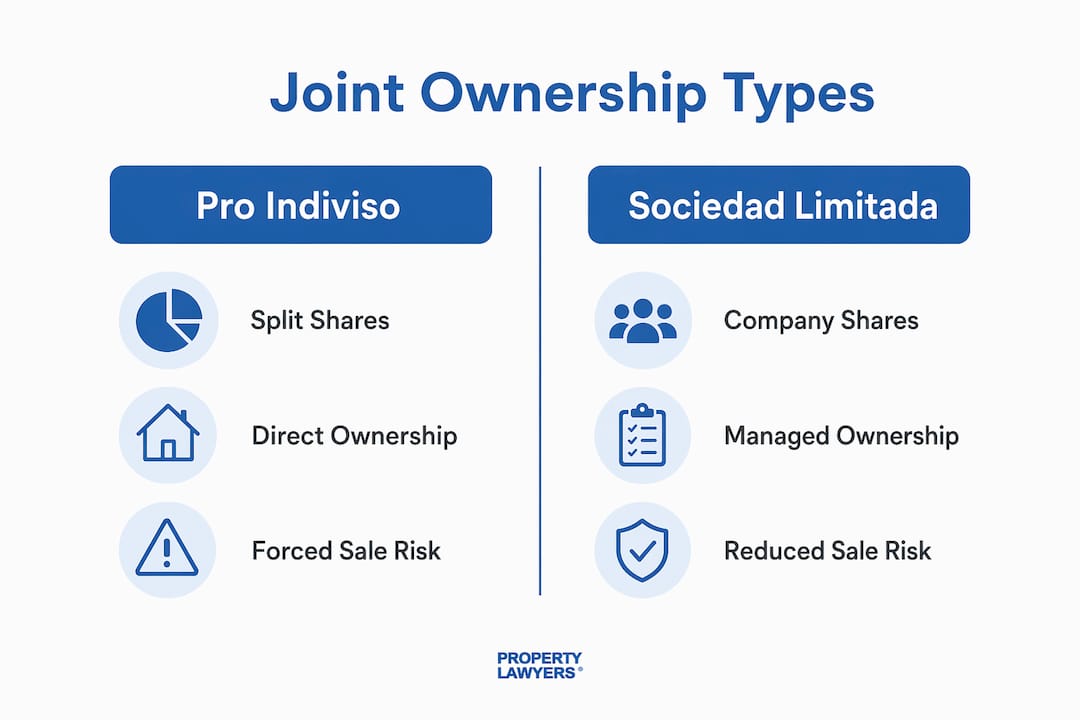
This is by far the most common structure. Each owner holds a legally recorded percentage, typically 50/50 but any split is valid (60/40, 70/30, and so on). That percentage appears in the escritura and the land registry. No owner has exclusive rights over a specific part of the building; each owns a fraction of the whole. Crucially, any co-owner can demand judicial division at any time under Article 400, and for an indivisible asset like a house, that usually means a court-ordered sale.

Ownership via a Sociedad Limitada (SL)
Some buyers, particularly those purchasing investment or holiday properties, hold the asset through a Spanish limited company. The SL owns the property; the buyers own shares in the SL. This changes the mechanics considerably: transferring an interest means selling company shares rather than registering a property transfer, which can simplify exits and reduce forced-sale risk. The trade-off is corporate compliance, annual filing obligations, and different tax treatment. Company-owned residential properties cannot benefit from personal residence tax exemptions, so this route suits portfolios and commercial assets more than primary homes.
Matrimonial property regimes
If you are married, your matrimonial regime affects what you actually own. The default in Spain is gananciales (community of gains): assets bought during the marriage with marital funds belong equally to both spouses, regardless of whose name is on the deed. Many UK couples, however, are married under separación de bienes (separation of assets), which is the default in Catalonia and the Balearic Islands and is also common for international couples. Under this regime, each spouse owns their assets independently, and joint purchases are registered as pro indiviso with defined shares. Check your matrimonial property regime before you buy, and make sure the notary records it correctly in the deed.
| Ownership structure | How shares are held | Forced-sale risk | Best suited for |
|---|---|---|---|
| Pro indiviso | Defined % in escritura and land registry | High — any co-owner can trigger acción de división | Couples, friends, family buying together |
| Gananciales | 50/50 by operation of marriage law | Lower during marriage; rises on death or divorce | Couples married under Spanish default regime |
| Separación de bienes | Each spouse owns independently; joint purchases as pro indiviso | As per pro indiviso | International couples, second marriages |
| Sociedad Limitada (SL) | Owners hold company shares; SL holds title | Low — no acción de división on property itself | Investment portfolios, holiday properties, larger groups |
What rights and obligations do co-owners have?
Co-ownership under pro indiviso gives you real legal rights, but it also comes with obligations that can create friction if they are not managed carefully from the start.
Your rights as a co-owner:
- Use and enjoy the whole property in proportion to your share
- Receive a proportionate share of any rental income
- Sell, mortgage, or gift your share independently (though other co-owners have a pre-emption right to match any offer)
- Request the judicial dissolution of co-ownership at any time
Your obligations:
- Contribute to IBI (local property tax), community charges, insurance, and maintenance costs in proportion to your share
- Obtain the consent of all co-owners for major decisions: selling the whole property, significant renovations, or mortgaging
- Inform co-owners before selling your share to a third party
The practical risks are significant. If one co-owner stops paying their share of costs, the others remain jointly and severally liable to third parties such as the community of owners. If a co-owner faces financial difficulty, creditors may pursue their share of the property. Decision deadlocks over usage, renovation, or rental are among the most common sources of disputes between co-owners.
Pro Tip: Draft a short private co-ownership agreement at the point of purchase. It costs relatively little and should cover: how costs are split, who can use the property and when, what happens if one owner wants to sell, and how disputes will be resolved. This document is not registered at the land registry but is legally binding between the parties and can prevent years of conflict.

How to end co-ownership when everyone agrees
When all co-owners are willing, the cleanest route is an Extinción de Condominio: a notarial deed that formally dissolves the shared ownership. This is the standard mechanism used in separations and buy-outs, and it is generally more tax-efficient than a standard property sale.
Step-by-step process for a consensual buy-out:
- Agree a valuation of the property (an independent surveyor’s report is advisable).
- Establish whether there is a mortgage and whether the lender will consent to a transfer or require the loan to be restructured.
- Instruct a Spanish notary to prepare the Extinción de Condominio deed.
- Sign the deed before the notary (or via a power of attorney if you are not in Spain).
- Register the updated title at the Registro de la Propiedad.
- File the relevant tax returns within the required deadlines.
Costs to budget for:
- Notary fees (scale-based on the declared value)
- Land registry fees
- Legal fees for your lawyer
- Stamp Duty (Actos Jurídicos Documentados, AJD): payable by the person acquiring full ownership; the transaction is generally exempt from Property Transfer Tax (ITP) when it is a true dissolution rather than a sale of a share
- Regional variations apply: for example, the Junta de Andalucía publishes guidance on administrative formalisation charges, which in some circumstances are around 1.2%
If you are based in the UK and cannot travel to Spain to sign, a power of attorney allows your lawyer to act on your behalf. An English-speaking Spanish lawyer is particularly valuable here, both for translating documents and for ensuring the deed is correctly structured for your tax position.
What happens when co-owners cannot agree?
If one co-owner wants out and the others refuse to buy them out or agree a sale, Spanish law gives that person a powerful remedy. Article 400 of the Spanish Civil Code grants any co-owner the right to demand dissolution of co-ownership at any time. This is the acción de división de la cosa común.
How the judicial process works:
- The co-owner files a claim in the Spanish civil courts
- The court appoints an expert to value the property
- If the property can be physically divided (rare for residential homes), the court may order division
- For indivisible assets, the court will typically order a public auction or a forced sale, with proceeds distributed according to ownership shares
- The remaining co-owners have no veto over this process
What to expect in practice:
- Litigation in Spain can take one to three years, depending on the region and court workload
- Legal fees, court fees, and expert valuation costs all fall on the parties (usually shared)
- The final sale price at auction is often below open-market value
- While proceedings are ongoing, you can apply for provisional measures to prevent the property being damaged or encumbered
The threat of an acción de división is often enough to bring reluctant co-owners to the negotiating table. Many disputes settle during proceedings once the costs and timelines become clear.
Why mediation should come before court
Spain has placed increasing emphasis on resolving property disputes through mediation before resorting to litigation, and practitioners consistently report that mediated settlements are faster, cheaper, and less damaging to relationships than court proceedings.
The practical case for mediation:
- A mediated agreement can be reached in weeks rather than years
- Costs are a fraction of full litigation
- Both parties retain control over the outcome rather than leaving it to a judge
- Proceedings are confidential, which matters when family relationships are involved
- A settlement can be tailored to the specific situation (for example, a phased buy-out or a rental arrangement while a sale is prepared)
Mediation is less suitable when one party needs urgent protective measures, such as a freezing order to prevent a co-owner disposing of assets, or when insolvency proceedings are already underway. In those cases, court action may be unavoidable from the outset.
Pro Tip: If you reach a mediated settlement, record the terms in a notarial deed rather than a private agreement. A notarial deed is directly enforceable without further court proceedings if one party later fails to comply.
What happens to jointly owned property when an owner dies?
This is where the difference between Spanish and UK law catches many international buyers off guard. Spain does not recognise joint tenancy with automatic survivorship. Under pro indiviso, a deceased owner’s share forms part of their estate and passes according to their will or, if there is no will, the applicable succession law.
The key risks for surviving co-owners:
- Heirs of the deceased (children, parents, siblings) become co-owners alongside you
- Those heirs can immediately demand a forced sale under Article 400
- An unmarried surviving partner has no automatic right to buy out the heirs and no veto over the process
- Without a Spanish will, the deceased’s share is distributed under intestacy rules, which may not reflect their wishes
Usufruct as a planning tool
A Spanish will can grant the surviving partner a usufruct (usufructo): the right to live in and use the property for their lifetime, while the underlying ownership passes to the heirs. This means the heirs cannot force the survivor out or demand a sale while the usufruct exists. It is a powerful protection, but it must be explicitly granted in a valid will. It does not arise automatically.
Immediate steps when a co-owner dies:
- Obtain the death certificate and have it officially translated if needed
- Instruct a Spanish lawyer to advise on the applicable succession law (EU Regulation 650/2012 allows EU nationals to elect their home country’s law in a will)
- Check the escritura to confirm the deceased’s registered share
- Consider whether a buy-out of the heirs is possible and desirable
- File Spanish inheritance tax (Impuesto sobre Sucesiones y Donaciones) within six months of the date of death
For more detail on succession rules and timelines, the succession and inheritance guide from Property-lawyers covers the process step by step.
Tax and costs when transferring or selling jointly owned property
Tax is one of the areas where co-owners most often get caught out, particularly non-residents who are unaware of Spain’s specific rules.
Capital Gains Tax (CGT)
Each co-owner is taxed on their own share of any gain arising from a sale. If you own 50% and the property has risen in value, you pay CGT on 50% of the gain. Reliefs and exemptions apply on a per-owner basis. Non-residents pay at a flat rate on their gain; residents may benefit from principal private residence relief. The rules differ, so always confirm your position with a tax adviser before completing a sale.
Transfer taxes and stamp duty
- Extinción de Condominio (consensual dissolution): generally subject to AJD (stamp duty) rather than ITP (transfer tax), which is more favourable
- Sale of a share to a third party: subject to ITP, not AJD
- Inheritance: subject to Impuesto sobre Sucesiones y Donaciones (ISD); rates and allowances vary significantly by region
Ongoing costs for co-owners
- IBI (local property tax): split by ownership share
- Community of owners fees: split by share
- Insurance: typically shared
- Rental income tax: if the property is let, each owner declares their proportionate share of income; non-residents pay a flat rate on gross rental income
Tax warning: Non-residents face different rates and fewer reliefs than Spanish residents. Regional rules vary considerably, particularly for inheritance tax. Andalusia, for example, offers a €1 million per-person allowance for Group I and II heirs (children and spouses), but unmarried partners without a registered civil partnership receive only the minimal national allowance of €15,956.87. Always take local tax advice before any transfer or sale.
Practical checklist for co-owners in Spain
Whether you are buying jointly, already co-own a property, or are dealing with a dispute or a death, the following steps will help you prepare and protect your position.
Documents to gather:
- Escritura (title deed): confirms ownership percentages and any conditions
- Nota Simple from the Registro de la Propiedad: shows current title, charges, and mortgages
- Mortgage documents (if applicable)
- Community of owners accounts and recent IBI bills
- Any existing private co-ownership agreement
Who to instruct:
- An English-speaking Spanish property lawyer: your first call for any ownership, dispute, or succession question
- A Spanish tax adviser: for CGT, ISD, and rental income obligations
- A notary: for any deed of transfer, dissolution, or will
- A POA holder in Spain: if you are based in the UK and need someone to act on your behalf
Questions to ask your lawyer:
- What ownership regime applies to my property and what are the risks?
- If a co-owner dies or wants to sell, what are my options?
- What taxes will I pay on a transfer or sale?
- Should I make a Spanish will, and should I consider a co-ownership agreement or SL structure?
- What is the realistic timeline and cost if we need to go to court?
If a dispute or death occurs:
- Do not sign anything without legal advice
- Secure access to the property and any rental income
- Instruct a lawyer before communicating formally with other co-owners or their heirs
- Check whether mediation is appropriate before filing any court claim
Which ownership structure works best for international buyers?
There is no single right answer, but three options cover most situations for UK nationals and other international buyers.
Option 1: Pro indiviso with a private co-ownership agreement
The simplest and lowest-cost route. You hold defined shares in the escritura and supplement this with a private agreement covering usage, cost-sharing, and exit mechanics. This works well for couples and small groups who trust each other and want a straightforward structure. The risk is that the agreement is not registered and does not eliminate the right of any co-owner to demand judicial division.
Option 2: Sociedad Limitada (SL)
The SL holds the property; the buyers hold company shares. Transferring an interest means selling shares rather than registering a property transfer, which is administratively simpler and eliminates the acción de división risk on the property itself. The SL structure suits investment properties, larger groups, and situations where regular changes of ownership are anticipated. The costs include annual accounts, corporate tax filings, and potentially higher ongoing tax obligations. For more detail, the holding company guide from Property-lawyers sets out the tax implications clearly.
Option 3: Managed co-ownership via a specialist SL
A specialist company acquires the property, divides it into shares (often eighths), and manages the asset professionally. Co-owners hold SL shares and have defined usage rights. This model removes day-to-day management burden and reduces forced-sale risk, but you are dependent on the management company’s quality and financial stability. It suits buyers who want a holiday property without operational responsibility.
| Structure | Cost to set up | Forced-sale risk | Tax complexity | Best for |
|---|---|---|---|---|
| Pro indiviso + agreement | Low | High | Low | Couples, small trusted groups |
| Sociedad Limitada (SL) | Medium | Low | Medium-high | Investment properties, larger groups |
| Managed co-ownership SL | Low (share price) | Very low | Medium | Holiday buyers, passive investors |
Key takeaways
Joint ownership in Spain requires a Spanish will, a clear co-ownership agreement, and an English-speaking lawyer to protect your interest against forced sale or inheritance loss.
| Point | Details |
|---|---|
| Pro indiviso is the default | All joint ownership in Spain is pro indiviso; any co-owner can force a sale under Article 400 of the Spanish Civil Code. |
| No automatic survivorship | A deceased owner’s share passes to their heirs, not the surviving co-owner, without a Spanish will in place. |
| A Spanish will is non-negotiable | Without one, unmarried partners receive no automatic inheritance rights and may face significantly higher inheritance tax. |
| Mediation before court | A mediated settlement is typically faster and cheaper than litigation; record any agreement in a notarial deed. |
| Property-lawyers connects you to help | Property-lawyers matches international buyers with vetted, English-speaking Spanish property lawyers across Marbella, Mallorca, Ibiza, Málaga, and Barcelona. |
The trap most international buyers miss
The most common mistake I see in jointly owned property situations in Spain is not the ownership structure itself. It is the assumption that Spanish law will behave like UK law when something goes wrong.
UK buyers are accustomed to joint tenancy, where a surviving partner automatically inherits. They are used to a legal system that gives courts discretion to adjust property rights on divorce or death. Spain offers none of that flexibility by default. Pro indiviso is a rigid, mathematically precise regime: your share is your share, and when you die, it goes where your will says, or where the law sends it.
The buyers who avoid serious problems are those who treat the legal structure as part of the purchase decision, not an afterthought. A Spanish will, a co-ownership agreement, and a clear understanding of your matrimonial regime cost a fraction of what a contested acción de división will cost in legal fees, stress, and lost time. The buyers who end up in court are almost always those who assumed it would never happen to them.
If you are unsure about your current position, the first step is straightforward: check your escritura, get a Nota Simple, and speak to a Spanish property lawyer before any dispute or death forces the issue.
Find a vetted Spanish property lawyer through Property-lawyers
Getting the right legal advice on jointly owned property in Spain is not about finding any lawyer. It is about finding one who understands your situation as an international buyer, speaks your language, and knows the regional rules in the area where your property sits.
Property-lawyers is Spain’s leading directory for international buyers seeking independent, English-speaking property lawyers. Whether your property is in Marbella, Mallorca, Ibiza, Málaga, or Barcelona, you can search by region, view vetted lawyer profiles, and make contact directly. Every lawyer listed has been independently assessed for their experience with international clients and Spanish property law.
How it works:
- Search by region or city on property-lawyers.com
- View profiles, areas of expertise, and languages spoken
- Contact your chosen lawyer directly to arrange an initial consultation
- Get clear guidance on fees and next steps before committing
For co-ownership disputes, inheritance questions, or buying jointly in Spain, the right lawyer makes the difference between a clean resolution and years of costly litigation. Find your Spanish property lawyer today.
Useful sources and further reading
- Spanish Civil Code, Articles 392–406 and Article 400 (BOE): the primary legal framework for co-ownership and dissolution rights
- Junta de Andalucía — regional tax and administrative guidance: regional transfer tax and formalisation charges
- Succession and inheritance in Spain: Property-lawyers guide to probate and succession rules
- Spanish inheritance tax and wills for foreign owners: practical guidance on making a Spanish will and inheritance tax obligations
- Capital Gains Tax in Spain for non-residents: detailed CGT rules for non-resident sellers
- Holding company for property in Spain: SL structures, tax benefits, and risks explained
FAQ
What happens to jointly owned property when someone dies in Spain?
Under pro indiviso, the deceased’s share does not pass automatically to the surviving co-owner. It forms part of their estate and is distributed according to their will or, if there is no will, Spanish intestacy law. The heirs become co-owners and can legally demand a forced sale.
Who pays Capital Gains Tax on jointly owned property in Spain?
Each co-owner is taxed on their own share of the gain. If you own 50% of a property, you pay CGT on 50% of the profit from the sale. Non-residents pay at a flat rate; residents may qualify for principal private residence relief.
What are the main disadvantages of joint property ownership in Spain?
Any co-owner can force a sale through the courts at any time, there is no automatic right of survivorship, and decision deadlocks over use, maintenance, or sale are common. Unmarried partners are particularly exposed without a Spanish will.
Can a co-owner be forced to sell their share of a Spanish property?
Not directly, but any co-owner can bring an acción de división, which for an indivisible property like a house typically results in a court-ordered sale of the whole property, with proceeds split by ownership share.
Does making a Spanish will protect a surviving co-owner?
Yes, significantly. A Spanish will can leave your share directly to your partner and can also grant them a usufruct, giving them the right to live in the property for their lifetime even if the underlying ownership passes to your children or other heirs.
This article provides general information about Spanish property law and is not legal or tax advice. Rules and rates vary by region and individual circumstance. Always confirm your position with a qualified Spanish property lawyer and tax adviser before making any decision.
Recommended
- Spanish real estate law: a buyer’s guide for 2026
- Property law in Spain: a 2026 guide for buyers
- Property Taxes in Spain — Full Guide for Foreign Owners (2026) | Property Lawyers
- Spanish foreign investment property rules explained

Sophie Gutenberg is a legal content specialist focused on Spanish property law, real estate transactions, conveyancing, due diligence and tax issues affecting international property buyers in Spain. She works alongside qualified Spanish property lawyers .
