

Spanish inheritance law: what property owners need to know
If you own property in Spain, or plan to inherit it, two separate legal questions decide what happens next: which country’s succession law controls who inherits, and who pays Spanish inheritance tax. For most foreign owners, the law of their habitual residence governs succession by default under EU Regulation 650/2012 (Brussels IV), while Spain’s inheritance and gift tax rules under Law 29/1987 apply to the property itself, administered either by the Spanish tax authority, AEAT, or by the relevant autonomous community.
Those two threads run in parallel and buyers frequently confuse them. Succession law decides who the legal heirs are and how much they’re entitled to. Tax law decides what those heirs owe once they inherit. Get either one wrong, and you can end up with an outcome you never intended, or a tax bill far higher than it needed to be.
- Which law usually governs: the deceased’s country of habitual residence, unless a Spanish will names a different nationality’s law (professio juris).
- Who files and when: heirs file Modelo 650, 651 or 655 within six months of death.
- Regional reliefs matter: in places like Madrid, the effective bill for a spouse or child can fall close to zero.
Pro Tip: Don’t wait for a death in the family to check which law applies to your Spanish property. A five-minute conversation with a Spanish lawyer when you buy can save your heirs months of delay later.
Key Takeaways
Spanish succession law and Spanish inheritance tax are separate systems, and getting professio juris and regional ISD reliefs right is what actually protects your heirs.
| Point | Details |
|---|---|
| Habitual residence governs by default | Under Brussels IV, your home country’s succession law applies unless a Spanish will elects your national law instead. |
| Six-month filing deadline | Heirs must file Modelo 650 (or 651 for gifts, within 30 working days) within six months of death. |
| Regional reliefs vary enormously | Madrid and Andalusia can reduce the bill for close relatives close to zero; other regions are less generous. |
| A Spanish will speeds everything up | Limiting a will to Spanish assets avoids cross-revocation risk and cuts probate delays significantly. |
| Get local advice early | Property-lawyers.com connects buyers and heirs with vetted, English-speaking Spanish lawyers by region. |
Table of Contents
- How does inheritance law in Spain affect foreign property owners?
- What inheritance tax and other costs apply to Spanish property?
- What steps do heirs need to take after a death?
- How can foreign owners plan ahead and avoid costly mistakes?
- When should you hire a Spanish property lawyer?
- What framework governs inheritance law more broadly?
- How does succession work without a will?
- How are wills validated and processed?
- What protections exist for spouses and children?
- How are inheritance disputes resolved?
- How Property-lawyers.com helps with Spanish inheritance matters
- Sources
- FAQ
How does inheritance law in Spain affect foreign property owners?
Succession and tax are decided by different rules, and confusing the two is the single most common mistake foreign owners make. Brussels IV sets the default: whoever’s estate is being settled, the law of their last habitual residence applies to the whole succession, including property sitting in Spain. If a British retiree living permanently in Málaga dies without a will, Spanish succession law, including its forced heirship rules, applies to their Spanish house even though they hold a British passport.
That default can be overridden. EU nationals, and in practice many non-EU nationals too, can insert a professio juris clause into a Spanish will, expressly choosing the law of their nationality to govern their estate instead. This single clause is often the difference between rigid Spanish forced heirship, which reserves fixed portions of an estate for children, and the far more flexible testamentary freedom found in English or Welsh law, where you can leave your estate to whoever you choose.
For non-EU nationals, including British citizens after Brexit, the same choice-of-law mechanism generally still applies, because Brussels IV is not conditional on EU citizenship, only on the deceased’s connection to a participating state’s courts. The practical advice stays constant: draft a Spanish will limited to Spanish assets, and word it carefully so it doesn’t accidentally revoke your will at home.
- English law: testamentary freedom, you choose your heirs.
- Spanish law (no election): forced heirship, children typically reserve two thirds of the estate.
Pro Tip: Two wills, properly drafted, beat one will trying to cover two countries. Ask your lawyer to confirm the Spanish will references, rather than cancels, your home country will.
What inheritance tax and other costs apply to Spanish property?
Spain’s Inheritance and Gift Tax, known as ISD, taxes the person receiving the property, not the estate itself, and it applies to any Spanish-located asset regardless of where the heir lives. A daughter in Toronto inheriting her late mother’s Marbella apartment still owes Spanish ISD on that property, even though she’s never paid Spanish tax before.
Three forms cover the main scenarios: Modelo 650 for inheritances, 651 for lifetime gifts, and 655 for the extinction of usufruct (when a life interest ends and full ownership passes to the remainder beneficiary). Inheritance filings are due within six months of death, with a possible extension to twelve months if you apply early enough; gift tax filings must be made within just 30 working days, a far tighter window that catches people out. Miss the deadline and interest and surcharges start accruing.
Where the tax gets administered, and how much relief is available, depends heavily on the autonomous community where the property sits:
| Region | Typical relief for spouse/children |
|---|---|
| Madrid | Very large rebate on the tax due |
| Andalusia | Reductions that can significantly lower the bill |
| Valencia | Allowances, generally less generous than Madrid |
| Catalonia | Moderate reductions |
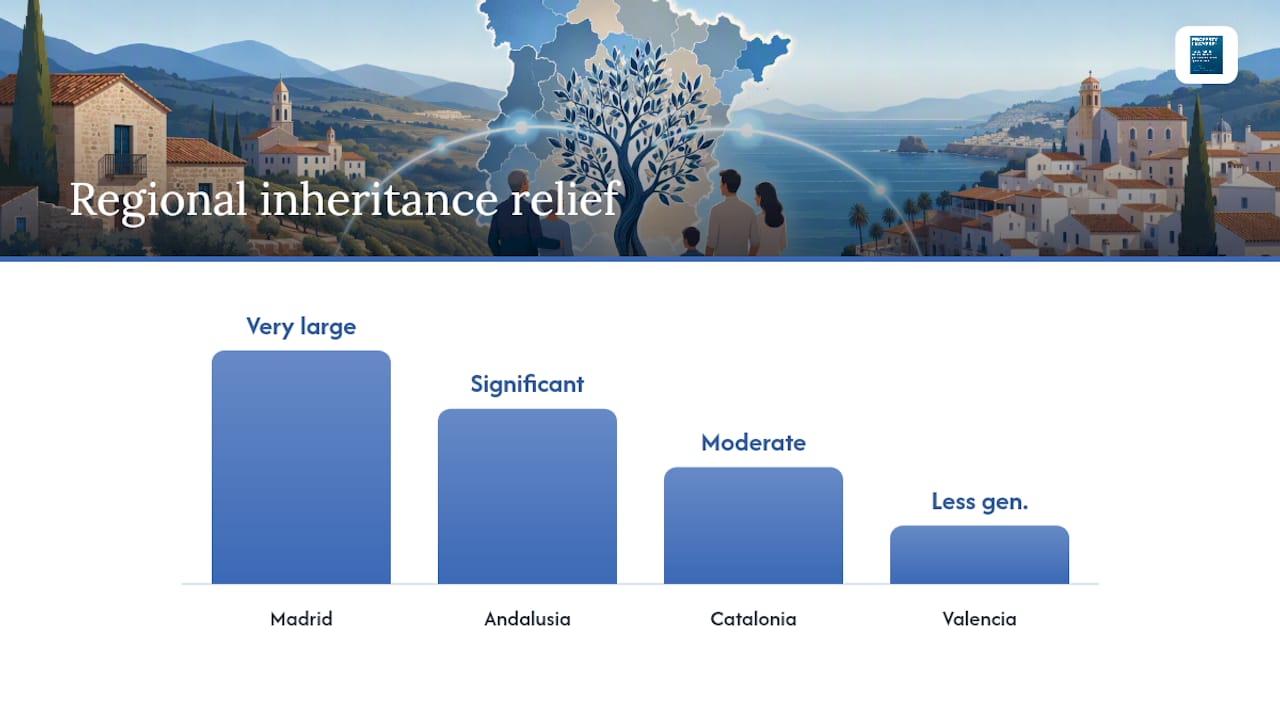
Following CJEU and Spanish court rulings, non-resident heirs can now claim the same regional bonificaciones as residents, a right that didn’t always exist and still surprises some overseas heirs.
Beyond ISD, budget for a professional valuation, notary fees for the deed of acceptance, Property Registry fees, and plusvalía municipal, a separate local tax on the increase in land value since the last transfer. None of these are optional extras; they’re routine parts of transferring inherited Spanish property.
What steps do heirs need to take after a death?
Losing a family member is difficult enough without a foreign legal system to navigate. This checklist follows the order most Spanish lawyers use with international clients.
- Obtain the death certificate and have it apostilled for use in Spain.
- Locate the will (Spanish and/or foreign) or, if none exists, begin the declaration of heirs process.
- Contact a Spanish property lawyer to confirm which succession law applies and secure the property if it’s vacant.
- Gather the property deeds, mortgage statements and any prior valuations.
- Instruct a professional valuation of the property for tax purposes.
- Sign the deed of acceptance of inheritance before a Spanish notary.
- File Modelo 650 and pay any ISD due, within the six-month deadline.
- Register the transfer at the Property Registry in the heir’s name.
Every document originating outside Spain, the death certificate, the foreign will, proof of kinship, generally needs an apostille and a sworn Spanish translation, which adds time you should plan for from day one. Full probate for Spanish assets typically takes anywhere from six months to two years depending on the region and whether the estate is contested; instalment payment of ISD is possible in some circumstances if you ask AEAT or the regional tax office early.
Pro Tip: A Spanish will restricted to Spanish assets usually moves through probate faster than relying on a foreign grant of probate, because the notary can work directly from a document already written for the Spanish system.
How can foreign owners plan ahead and avoid costly mistakes?
Good planning here is genuinely simple, it’s just rarely done. Four actions cover most of what matters: draft a Spanish will limited to your Spanish assets, use professio juris to elect your national law if that serves your family better, check how your property is titled (sole owner, joint tenants, or tenants in common changes what happens on the first death), and confirm your region’s ISD regime before you even complete the purchase.
The mistakes are just as predictable:
- Doing nothing, and letting Brussels IV’s default rule decide everything.
- Assuming a foreign will alone is enough to cover Spanish property cleanly.
- Never checking whether the property’s region offers generous bonificaciones.
- Leaving property to a distant relative or friend without realising Groups III and IV heirs face far higher tax rates and smaller allowances than a spouse or child.
- Missing the six-month filing deadline and incurring avoidable surcharges.
Spain has few dedicated inheritance tax treaties with other countries, so a cross-border estate risks being taxed twice, once in Spain and once at home. Relief usually comes as a unilateral credit rather than an automatic exemption, which means coordinated planning between your Spanish and home-country advisers is not optional if your estate spans two jurisdictions.
Forced heirship, usufruct and substitution of heirs are areas where Spanish and home-country expectations differ sharply enough that DIY planning is genuinely risky.
When should you hire a Spanish property lawyer?
Certain moments call for a lawyer rather than a guidebook: buying or selling property, drafting a Spanish will, handling a cross-border succession, resolving a dispute between heirs, or filing ISD and claiming a regional bonificación you’re not certain applies to you.
When choosing one, look for:
- Fluent English and experience working with international clients.
- Regular dealings with Spanish notaries and the Property Registry.
- Working knowledge of Brussels IV and cross-border succession.
- Direct experience filing with AEAT and regional tax offices.
- Verifiable local references and clear, upfront fees.
Pro Tip: Ask a prospective lawyer for one example of a bonificación they’ve successfully claimed for a non-resident client. A vague answer usually means limited experience with foreign estates. Property-lawyers exists precisely to connect international buyers with vetted, English-speaking lawyers who handle exactly these cases.
What framework governs inheritance law more broadly?
Civil law systems like Spain’s build succession around fixed rules of forced heirship, reserved portions for close family that a testator cannot simply override, and Spain’s own regime shares the same underlying logic as much of continental Europe. The core principle is that a portion of every estate, typically two thirds for children under the general Civil Code regime, is protected regardless of what a will says.
This structure exists to protect family continuity, particularly with property, rather than to maximise a testator’s personal freedom. For foreign owners used to common law systems, where a will can leave everything to a single beneficiary or even a charity, this is often the single biggest cultural adjustment. It’s also precisely why the professio juris election matters so much: it lets you opt into a framework built around individual choice instead, where that’s the outcome your family actually wants.
Understanding this framework matters even if your own succession is governed by your home country’s law rather than Spain’s, because it shapes how Spanish notaries, registries and tax offices process every estate that crosses their desks, including yours if no valid election has been made.
How does succession work without a will?
When someone dies without a valid will, intestate succession rules apply a fixed order of heirs: children and descendants first, then parents and ascendants, then the surviving spouse in specific circumstances, then collateral relatives such as siblings. Testamentary succession, by contrast, lets a person direct their estate through a will, subject always to the reserved portions forced heirship protects.
The practical gap between the two is significant. With a will, even a simple one, the testator can specify particular assets to particular people, name guardians, and set out clear instructions that speed up administration considerably. Without one, the notary or court must first establish exactly who the legal heirs are, which can mean tracking down relatives, verifying kinship documentation, and resolving disagreements about entitlement before any property can even be valued.
For a foreign-owned Spanish property, dying intestate almost always means longer delays and higher administrative costs than dying with a will, because establishing heirship from abroad involves apostilled documents, sworn translations and, frequently, additional notarial acts. A will doesn’t remove forced heirship protections, but it does remove most of the guesswork about who inherits what, which is where the real time and cost savings come from.
How are wills validated and processed?
A will is only as useful as its legal validity, and different forms carry different levels of certainty. A notarial will, signed before a notary and recorded in the national registry of wills, is the most secure option: it’s difficult to lose, hard to forge, and simple for a notary to locate after death. Holographic wills, written entirely by hand by the testator, are valid in principle but must go through a court validation process after death, adding time and cost precisely when heirs want speed.
Probate itself begins with locating the will, most reliably through the central wills registry, followed by the formal reading and acceptance of inheritance before a notary. Heirs then need a certificate confirming their status before they can access bank accounts, register property transfers, or otherwise deal with estate assets. Where the estate crosses borders, this process runs alongside whatever probate or grant of representation formalities apply in the deceased’s home country, and the two rarely move at the same pace.
For foreign owners of Spanish property, the practical lesson mirrors the wider guidance in this article: a locally valid, notarised will restricted to local assets removes most of the friction from this stage, letting heirs deal with the property without waiting on a slower foreign probate process to conclude first.
What protections exist for spouses and children?
Reserved portions exist specifically to protect close family, and spouses and children sit at the centre of that protection. Children and other direct descendants are entitled to a fixed share of the estate that a will cannot remove, reflecting the same forced heirship principle that shapes succession law across much of continental Europe. A surviving spouse typically receives a usufruct, a legal right to use and benefit from a portion of the estate, often the marital home, for life, rather than outright ownership of it.

Usufruct is a source of real confusion for foreign owners, because it separates the right to live in and benefit from a property from the underlying legal ownership, which typically passes to the children instead. That split matters enormously if the surviving spouse ever wants to sell, since both the usufruct holder and the underlying owners generally need to agree, or one needs to buy out the other’s interest first.
These protections apply firmly within a purely Spanish succession. Where a foreign national has validly elected their national law through professio juris, their home country’s rules on spousal and child entitlement apply instead, which is exactly why that election matters so much for blended families, second marriages, or anyone whose wishes don’t map neatly onto Spain’s reserved-portion structure.
How are inheritance disputes resolved?
Disputes between heirs are common enough that Spanish courts and notaries have well-established procedures for handling them, but they still add months, sometimes years, to a straightforward transfer. The most frequent flashpoints are disagreements over the validity of a will, disputes about the value assigned to an asset for tax and distribution purposes, and conflicts between a surviving spouse’s usufruct and the underlying owners’ wishes.
Where heirs can’t agree, the matter typically goes before a Spanish civil court, which can rule on the validity of a will, the correct division of an estate, or a challenge to how forced heirship portions have been calculated. Mediation is increasingly used as a first step before litigation, particularly for disputes between siblings over a shared family property, since it’s faster and considerably cheaper than a full court process.
For foreign heirs, the practical risk is usually distance and unfamiliarity rather than the dispute itself. Contesting a valuation or a will’s validity from abroad, without a lawyer already instructed locally, tends to draw matters out far longer than they need to. This is precisely the scenario where instructing a Spanish lawyer early, before a disagreement hardens into a formal dispute, pays for itself many times over.
A short note on what actually reassures international owners
Most of the anxiety I hear from foreign owners about Spanish inheritance turns out to be broader than the reality once someone looks at their specific region and family situation. Regional reliefs, a properly drafted Spanish will, and a handful of correctly filed forms remove the vast majority of risk. A modest planning cost now, one will, one conversation with a lawyer, routinely saves heirs months of delay and a much larger bill later. Check your own region’s rules early, and don’t leave that conversation until it’s urgent.
How Property-lawyers.com helps with Spanish inheritance matters
Property-lawyers.com is a directory built specifically to connect international buyers and heirs with vetted, English-speaking property lawyers across Spain, so you’re never trying to explain forced heirship or ISD deadlines to someone unfamiliar with either.
Whether you need a Spanish will drafted with the right professio juris wording, help filing Modelo 650 before the six-month deadline, or guidance on registering an inherited property once ISD has been paid, the directory lets you search by region and view lawyer profiles before you commit to anyone. That matters most in high-demand areas: if your property sits in Madrid, where ISD relief for close family is particularly generous, working with a lawyer who already knows the regional filing process saves real time. Search Property-lawyers.com by region, review a lawyer’s profile and experience, and contact them directly through the site to get your specific situation assessed before a deadline, not after one.
Sources
This article is general information, not a substitute for advice from a qualified lawyer. Consult a qualified legal professional about your own circumstances before acting on anything here.
FAQ
Does English law or Spanish law decide who inherits my Spanish property?
By default, the law of your habitual residence applies under Brussels IV, but you can elect your nationality’s law instead through a professio juris clause in a Spanish will.
How long do heirs have to pay Spanish inheritance tax?
Inheritance tax filings (Modelo 650) are generally due within six months of death, with a possible extension to twelve months if requested early; gift tax filings are due within 30 working days.
Can non-resident heirs claim regional tax reliefs?
Yes. Following CJEU and Spanish court rulings, non-resident heirs can claim the same regional bonificaciones as residents, which can reduce the bill close to zero in regions like Madrid.
Do I need a separate Spanish will if I already have one at home?
A Spanish will limited to your Spanish assets generally speeds up probate and avoids accidentally revoking your home country will; Property-lawyers.com can connect you with a lawyer to draft one correctly.
What happens to a surviving spouse’s share of a Spanish property?
A surviving spouse typically receives a usufruct, the right to use the property for life, while ownership itself usually passes to the children under Spain’s forced heirship rules.
Recommended
- Spanish Inheritance Tax and Wills for Foreign Property Owners | Property Lawyers
- Succession and inheritance in Spain | Property Lawyers
- Spanish real estate law: a buyer’s guide for 2026
- Property law in Spain: a 2026 guide for buyers

Sophie Gutenberg is a legal content specialist focused on Spanish property law, real estate transactions, conveyancing, due diligence and tax issues affecting international property buyers in Spain. She works alongside qualified Spanish property lawyers .
