

Avoid Losing 10%: The Three Arras Types in Spain for Foreign Buyers
Spanish property sales recognise three types of arras: confirmatorias, penitenciales, and penales. Most residential deals use arras penitenciales, with a deposit around 10% of the price, because they let either party walk away under set penalties. Before you pay anything, have an English-speaking Spanish lawyer review the exact wording, since the type used changes what happens to your money entirely.
TL;DR:
- Arras penitenciales are the most common in Spanish residential property sales, typically involving a deposit close to 10%, but the amount is negotiable.
- Contract ambiguity about the type of arras can default to confirmatorias, which do not allow withdrawal without legal action, risking the buyer’s deposit.
- Explicitly stating the arras type, penalty calculation, and a financing condition in the contract can prevent disputes and protect the deposit if the mortgage falls through.
- A legal review before signing is essential to confirm property ownership, clear charges, accurate wording, and proper inclusion of all contractual conditions.
- Deposit funds generally go to the seller, but clarity on this and the contract’s exact terms is crucial to avoid losing money or facing multiple penalties.
Table of Contents
- What is arras and what are the three types?
- Arras types compared at a glance
- What your arras contract must include
- Where deposits commonly go wrong
- Due diligence before you sign
- Speed versus protection: a publisher’s view
- Get your arras contract checked before you pay
- Sources
- FAQ
What is arras and what are the three types?
Because the deposit contract becomes binding quickly, buyers should have the wording checked in the market where they are purchasing. Property Lawyers lists specialists for Mallorca, Marbella, Madrid, Barcelona and Ibiza.
Arras is a Spanish deposit contract signed between buyer and seller before completion, setting out a sum of money that guarantees the deal and defines what happens if either side backs out. Spanish law and market practice recognise three distinct types, and the one written into your contract determines your legal position completely.
Arras confirmatorias treat the deposit simply as part payment of the price, proof that both sides are committed. Neither party has a contractual right to walk away. If the seller fails to complete, the buyer can sue for the property itself or for damages; if the buyer fails to pay the balance, the seller has the same options. Say a buyer pays €20,000 on a €200,000 flat in Málaga under this type. If the seller then accepts a higher offer from someone else, the buyer can demand the sale goes ahead or claim compensation through the courts.
Arras penitenciales work differently: they build in a right to withdraw, at a price. Under Article 1454 of the Código Civil, if the buyer pulls out, they simply lose the deposit. If the seller pulls out, they must return double the amount received. This is the most common structure for residential purchases, largely because it gives both sides a known, capped cost for changing their mind. A buyer who deposits €15,000 on a Marbella villa and later decides not to proceed forfeits that €15,000, full stop. A seller who gets cold feet and refuses to sell must hand back €30,000.
Arras penales sit somewhere in between: they act as a penalty clause for breach, but they do not hand either party a clean right to cancel. The injured party can still demand completion of the sale on top of claiming the agreed penalty, which makes this type tougher on whoever breaks the agreement.
| Type | Purpose | Can either party withdraw? | Consequence for buyer | Consequence for seller |
|---|---|---|---|---|
| Confirmatorias | Deposit counts as part payment; proof of commitment | No automatic right | Can be sued for completion or damages | Can be sued for completion or damages |
| Penitenciales | Buys a right to cancel at a fixed cost | Yes, for a price | Loses the deposit | Must return double |
| Penales | Penalty clause for breach | No automatic right | Pays penalty and may still be forced to complete | Pays penalty and may still be forced to complete |
Arras types compared at a glance
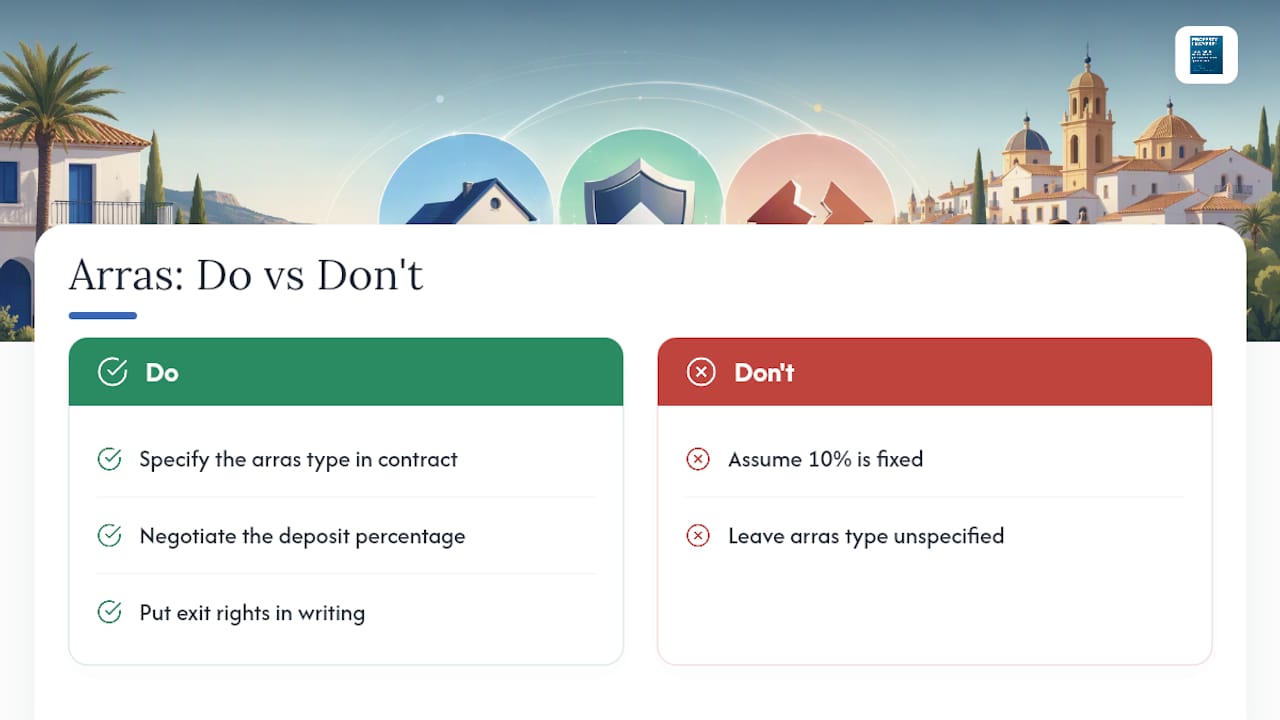
The table above covers the essentials, but two points routinely trip up foreign buyers. First, when a contract does not clearly state which type applies, Spanish courts default to treating it as confirmatorias, the type with no built-in exit route. If you are counting on being able to walk away, silence in the contract works against you.
Second, that 10% figure you’ll see quoted everywhere is a norm, not a rule. Guides from major banks confirm the three types exist in law, but the actual percentage is always agreed between the parties. Sellers in competitive markets like Ibiza sometimes push for more; buyers with strong bargaining positions can negotiate less.
What your arras contract must include
A well-drafted arras contract leaves nothing open to interpretation. Before signing, check that it covers:
- Full identities of buyer and seller, plus the exact property reference (land registry details, not just an address)
- Agreed price for the whole property, with the deposit amount and payment method spelt out
- The precise type of arras stated in words, not left to be inferred
- A completion date for signing the final deed before a notary
- A financing or mortgage condition, if you need a loan to complete
- Penalty wording that states exactly how any forfeited or doubled sum is calculated
- Who covers which costs between signing arras and completion
Pro Tip: If you’re buying with a mortgage, never sign an arras contract without a financing clause. Without one, a declined mortgage application can cost you the entire deposit, even though the refusal was the bank’s decision, not yours.
Where deposits commonly go wrong
Mortgage refusal is the single biggest cause of lost deposits among foreign buyers. If your arras contract includes an explicit financing condition, a declined mortgage lets you cancel without losing your money. Without that clause, you risk losing the deposit or facing a claim for the seller’s losses, even if the bank said no through no fault of your own.
Disputes over vague wording are the second common trap. When a contract does not name the type of arras or leaves the penalty calculation unclear, resolving the disagreement often needs formal legal steps rather than a quick phone call, and courts fill the gap with the confirmatorias interpretation by default. That is rarely what either party actually wanted.
Practical fixes are straightforward:
- Name the type of arras explicitly, in writing
- Set out the exact penalty calculation, including any interest on held funds
- Build in a financing deadline with a clear cancellation right if the mortgage is refused
Due diligence before you sign
A lawyer reviewing your arras contract will typically check:
- Title and charges at the Land Registry, confirming the seller actually owns the property free of undisclosed debts
- Planning and occupancy certificates, especially important on older properties in Mallorca or rural Andalusia
- Community fees and utility accounts, checking nothing is outstanding
- The financing clause and timeline, matching it against realistic mortgage offer timescales
- Deposit size against your funding risk, since a larger deposit means more exposure if finance falls through
Foreign buyers sometimes confuse a simple reservation fee with a binding arras contract; the two are not the same thing, and only a lawyer reading the actual wording can tell you which one you are signing. This is exactly why instructing an independent, English-speaking Spanish lawyer before you pay anything matters, and why Property-lawyers exists to connect buyers with vetted professionals across the country.
Speed versus protection: a publisher’s view
Buyers under time pressure often accept whatever deposit terms a seller’s agent proposes, simply to secure the property. That instinct is understandable, but it is the wrong trade. Negotiate the deposit size and completion date before signing, not after, and treat legal review as the step that prevents an expensive mistake, not a delay that costs you the sale.
— Sophie
Get your arras contract checked before you pay
You’ve now seen how differently confirmatorias, penitenciales, and penales treat your deposit, and how much rides on the exact wording your seller’s agent hands you. This kind of service can be a practical shortcut past that risk: rather than searching for a solicitor cold or relying on the seller’s own lawyer, you can get connected to an independent, English-speaking property lawyer who works for you alone, not the other side of the table.

That independence matters most in the days before you sign an arras contract, when a single missing clause (no financing condition, no stated type, vague penalty wording) can cost you your entire deposit. If you have a draft arras contract in hand right now, or you are about to receive one on a property in Marbella, Barcelona, or anywhere else in Spain, get it checked before you pay. Start by browsing property lawyers across Spain and requesting a review before your deposit leaves your account.
Sources
For the legal text itself, see Article 1454 of the Código Civil on BOE. For plain-language guidance, BBVA’s explainer on arras contracts and idealista’s guide to arras types are both reliable. For a deeper walkthrough tailored to buyers, read Property-lawyers’ guide to the contrato de arras in Spain.
This article is general information, not a substitute for advice from a qualified lawyer. Consult a qualified legal professional about your own circumstances before acting on anything here.
- Boe
- Tipos de contratos de arras, ¿cómo funciona cada uno? — idealista/news
- Contrato de arras – BBVA
- Tipos de arras ¡Te lo contamos aquí! – De Miguel Leiro Abogados Madrid
FAQ
What are the three types of arras?
The three types recognised in Spanish practice are confirmatorias (deposit as part payment, no automatic exit), penitenciales (a paid right to withdraw), and penales (a penalty clause without a clean cancellation right).
Which is better, confirmatorias or penitenciales?
Neither is universally better: confirmatorias suit buyers and sellers who are certain about the deal, while penitenciales suit those who want flexibility to walk away at a known, capped cost, which is why they dominate residential sales.
What is the most common type of arras contract?
Arras penitenciales are the most common structure in Spanish residential property sales, largely because the fixed penalty under Article 1454 of the Código Civil gives both parties clarity if either side changes their mind.
What does the Código Civil say about arras types?
The Código Civil specifically addresses arras penitenciales in Article 1454, setting out that a withdrawing buyer loses the deposit and a withdrawing seller must return double; it does not separately codify confirmatorias or penales, which come from case law and contract practice instead.
How much deposit is normal for an arras contract?
Around 10% of the purchase price is common market practice, though the exact figure is negotiated between buyer and seller rather than fixed by law.
Recommended
- Gazumping in Spain: what property buyers must know
- How foreign buyers are protected under Spanish law
- Property Buying Guide Spain: Legal Advice for Foreign Buyers
- 10 important steps before buying property in Spain | Property Lawyers

Sophie Gutenberg is a legal content specialist focused on Spanish property law, real estate transactions, conveyancing, due diligence and tax issues affecting international property buyers in Spain. She works alongside qualified Spanish property lawyers .
