

How to set up business in Spain: 2026 guide
TL;DR:
- Setting up a business in Spain involves registering the company in the Commercial Registry and obtaining a tax identification number. The most common legal form is the Sociedad Limitada with a minimum capital of EUR 1. Thanks to digital platforms like CIRCE, entrepreneurs can complete registration processes quickly and electronically.
Setting up a business in Spain means incorporating a legal entity, obtaining a tax identification number, and completing a sequence of administrative registrations required by Spanish authorities. The process divides into two distinct phases: creating the legal structure and then registering it so the company acquires legal personality. Until registration in the Commercial Registry is complete, the company cannot sign contracts, open bank accounts, or issue invoices as a legal entity. Digital platforms such as CIRCE now allow entrepreneurs to handle much of this process electronically, reducing both time and cost. This guide covers every stage, from choosing a legal structure to obtaining your permanent tax number.
What legal forms can you choose when setting up a business in Spain?
Spain allows entrepreneurs to operate either as a natural person or as a legal person. A natural person trades as a sole trader, known in Spain as an autónomo. A legal person means incorporating a commercial company, which creates a separate legal entity with its own rights and obligations.
The most common commercial forms are:
- Sociedad Limitada (SL): A private limited company. The most popular choice for small and medium businesses. Shareholders are liable only up to the value of their shares.
- Sociedad Anónima (SA): A public limited company. Suited to larger businesses or those seeking external investment. Requires a minimum share capital of EUR 60,000.
- Sociedad Colectiva: A general partnership where all partners share unlimited liability.
- Sociedad Comanditaria: A limited partnership combining partners with unlimited liability and partners with limited liability.
| Structure | Minimum capital | Liability | Best suited for |
|---|---|---|---|
| Sole trader (autónomo) | None | Unlimited personal | Freelancers, single operators |
| SL (private limited) | EUR 1 | Limited to shares | SMEs, startups |
| SA (public limited) | EUR 60,000 | Limited to shares | Large companies, listed firms |
| General partnership | None | Unlimited | Professional firms |
Law 18/2022 reduced the minimum capital for an SL to EUR 1, with a transitional regime applying to amounts not exceeding EUR 3,000. This change makes the SL structure accessible to almost any entrepreneur, though specific rules on profit allocation and legal reserves still apply during the transitional period.
Pro Tip: For most foreign entrepreneurs opening a business in Spain, the SL is the most practical choice. It limits personal liability, requires minimal capital, and is the structure most Spanish accountants and lawyers know best.
What documents and prerequisites do you need before registering?
Preparation before the formal registration process saves significant time. Missing a single document at the notary stage can delay incorporation by weeks.
- Obtain a negative company name certificate. Apply to the Central Mercantile Registry (Registro Mercantil Central) to confirm your chosen company name is available. This certificate is valid for six months but only valid for three months to execute the deed of incorporation. Plan your timeline carefully.
- Obtain a Spanish NIE. Foreign nationals must hold a Número de Identificación de Extranjero before signing any legal documents, opening a bank account, or completing tax registrations. The NIE is non-negotiable for every step that follows.
- Open a Spanish bank account and deposit share capital. The bank issues a certificate confirming the deposit. You present this certificate to the notary at the time of signing the deed of incorporation.
- Prepare the articles of association. These govern how the company operates, including decision-making rules, profit distribution, and management structure. A Spanish lawyer should draft or review these documents.
- Obtain a provisional tax number (NIF). Submit Form 036 to the Spanish Tax Agency (Agencia Tributaria) to receive a provisional NIF. This number identifies the company for tax purposes before commercial registration is complete.
- Obtain a digital certificate. A digital certificate allows you to sign documents and complete procedures electronically, which is required for using the CIRCE platform.
Pro Tip: Apply for your NIE well in advance. Processing times at Spanish consulates abroad can run to several weeks, and delays here will stall every subsequent step.
How to incorporate and formally register your company in Spain
The incorporation and registration process follows a fixed sequence. Skipping or reordering steps creates legal and administrative problems.

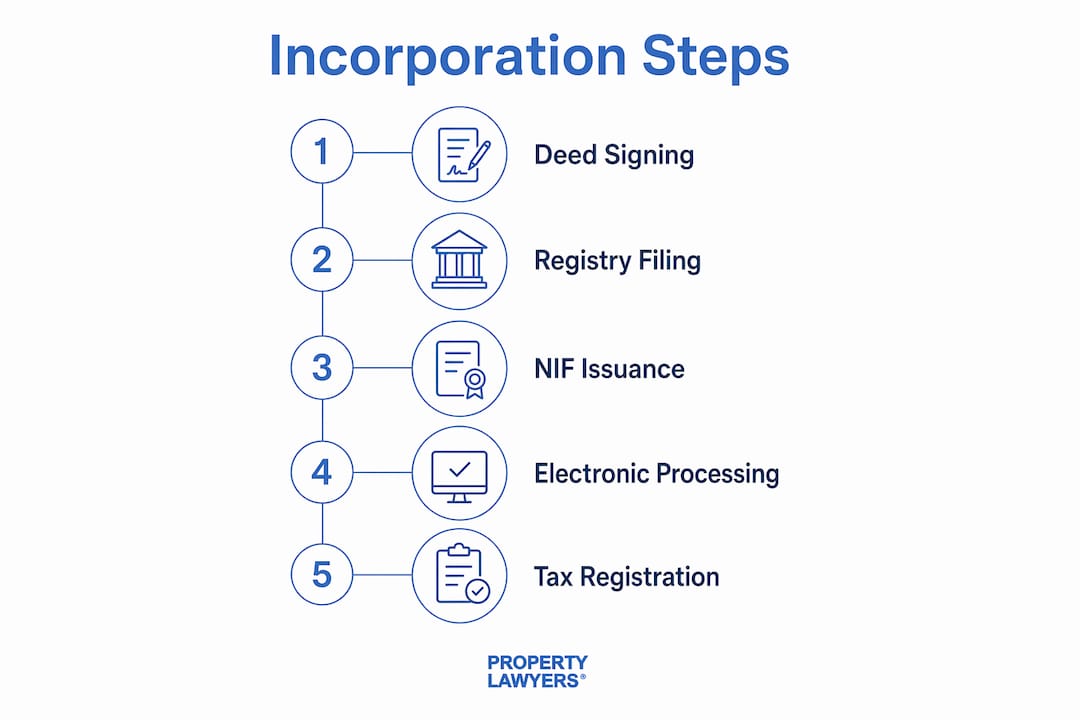
Step 1: Execute the deed of incorporation before a notary
The founders sign the deed of incorporation (escritura de constitución) before a Spanish notary. The notary verifies the identity of all parties, confirms the articles of association are legally sound, and certifies the bank deposit certificate. This deed is the founding legal document of the company.
Step 2: Submit the deed to the Commercial Registry
After notarisation, the deed must be submitted to the Commercial Registry (Registro Mercantil) of the province where the company’s registered address is located. The registry has 15 business days to review and process the submission. The company must be registered within two months of the deed being executed. Missing this deadline means the deed lapses and the process must restart.
Step 3: Obtain the permanent NIF
Once the Commercial Registry confirms registration, the company applies to the Agencia Tributaria for its permanent NIF. This replaces the provisional number obtained via Form 036. The permanent NIF is required to invoice, pay taxes, and enter into contracts as a legal entity.
Step 4: Use CIRCE for electronic processing
The CIRCE system (Centro de Información y Red de Creación de Empresas) integrates multiple administrative procedures into a single electronic window. Using the Documento Único Electrónico (DUE), entrepreneurs can submit incorporation documents electronically, covering notary, registry, and tax steps simultaneously. In straightforward cases, CIRCE can reduce total incorporation time to under 48 hours. The system still requires a notary deed, but it removes the need to visit multiple offices separately.
| Route | Typical timeline | Key advantage |
|---|---|---|
| Traditional (in person) | 2–6 weeks | Suitable for complex structures |
| CIRCE electronic route | Under 48 hours (simple cases) | Faster, fewer office visits |
Pro Tip: CIRCE works best for standard SL incorporations with straightforward articles of association. If your structure involves multiple share classes, foreign shareholders, or complex governance arrangements, the traditional route with a specialist lawyer gives you more control.
What tax and operational registrations are needed after incorporation?
Completing commercial registration is not the final step. Several further registrations are required before the company can operate legally.
- Economic Activities Tax (IAE) registration. Companies must register with the Agencia Tributaria for the specific economic activity they intend to carry out. This registration defines the tax category under which the business operates.
- Social Security registration. Employers must register with the Tesorería General de la Seguridad Social before hiring any staff. Directors who are also shareholders may also need to register as self-employed under the Special Regime for Self-Employed Workers (RETA).
- Municipal activity licence. Depending on the nature of the business and its physical premises, a licence from the local town hall (ayuntamiento) may be required before trading begins. Requirements vary by municipality and activity type.
- VAT registration and periodic declarations. The permanent NIF links directly to VAT obligations. Tax registration and commercial registration are sequenced deliberately. A company cannot legally invoice until both are complete.
- Annual accounts filing. Once operational, the company must file annual accounts with the Commercial Registry each year. Failure to file results in fines and, eventually, the company being struck off the register.
Pro Tip: Register for Social Security on the same day you complete commercial registration. Gaps in employer registration create retroactive liability for contributions, which Spanish authorities pursue actively.
What timing pitfalls should entrepreneurs watch for?
The Spanish company registration process has several points where timing errors cause serious delays. Understanding these in advance prevents avoidable setbacks.
- Name certificate expiry. The negative company name certificate is valid for six months overall, but you must execute the deed within three months of obtaining it. If you miss this window, you must apply again, and your chosen name may no longer be available.
- Two-month registration deadline. The deed of incorporation must reach the Commercial Registry within two months of notarisation. Missing this deadline invalidates the deed entirely.
- Incomplete documentation at the notary. Arriving at the notary without the bank deposit certificate, a valid NIE, or complete articles of association causes the appointment to fail. Rescheduling adds weeks to the process.
- CIRCE limitations. Though CIRCE reduces administrative burden, it does not eliminate the need for accurate corporate documentation. Errors in the DUE submission still trigger manual review and delays.
- Misaligned operational planning. Legal personality begins only after Commercial Registry registration. Signing supplier contracts or accepting payments before this point creates personal liability for the founders.
Entrepreneurs who treat the two-month registration deadline as a hard constraint, and plan all preparatory steps to complete well before it, consistently avoid the most common and costly delays in Spanish company formation.
Pro Tip: Build a simple checklist with dates for each step, working backwards from your intended trading date. Allow at least four weeks of buffer between deed execution and your planned launch.
Key takeaways
Setting up a business in Spain requires completing both commercial registration and tax registration before the company can legally operate or invoice.
| Point | Details |
|---|---|
| Two-phase process | Incorporation creates the structure; Commercial Registry registration gives the company legal personality. |
| SL is the standard choice | Law 18/2022 allows SL formation with EUR 1 minimum capital, making it accessible for most entrepreneurs. |
| NIE is non-negotiable | Foreign nationals must obtain a Spanish NIE before signing documents, opening accounts, or registering. |
| CIRCE speeds up the process | Electronic incorporation via CIRCE can complete in under 48 hours for straightforward SL formations. |
| Timing discipline matters | The name certificate lasts three months for deed execution; the deed must reach the registry within two months. |
What I have learned from watching entrepreneurs set up in Spain
The single biggest mistake I see is treating the Commercial Registry step as an administrative formality rather than the legal event it actually is. Founders sign the notary deed, feel the company is “done,” and start operating. They sign leases, take on clients, and open trading accounts. Then the registry flags an error in the articles of association, and suddenly the company has no legal personality while the founders have personal exposure for every commitment made in its name.
The second pattern I see consistently is underestimating the NIE timeline for non-EU founders. British entrepreneurs post-Brexit face the same NIE requirement as any other non-EU national. Consulate appointments in London can run to six weeks or more. I have seen entire incorporation timelines collapse because the NIE was left until the last moment.
My honest view on CIRCE is that it is genuinely useful for standard SL formations, but it rewards entrepreneurs who have already done their preparation. The platform does not guide you through drafting articles of association or structuring shareholder agreements. It processes what you submit. If what you submit is wrong, you still face delays. Use CIRCE as a submission tool, not as a substitute for legal advice.
The capital requirement change under Law 18/2022 is real and significant. An SL with EUR 1 of share capital is legally valid. Practically, however, banks and suppliers will scrutinise a company with negligible capital. Depositing a more substantial amount signals credibility, even if the law no longer requires it.
— Sophie
Legal support for your business registration in Spain
Setting up a company in Spain involves precise sequencing across multiple authorities, and errors at any stage carry real legal and financial consequences.

Property-lawyers connects entrepreneurs with English-speaking solicitors across Spain who handle company formation, tax registration, and compliance from start to finish. Whether you are incorporating in Madrid or any other Spanish province, the directory includes specialist lawyers in Madrid with direct experience in Spanish company registration for international clients. For broader legal support across Spain, Property-lawyers also lists English-speaking solicitors who advise on both property and business matters. Getting the right legal advice at the outset costs far less than correcting a registration error after the fact.
FAQ
What is the minimum capital required to register a company in Spain?
Under Law 18/2022, the minimum share capital for a Sociedad Limitada (SL) is EUR 1, with a transitional regime applying to amounts up to EUR 3,000. A Sociedad Anónima (SA) requires a minimum of EUR 60,000.
How long does company registration in Spain take?
Using the CIRCE electronic system, straightforward SL formations can complete in under 48 hours. The Commercial Registry has 15 business days to process a deed submission via the traditional route.
Do foreign nationals need a NIE to register a company in Spain?
Yes. Foreign nationals must obtain a Spanish NIE before signing the deed of incorporation, opening a bank account, or completing any tax or social security registration.
What is the Commercial Registry in Spain?
The Commercial Registry (Registro Mercantil) is the official body where companies are formally registered. Registration in the Commercial Registry is the step at which a company acquires legal personality and can legally operate, sign contracts, and invoice.
Can I use CIRCE to register my company electronically?
Yes. The CIRCE system and the Documento Único Electrónico (DUE) allow entrepreneurs to submit incorporation documents electronically, integrating notary, registry, and tax steps into a single process. A notary deed is still required.
Recommended
- Spanish real estate law: a buyer’s guide for 2026
- Conveyancing in Spain: a 2026 guide for buyers
- Spain Non-Lucrative Visa 2026: Complete Legal Guide to Residency Without Working | Property Lawyers
- Attract international property clients in Spain: 2026 guide

Sophie Gutenberg is a legal content specialist focused on Spanish property law, real estate transactions, conveyancing, due diligence and tax issues affecting international property buyers in Spain. She works alongside qualified Spanish property lawyers .
