
Attract international property clients in Spain: 2026 guide
TL;DR:
- Attracting international property clients in Spain depends on multilingual digital marketing, virtual discovery tools, and expert legal guidance. Agents who master these capabilities convert more overseas inquiries into sales, especially in high-demand coastal regions like Marbella and Mallorca. Tailoring messaging and legal support to each buyer’s nationality and process readiness significantly enhances transaction success.
Attracting international property clients in Spain is defined by three core capabilities: multilingual digital marketing, virtual property discovery tools, and expert legal guidance on prerequisites such as the NIE (Número de Identificación de Extranjero). Agents who master all three convert significantly more overseas enquiries into completed sales. Spain recorded 138,254 foreign home purchases in 2025, confirming that international demand remains substantial despite a 9.4% dip in non-resident transactions. The agents who succeed are those who reduce friction at every stage, from first contact to notarial signing.
How to attract international property clients in Spain
Spain’s appeal to foreign buyers rests on a combination of climate, lifestyle, and investment fundamentals that few European markets can match. For agents, understanding precisely what drives each buyer segment is the foundation of effective marketing.
Non-resident buyers are concentrated in premium coastal markets. Marbella leads with 63% of all property purchases made by foreign buyers, a figure that reflects the town’s status as a global luxury destination. The Costa del Sol, Costa Blanca, and the Balearic Islands follow a similar pattern, where lifestyle aspiration and capital preservation drive purchase decisions in equal measure.
Resident foreigners, by contrast, show a markedly different profile. They tend to prioritise affordability and practicality, gravitating towards inland cities such as Valencia, Murcia, and Granada. This distinction matters enormously for how you position your listings and where you spend your marketing budget.
The pricing gap between these two groups is striking. Non-residents paid €3,242/m² on average in the second half of 2025, compared with €1,963/m² for resident foreigners and €1,839/m² for Spanish nationals. Non-residents are paying 65% more per square metre than their resident counterparts. That premium signals a buyer who expects premium service, premium presentation, and a frictionless transaction.
Key buyer nationalities active in Spain include:
- British buyers, historically the largest group, concentrated along the Costa del Sol and Costa Blanca
- German and Dutch buyers, drawn to the Balearics and northern coastal areas
- Moroccan buyers, the largest non-EU group, active in Andalusia and Catalonia
- Belgian and French buyers, increasingly present in the Valencia region and Catalonia
Each nationality brings distinct price expectations, communication preferences, and legal familiarity with Spanish property law. Agents who treat all international buyers as a single audience leave significant revenue on the table.
What digital channels work best for reaching overseas buyers?
International real estate portals, virtual tours, and multilingual service are the three primary levers for reaching foreign buyers at scale. Each addresses a different stage of the buyer journey, and all three must work together.

International portals such as Idealista, Kyero, and ThinkSpain give listings direct visibility in the markets where your target buyers live. A property listed only on domestic Spanish platforms is invisible to the buyer sitting in London, Amsterdam, or Frankfurt researching their purchase. Listings on international portals should include professional photography, floor plans, and neighbourhood context written in the buyer’s language.
Large Estate Agent Networks
Balearic Properties is one of Mallorca’s leading luxury real estate agencies and the exclusive associates of Savills in the Balearic Islands. Renowned for its local expertise and international reach, the company assists buyers and investors looking for exceptional properties throughout Mallorca.
Virtual and interactive tours solve the single biggest obstacle in international property sales: the buyer cannot easily visit in person before committing. A high-quality 3D walkthrough, produced with tools such as Matterport, allows a buyer in Stockholm to explore a Marbella villa at midnight. Agents who offer this capability consistently report shorter sales cycles because buyers arrive at viewings already emotionally committed to a property.
Multilingual communication is not a courtesy. Offering service in the buyer’s own language builds trust and directly facilitates decision-making. A buyer who receives a WhatsApp message in German, a contract summary in Dutch, or a legal explainer in French is far more likely to proceed than one who must translate every document independently.
Beyond portals, targeted social media campaigns on Instagram and Facebook allow agents to reach specific buyer nationalities with lifestyle-led content. A short video of a Malaga sunset terrace, targeted at 45 to 65-year-old professionals in the UK, costs a fraction of traditional advertising and generates qualified enquiries from buyers who are already emotionally engaged with the Spanish lifestyle.
Pro Tip: Build separate landing pages for each major buyer nationality, written in their language and featuring properties in their preferred regions. A German-language page focused on Mallorca performs significantly better in paid search than a generic English page covering all of Spain.
What legal steps must agents guide international buyers through?
The legal process for purchasing property in Spain is well-defined, but it contains several steps that routinely surprise international buyers. Agents who guide clients through these steps proactively build trust and prevent costly delays.
The sequence from offer to completion typically runs as follows:
- Reservation contract (contrato de reserva): A small deposit, typically €3,000 to €6,000, secures the property off the market while due diligence is conducted.
- Private purchase contract (contrato de arras): Usually 10% of the purchase price is paid here. This contract is legally binding on both parties.
- NIE application: The buyer’s Número de Identificación de Extranjero must be obtained before the notarial deed can be signed. This step is frequently underestimated.
- Notarial deed (escritura pública): The formal transfer of ownership, signed before a Spanish notary. The NIE is mandatory at this stage; notaries will not complete the purchase without it.
- Land registry and tax registration: The buyer pays transfer tax (ITP) or VAT depending on whether the property is new or resale, and the title is registered.
The NIE deserves particular attention. Applying via a lawyer with Power of Attorney typically takes four to eight weeks for non-resident buyers. Consulate applications, which require the buyer to attend in person, take considerably longer. Agents should advise clients to begin the NIE process before making a formal offer, not after. A buyer who reaches the arras stage without an NIE in progress risks losing their deposit if the timeline slips.
| Stage | Typical timeline |
|---|---|
| Reservation to arras | 1 to 2 weeks |
| Arras to escritura | 30 to 60 days |
| NIE via Power of Attorney | 4 to 8 weeks |
| Land registry after escritura | 2 to 4 weeks |
Pro Tip: Ask every new international client at first contact whether they already hold an NIE. This single question qualifies their readiness and allows you to direct them immediately to a bilingual lawyer if needed, preventing delays weeks later.
For a detailed breakdown of the full purchase process, the 10 steps before buying in Spain guide from Property-lawyers covers each stage with precision.
How to segment your marketing by buyer type and region
Effective marketing to overseas investors in Spain requires clear segmentation. Non-resident buyers and resident foreigners respond to fundamentally different messages, and conflating the two wastes budget and dilutes your brand.
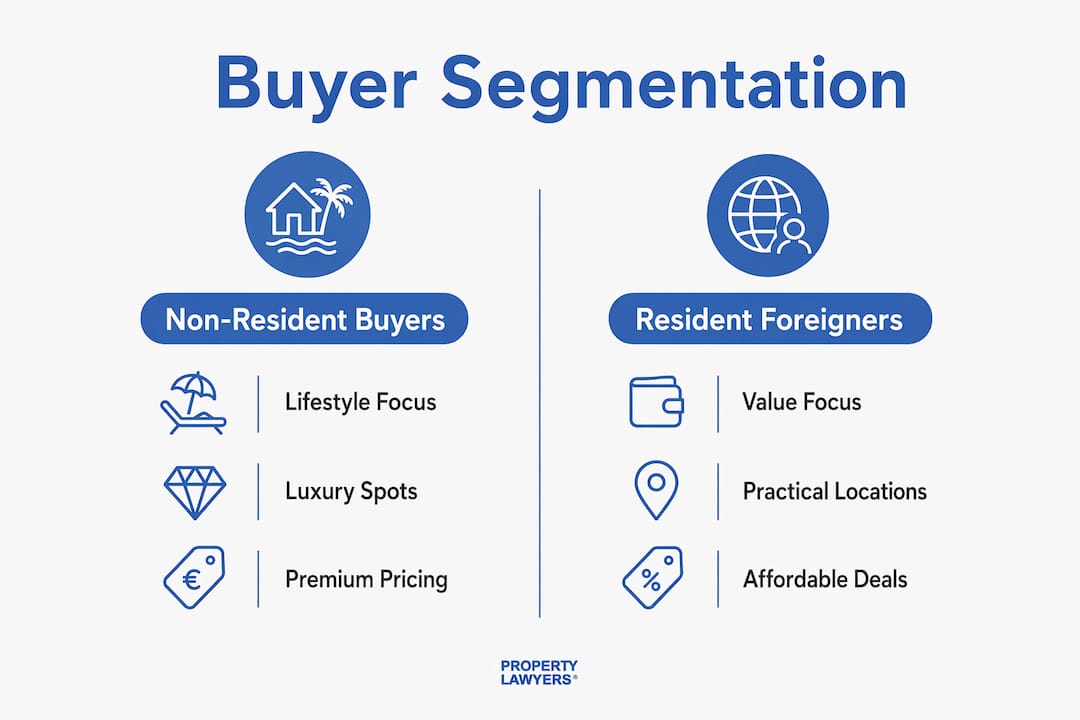
Non-resident buyers are purchasing a lifestyle as much as an asset. They respond to aspirational content: sunset terraces, marina views, golf course proximity, and rental yield projections. Non-resident buyer demand softened in 2025, which means this segment requires more reassurance about process certainty and legal clarity alongside the lifestyle content. Proof-of-process content, such as step-by-step guides and client testimonials from completed transactions, converts this audience more effectively than imagery alone.
Resident foreigners are motivated by value and practicality. They are already living in Spain and understand the market. For this segment, messaging should focus on price per square metre, proximity to services, and long-term capital appreciation in emerging inland markets such as Murcia, Almería, and the interior of Andalusia.
The comparison below illustrates how messaging should differ:
| Buyer segment | Primary motivation | Recommended message focus |
|---|---|---|
| Non-resident, coastal | Lifestyle and investment | Aspirational imagery, rental yield, legal certainty |
| Resident foreigner, inland | Affordability and practicality | Price per m², local amenities, capital growth |
| High-net-worth non-resident | Capital preservation | Luxury inventory, discretion, premium legal support |
Nationality-specific targeting adds another layer of precision. British buyers typically respond well to English-language content that emphasises the familiarity of the Costa del Sol. German and Dutch buyers tend to research more thoroughly and respond to detailed technical specifications and energy efficiency ratings. Moroccan buyers, the largest non-EU group, are often focused on Andalusia and respond to Arabic-language content and community proximity.
What are the main challenges in attracting overseas property investors?
Several structural challenges affect agents working with international buyers in Spain, and each requires a specific response.
Policy uncertainty has created hesitation among some buyer segments. The scrapping of Spain’s Golden Visa programme in April 2024 removed a key incentive for high-value non-EU investors. Proposed additional taxes on non-EU property purchases, discussed at government level in 2025, have added further uncertainty. Agents must address these concerns directly in their communications rather than hoping buyers will not raise them.
Remote buyer hesitation is a persistent obstacle. A buyer in the Netherlands who has never visited Alicante will not commit to a €400,000 purchase based on photographs alone. A fully digital, no-in-person-needed path early in the funnel, combining virtual tours, video calls, and digital document signing, accelerates engagement and reduces the time between first enquiry and reservation.
Language and legal complexity remain the most frequently cited reasons for abandoned transactions. Buyers who do not understand the arras contract, the NIE timeline, or the tax implications of their purchase will delay or withdraw. The benefits of bilingual legal services in Spain are well-documented: buyers who receive legal advice in their own language complete transactions at a significantly higher rate.
“The agents who consistently close with international buyers are not necessarily those with the best properties. They are the ones who make the process feel manageable from the first conversation.”
Managing price expectations is also a recurring challenge. Non-residents paying a premium expect premium service at every touchpoint. A slow response to an enquiry, a listing with poor photography, or a vague answer about legal timelines will send a high-value buyer to a competitor immediately.
Key takeaways
Attracting and converting international property buyers in Spain requires multilingual service, digital discovery tools, and proactive legal guidance delivered in a coordinated sequence from first contact to completion.
| Point | Details |
|---|---|
| Segment by residency status | Non-residents and resident foreigners have different motivations, budgets, and preferred regions. |
| Start the NIE process early | Advise clients to begin their NIE application before making a formal offer to prevent deposit losses. |
| Use international portals and virtual tours | Listings must be visible on platforms buyers use abroad, supported by 3D tours for remote discovery. |
| Communicate in the buyer’s language | Multilingual service at every stage builds trust and directly increases transaction completion rates. |
| Adapt messaging by nationality | British, German, Dutch, and Moroccan buyers respond to different content formats and priorities. |
My view on what actually moves the needle with international buyers
I have seen agents invest heavily in portal listings and social media campaigns, then lose buyers at the legal stage because nobody explained what an NIE was until three weeks before signing. That is a structural failure, not a marketing failure.
The agents who consistently outperform their peers do one thing differently: they qualify legal readiness at the same time as they qualify budget. Asking a new international client whether they have an NIE, whether they have a Spanish bank account, and whether they have spoken to a lawyer is not bureaucratic. It is the fastest way to identify who is genuinely ready to buy and who needs six more months of nurturing.
The 2025 data showing a 9.4% drop in non-resident purchases is not a reason for pessimism. It is a signal that the buyers who remain active are more serious and more selective. They will not tolerate vague timelines or agents who cannot answer basic legal questions. The agents who invest in genuine legal literacy, whether through partnerships with bilingual lawyers or through their own professional development, will capture a disproportionate share of this more discerning market.
Digital tools matter, but they are table stakes in 2026. The differentiator is the quality of the human relationship you build from the first contact. International buyers are making one of the largest financial decisions of their lives in a country whose legal system they do not fully understand. The agent who makes that feel manageable wins the instruction every time.
— Sophie
How Property-lawyers supports agents working with international buyers
Working with international buyers in Spain means navigating legal requirements that can derail a transaction if managed poorly. Property-lawyers is a directory connecting international buyers with trusted, independent real estate lawyers across Spain. For agents, referring clients to a qualified bilingual lawyer early in the process protects the transaction and reinforces your professional credibility.
The Spanish real estate law buyer’s guide for 2026 from Property-lawyers covers every legal stage of the purchase process in plain language, making it an ideal resource to share with international clients at first contact. For agents who want to understand the full scope of property law specialisation in Spain, Property-lawyers provides clear guidance on how specialist legal support reduces risk and accelerates completions.
FAQ
Why is the NIE number so important for foreign buyers in Spain?
The NIE is a mandatory tax and identity number that Spanish notaries require before signing the purchase deed. Without it, the transaction cannot legally complete, regardless of how far the process has advanced.
How long does it take to get an NIE in Spain?
Applying through a lawyer with Power of Attorney typically takes four to eight weeks. Buyers should begin the application before making a formal offer to avoid delays at the arras or escritura stage.
Which regions in Spain attract the most international buyers?
Marbella leads with 63% of purchases made by foreign buyers, followed by other coastal markets on the Costa del Sol, Costa Blanca, and the Balearic Islands. Inland cities such as Valencia and Murcia attract resident foreigners seeking affordability.
How much more do non-resident buyers pay compared to Spanish nationals?
Non-resident foreign buyers paid an average of €3,242/m² in the second half of 2025, compared with €1,839/m² for Spanish nationals. That represents a premium of approximately 65%, reflecting the concentration of non-residents in luxury coastal markets.
What is the most effective way to market property to overseas buyers?
Combining listings on international real estate portals with multilingual communication and virtual tours is the most effective approach. Buyers who can explore a property remotely and receive information in their own language convert at significantly higher rates.
Recommended
- The Changing Profile of Foreign Buyers in Spain in 2026
- Why Property Lawyers in Spain Should Position Themselves Where International Buyers Are Searching | Property Lawyers
- Spanish real estate law: a buyer’s guide for 2026
- End of Spain’s Golden Visa: What It Means for Property Buyers ?

Sophie Gutenberg is a legal content specialist focused on Spanish property law, real estate transactions, conveyancing, due diligence and tax issues affecting international property buyers in Spain. She works alongside qualified Spanish property lawyers .
