

Alquiler con opción a compra: how it works in Spain
Alquiler con opción a compra can work well if you cannot yet raise a full deposit but expect to qualify for a mortgage within a few years, or if you want to lock in a price while you test a neighbourhood in Marbella, Mallorca, or Barcelona. Before signing anything, request the nota simple from the Land Registry, confirm the option will be written into the contract and registered, and get a mortgage pre-check done now. Treat the initial payment, the prima, as money you will likely lose if you walk away.
TL;DR:
- The prima de opción typically ranges from 2% to 15% of the property’s sale price, requiring a significant upfront payment that is usually non-refundable.
- Rent credits often cover 30% to 100% of monthly rent and are applied toward the final purchase price, with contract durations usually between 2 to 5 years.
- Registering the purchase option at the Land Registry is crucial to protect your rights against third-party claims, as unregistered options are only enforceable between the original parties.
- A mortgage pre-approval is essential early on to assess financing feasibility, with potential outcomes including renegotiation or losing the prima and rent credit if the bank declines.
- Renting with an option to buy is most suitable for buyers with a temporary credit gap or neighborhood testing needs, not for those hoping to avoid a deposit or expecting property values to fall.
Table of Contents
- Where to find alquiler con opción a compra offers in Spain
- How the lease and purchase option work together
- What percentage and terms are typical in Spain?
- Documents and clauses to check before you sign
- Preparing your mortgage for when you exercise the option
- What are the main risks with rent-to-own contracts?
- Worked example: what the numbers actually look like
- Steps to exercise the option and complete the purchase
- Who should actually consider this route in Spain?
- How Property-lawyers helps you get this right
- Sources
- FAQ
Where to find alquiler con opción a compra offers in Spain
The three sites that dominate the Spanish rental and property market are Idealista, Fotocasa, and Milanuncios. Idealista carries the largest volume of listings and tends to attract agency-managed properties, so adverts are generally more detailed about price and terms. Fotocasa often shows a mix of agency and private listings, useful if you want to compare how different sellers price the same type of deal. Milanuncios leans more towards private owners, which can mean better prices but also thinner paperwork and less consistency in how the option is described.
None of these portals have a dedicated filter for “rent to own,” so you will need to search using the exact phrase alquiler con opción a compra, or the shorter “opción a compra,” directly in the search bar. Adverts that are worth pursuing usually state three numbers clearly: the prima de opción as a percentage or fixed sum, the portion of monthly rent that counts towards the final price, and the length of the option period. If an advert only says “opción a compra posible” with no figures, treat that as a starting point for negotiation, not a finished offer.
Before you contact the advertiser, prepare a short list of questions:
- What percentage of the sale price does the prima represent, and is it refundable under any circumstances?
- What share of the monthly rent will be credited towards the final purchase price?
- Is the sale price fixed now, or will it be revalued at the time you exercise the option?
- Will the option be formalised before a notary and registered at the Registro de la Propiedad?
Pro Tip: Save every advert as a PDF or screenshot the day you see it. Sellers sometimes edit or remove the original figures once negotiations start, and having the original listing helps you hold them to what was first offered.
How the lease and purchase option work together
Alquiler con opción a compra is not one contract but two linked agreements sitting inside a single document. The rental part is governed by the Ley de Arrendamientos Urbanos (LAU), the standard law covering tenancies in Spain, which sets out notice periods, deposit rules, and tenant protections just as it would for any ordinary rental. The option to buy sits alongside it as a separate, freely negotiated agreement between landlord and tenant, and this is where the real financial detail lives.
Three elements define that option:
- The prima de opción. This upfront payment secures your exclusive right to buy the property within the agreed period. It is usually treated as non-refundable if you decide not to proceed, unless the contract states otherwise, so read that clause with real care.
- The fixed or adjustable sale price. Most contracts fix the price at signing, protecting you if local property values climb, though some allow for revision linked to an index or market valuation.
- The registration of the option. Spanish law lets you inscribe the purchase option itself at the Registro de la Propiedad, the same land registry that records ownership and charges. This registration makes the option enforceable against third parties, meaning that if the owner tries to sell the property to somebody else during the option period, your right to buy still stands.
Skipping registration is the single most common mistake buyers make. An unregistered option is only a promise between the two parties, and if the landlord sells to a third buyer or the property is repossessed by a bank, your claim can effectively disappear. A property contract drawn up correctly from the outset avoids this entirely.
What percentage and terms are typical in Spain?
The prima de opción in Spain typically ranges from 2% to 15% of the agreed sale price.
Rent-credit terms vary just as widely. Many contracts credit a portion of the monthly rent towards the eventual purchase price, though the exact share is negotiated between landlord and tenant, as indicated by CaixaBank., though the exact share is entirely down to negotiation between landlord and tenant. Contract length commonly falls within a few years, usually enough time for most tenants to improve their financial position, long enough for most tenants to improve their financial position but short enough that sellers are not locked out of the market indefinitely.
| Term | Typical range in Spain |
|---|---|
| Prima de opción | 2% to 15% of sale price |
| Rent credited towards purchase | 30% to 100% of monthly rent |
| Contract duration | 2 to 5 years |
In practice: on a property priced at €300,000 with a prima and a rent-credit over several years at a typical monthly rent, you would pay a significant upfront amount and accumulate some rent credit, reducing the amount you need to finance to around €263,400 when you exercise the option.
Term length changes your risk profile. A longer contract gives you more time to build savings and rent credit, but it also leaves you exposed for longer to a fixed price if the local market falls, and it delays the point at which you actually own the property.
Documents and clauses to check before you sign
Do not sign anything until you have seen the property’s legal history in writing. The nota simple, a short extract from the Land Registry, tells you who legally owns the property and whether it carries mortgages, embargoes, or other charges (cargas) that could block a future sale. If the property is a vivienda de protección oficial (VPO), additional restrictions apply. Protected housing carries eligibility rules and, in many regions, a right of first refusal (tanteo y retracto) held by the local administration, which can complicate or block a private rent-to-own arrangement altogether.
Beyond the nota simple, insist on these clauses being spelt out in plain language:
- The exact sale price, and whether it is fixed for the whole option period or subject to revision.
- The precise mechanics of the rent-credit: how much, when it is calculated, and what happens to accrued credit if you don’t exercise the option.
- What counts as a valid notification that you intend to buy, and the deadline for giving it.
- The consequences of non-exercise, including whether any part of the prima or rent credit is ever returned.
- Confirmation that the option will be registered at the Registro de la Propiedad, not just referenced in a private contract.
Pro Tip: Ask who pays the community fees and IBI (the annual property tax) during the rental period. Some contracts quietly shift these onto the tenant, which changes your real monthly cost significantly.
Getting a lawyer to review the draft contract before you sign is not an optional extra here. Rent-to-own agreements combine tenancy law and property law in ways that catch out buyers who assume a standard rental checklist is enough.

Preparing your mortgage for when you exercise the option
Getting a mortgage pre-approval now, even years before you plan to exercise the option, tells you whether the whole strategy is realistic. Spanish banks will eventually assess your income, employment history, existing debts recorded with the Bank of Spain’s CIRBE register, and the loan-to-value ratio on the property, exactly as they would for any other mortgage application.
- Request an informal mortgage simulation today. This shows roughly how much you could borrow and flags any issues, such as debt levels or employment type, well before you are locked into a contract.
- Recalculate your required loan once prima and rent credit are known. If a €300,000 property carries €15,000 in prima and €20,000 in accumulated rent credit, your actual financing need drops to around €265,000, which changes the loan-to-value ratio the bank will assess.
- Plan for refusal. If the bank declines the mortgage when you try to exercise the option, your realistic choices are to negotiate an extension of the option period if the contract allows it, bring in a guarantor to strengthen the application, or accept the loss of the prima and any rent credit built up. None of these are comfortable, which is exactly why the pre-check matters now rather than later.
A mortgage protection policy is also worth discussing with your adviser once the loan is in place, since it covers repayments if illness or job loss disrupts your income during the mortgage term.
What are the main risks with rent-to-own contracts?
The biggest financial risk is straightforward: if you cannot or decide not to buy, you generally lose the prima and any rent credit built up over the contract term. Rent-to-own routes often end up costing several thousand euros more overall than simply taking a mortgage from day one, and recommends the structure mainly for tenants who genuinely cannot get financing today but expect to qualify later.
Watch for these specific gaps:
- No registration of the option, leaving you exposed if the owner sells to someone else or the property is repossessed.
- Undefined rent-credit percentage, or vague wording about “part of the rent” with no fixed figure.
- Unclear notification process for exercising the option, which can let a seller argue you missed the deadline.
- A sale price fixed above realistic future market value, particularly in areas where prices have already risen sharply.
- Seller insolvency or a change of ownership during the rental period, which is precisely the scenario registration is designed to protect against.
Worked example: what the numbers actually look like
The prima comes to €16,800, paid upfront. Over 48 months, total rent paid is €52,800, of which 60% (€31,680) is credited towards the purchase.
| Element | Amount |
|---|---|
| Property price | €280,000 |
| Prima de opción (2% to 15%) | €16,800 |
| Total rent over 4 years | €52,800 |
| Rent credited (60%) | €31,680 |
| Amount still to finance | €231,520 |
By the time you exercise the option, you need to finance €231,520 rather than the full €280,000, a saving of roughly €48,480 against a straight purchase with no rent-to-own arrangement. Compared to taking a mortgage on the full price today, the trade-off is the four years of rent you have paid that a direct buyer would not have paid at all. Push the prima down to 3% or the rent-credit down to 30%, and the arithmetic tilts noticeably against you, which is why checking these two figures matters more than almost anything else in the contract.
Steps to exercise the option and complete the purchase
Once you decide to buy, formal notification to the seller usually needs to happen through a burofax (a certified, trackable form of post) or a notarial act, exactly as specified in your contract’s notification clause.
- Send formal notice within the deadline set in the contract, using the method the contract requires.
- Finalise your mortgage with the bank, confirming the exact amount needed once prima and rent credit are deducted from the price.
- Book the notary appointment, where the final purchase deed (escritura) is signed and the mortgage is formally executed.
- Pay the applicable taxes and fees. For resale properties, this typically means Impuesto de Transmisiones Patrimoniales (ITP); for new-build purchases, IVA applies instead, alongside notary and Land Registry fees. A detailed breakdown of these purchase taxes is worth reading before completion day.
- Register the final purchase at the Registro de la Propiedad, and request updated proof of ownership once the entry is complete.
Who should actually consider this route in Spain?
Rent-to-own suits a specific type of buyer: someone with a temporary gap in savings or credit history, a clear and realistic path to a stronger income within a few years, or a genuine need to live in a neighbourhood like Málaga or Mallorca before committing to buy there. It is not a shortcut for people who simply want to avoid a deposit indefinitely.
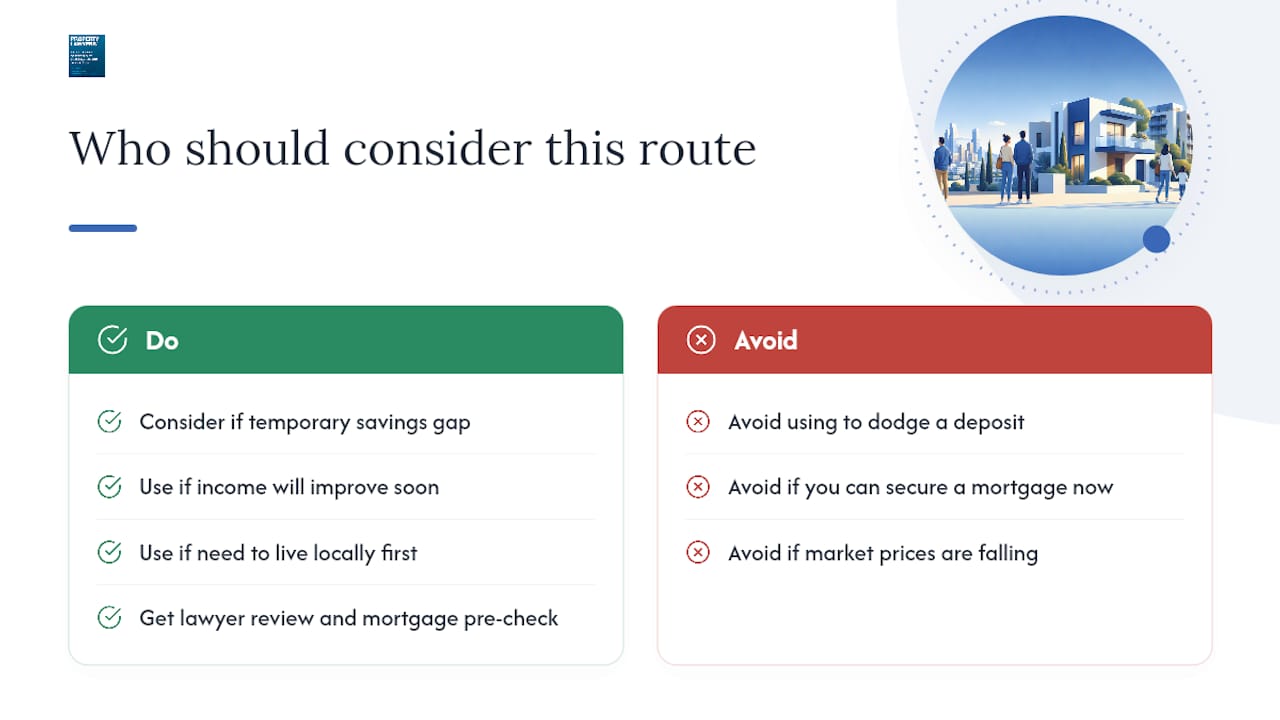
If you can secure a mortgage today, or you are buying in a market where prices are softening, a direct purchase is almost always the cheaper and less risky route. The rent-to-own structure fixes a price now, which works against you if values fall during the option period. It only makes financial sense when the alternative genuinely is “wait and hope” rather than “buy now.”
Whichever way you lean, get a lawyer to review the draft contract and get a mortgage pre-check done before you commit to anything. Both cost relatively little compared to the prima you stand to lose.
— Sophie
How Property-lawyers helps you get this right
Property-lawyers is the practical alternative to signing a rent-to-own contract on trust alone. Rather than relying on an agent’s summary of the terms, you get connected with an independent, English-speaking property lawyer in Spain who checks the nota simple for you, drafts or reviews the option clause so it says what you think it says, and confirms it will actually be registered at the Registro de la Propiedad.

International buyers in Marbella, Ibiza, and Barcelona are particularly exposed here, since local custom around rent-to-own varies by region and a contract that looks standard can hide a missing registration clause or an undefined rent-credit percentage. A specialist lawyer catches these before you sign, not after, and can also flag tax consequences at the point you exercise the option, including how property purchase tax will apply to your final price. Get in touch through the Property-lawyers directory to arrange a contract review before you commit to a prima you cannot get back.
Sources
For the figures and legal points covered here, INE’s official housing statistics provide broader market context on typical rent-to-own arrangements in Spain.
This article is general information, not a substitute for advice from a qualified lawyer. Consult a qualified legal professional about your own circumstances before acting on anything here.
- INE housing statistics — official market data
FAQ
How much money is typically paid upfront in an alquiler con opción a compra?
The prima de opción usually ranges from 2% to 15% of the property’s sale price, depending on the property and how the negotiation goes.
How does alquiler con opción a compra work in Spain?
It combines a standard rental contract governed by the LAU with a separately negotiated purchase option; you pay rent plus a prima, and a share of that rent (commonly 30% to 100%) can be credited towards the final price if you buy.
What are the risks of a rent-to-own contract?
The main risk is losing the prima and any accumulated rent credit if you don’t exercise the option, alongside contractual gaps like missing registration or an undefined rent-credit percentage that can weaken your position.
How long can you stay under a rent-to-own contract before buying?
Contract terms commonly run between two and five years, though the exact length is negotiated between landlord and tenant and stated in the contract itself.
Does Property-lawyers help with rent-to-own contracts specifically?
Yes. Property-lawyers connects you with independent property lawyers in Spain who review the option clause, check the nota simple, and confirm the option is properly registered before you sign.
Recommended
- Leasehold vs freehold in Spain: what buyers must know
- Buying new build in Spain: the legal process explained
- Gazumping in Spain: what property buyers must know

Sophie Gutenberg is a legal content specialist focused on Spanish property law, real estate transactions, conveyancing, due diligence and tax issues affecting international property buyers in Spain. She works alongside qualified Spanish property lawyers .
