
Junta de compensación in Spain: what UK buyers must know
A junta de compensación is a private owners’ body formed under Spanish planning law to carry out the urbanisation of a development sector, redistribute land into buildable plots, and deliver public infrastructure to the local council. If you are buying land or a plot in Spain that sits within a designated development area, there is a real chance a junta de compensación is already active, or will be formed, and that membership brings both financial obligations and legal consequences you cannot ignore.
Three things every UK buyer should know straight away:
- Title is affected. Once a junta is registered and the proyecto de reparcelación is approved, your original plot boundaries change. You receive a new “result parcel” in exchange for your contribution, and the old title entries are cancelled.
- Extra payments can arise at any time. Members are liable for derramas (extraordinary levies) to fund urbanisation works, even if they bought the land after the junta was formed.
- Delays are common. The process from plan approval to receiving a buildable plot can take a substantial period, and the timetable is rarely guaranteed.
The legal framework sits primarily in the Ley del Suelo (arts. 126–130) and the Reglamento de Gestión Urbanística (R.G.U.). Regional rules in Andalucía, Catalonia, the Balearics, and Madrid can modify the thresholds and procedures, so the national framework is only the starting point.
Pro Tip: Before signing any purchase contract on a plot in a development sector, ask the seller for the junta’s statutes, the latest assembly minutes, and confirmation of whether the proyecto de urbanización has received municipal approval. These three documents tell you more about the real risk than any sales brochure.
Key takeaways
A junta de compensación is a legally powerful private body that can levy costs, redraw your title, and bind you to obligations you did not personally agree to, making independent legal advice the single most important step before any purchase in a junta sector.
| Point | Details |
|---|---|
| Legal nature | A junta is a private entity with public-law powers; its decisions bind all members, including those who did not vote in favour. |
| Financial risk | Members are liable for derramas (extraordinary levies) at any point during the execution phase, which can be significant and unpredictable. |
| Title changes | The reparcelación project cancels original plot titles and replaces them with new result parcels; confirm your result parcel is identified before exchange. |
| Timeline | The full process from plan approval to a registered, buildable result parcel typically takes five to eight or more years in active coastal markets. |
| Property-lawyers | Use the Property-lawyers directory to find a vetted, English-speaking Spanish property lawyer who can review junta documents and protect your position. |
Table of Contents
- What is a junta de compensación in Spain?
- What does a junta de compensación actually do?
- What are the different types of junta?
- How is a junta formed, step by step?
- How do the reparcelación and urbanisation projects work?
- How is a junta governed and who makes the decisions?
- What happens when the works are finished?
- Risks, benefits, and due diligence for UK buyers
- A real-world example: what large juntas show buyers
- An adviser’s perspective on what buyers get wrong
- How Property-lawyers can help you with junta due diligence
- Sources
- FAQ
What is a junta de compensación in Spain?
A junta de compensación is a private urbanistic entity with its own legal personality, created specifically to execute the sistema de compensación under Spanish urban planning law. The word “private” matters: this is not a government body. It is formed and run by the landowners themselves. Yet it operates under public-law controls, can exercise powers normally reserved for the administration, and its decisions bind all members, including those who did not vote in favour.
The entity acquires full legal personality only upon registration in the Registro de Entidades Urbanísticas Colaboradoras (Register of Urbanistic Collaborative Entities). Before that registration, the junta has no formal legal standing to act.
Statistic callout: Under the classic national framework, a junta can only be constituted once owners representing a minimum share of the sector’s surface area have joined, commonly set around half or more, though thresholds vary by region. Autonomous communities may set different thresholds, so the figure you need to verify is the one in your region’s planning legislation, not the national default.
The hybrid nature of the junta is what makes it legally unusual. It promotes a public interest (delivering urbanised land and infrastructure) but is managed as a private association. Administrative law governs its governance and decisions, yet the day-to-day management resembles that of a private company or cooperative. For a UK buyer accustomed to straightforward freehold or leasehold transactions, this combination can be genuinely surprising.
Key implications for owners:
- Binding decisions. Assembly resolutions bind all members, including those who abstain or vote against.
- Expropriation risk. Owners who refuse to join a constituted junta can have their land expropriated at a judicially assessed price (justiprecio), which may be lower than market value.
- Financial liability. Members share the costs of urbanisation works proportionally to their quota, which is usually calculated by surface area or aprovechamiento (building rights).
- No passive ownership. Buying into a junta area means accepting ongoing obligations, not just waiting for a plot to become buildable.
What does a junta de compensación actually do?
The junta’s core job is to turn raw, unserviced land into legal, buildable plots, then hand the public portions to the council. Its powers are broad and they cover the entire lifecycle of a development sector.
Core functions include:
- Drafting and approving the Proyecto de Reparcelación. This document redraws all the plots within the sector, cancels old titles, and allocates new “result parcels” to owners in proportion to their original contribution.
- Drafting and approving the Proyecto de Urbanización. This is the physical infrastructure plan: roads, pavements, drainage, electricity, water, and green spaces.
- Contracting and supervising works. The junta procures and oversees the construction of all infrastructure within the sector.
- Collecting levies and derramas. Members pay their share of costs through regular quotas and, where budgets are exceeded, extraordinary levies. The junta has apremio powers, meaning it can enforce collection through administrative channels if members do not pay.
- Requesting expropriation. Where a non-adhering owner refuses to join, the junta can ask the administration to expropriate that owner’s land and incorporate it into the sector.
- Ceding public-use land. Once works are complete and accepted by the council, the junta formally transfers roads, parks, and other public spaces to the municipality.
- Allocating result parcels. After reparcelación, each member receives their new plot, registered in their name at the Land Registry.
The sequence runs roughly as follows: the municipality approves the development sector and its plan → owners form the junta → the junta drafts both projects → the council approves the projects → works are executed → the council formally receives the infrastructure → public land is ceded → result parcels are registered → the junta dissolves.
The administration delegates these powers to the junta but retains oversight. If the junta fails to perform, the administration can intervene and substitute public execution, which changes both the timetable and the cost structure for members.
What are the different types of junta?
Not every junta is formed the same way, and the type you encounter has direct consequences for your position as a buyer.
This is the most common type in active development markets. Owners who join early have more influence over the statutes and the governance structure.
Obligatory (compulsory) junta. Where voluntary formation stalls or owners cannot agree, the municipality can order the constitution of a junta and compel participation. Owners who have not joined voluntarily are incorporated by administrative decision. Their land is included in the sector, and they become subject to all the same financial obligations as voluntary members.
Expropriation-derived junta. In some cases, the administration expropriates non-adhering owners outright rather than incorporating them into the junta. The expropriated owner receives justiprecio (the officially assessed compensation price) and loses their land. The junta then manages the expropriated plots as part of the sector.
The practical consequence of refusal is worth spelling out clearly. If you own a plot within a sector and decline to join a constituted junta, you do not simply opt out. The administration will either incorporate your land compulsorily or expropriate it. In either case, you lose control of the timing and, potentially, the financial outcome. Buyers who inherit a non-adhering position from a previous owner face the same exposure.
How is a junta formed, step by step?
Understanding the formation process helps you identify exactly where a plot sits in the development timeline, which is one of the most useful pieces of due diligence you can do before exchange.
- Municipal plan and sector approval. The local council approves the urban development plan (plan parcial or equivalent) that designates the sector for development. This is the trigger for everything that follows. Check planning permissions for Spain property at this stage to confirm the plan’s legal status.
- Owner initiative. Owners representing the required threshold prepare and submit a proposal to the municipality, including draft statutes and bases de actuación (operational rules).
- Drafting statutes and bases. The statutes set out the junta’s governance structure, voting rules, and financial arrangements. The bases define how contributions and result parcels will be calculated. Both documents require administrative approval.
- Municipal approval. The council reviews and formally approves the statutes and bases. This approval converts the private initiative into an administrative instrument with binding effect on all owners in the sector.
- Registration. The junta is registered in the Registro de Entidades Urbanísticas Colaboradoras. Full legal personality is acquired at this point.
- Execution phase. The junta drafts the Proyecto de Reparcelación and Proyecto de Urbanización, obtains approvals, contracts works, collects levies, and manages the sector through to completion.
Timeline estimates vary considerably. Steps 1–5 can take anywhere from one to three years depending on the municipality, the complexity of the sector, and whether owners agree quickly. The execution phase (step 6) typically adds a further two to five years. The full process from plan approval to receiving a registered, buildable result parcel typically takes several years in active coastal markets, though exact durations vary.
Costs at each stage are borne by the members in proportion to their quota. Municipal fees for plan approval and registration are relatively modest; the major costs are the urbanisation works themselves.
Pro Tip: Ask the seller to confirm which step the junta has reached and request the municipal approval document for the statutes. A junta that has not yet been registered has no legal personality and cannot bind you as a buyer, but the obligation to join will arise as soon as registration occurs.
Warning: If a junta fails to meet its obligations or runs out of funds, the administration may substitute public execution. This changes the timetable, the cost structure, and potentially the financial exposure of existing members. Verify that adequate bank guarantees or bonds are in place before committing to a purchase.
How do the reparcelación and urbanisation projects work?
These two projects are the technical heart of the junta’s work. The junta manages both, and understanding what each does helps you assess what you will actually receive at the end of the process.
The Proyecto de Reparcelación
The reparcelación project redraws the land within the sector. Every owner’s original plot is dissolved and replaced by a new “result parcel” (parcela de resultado). The allocation is proportional to each owner’s original contribution, measured in aprovechamiento (building rights or floor-area entitlement) rather than simply surface area. Owners who contribute more aprovechamiento receive larger or more valuable result parcels.
Worked example (illustrative only):
Imagine a sector of 10,000 m² with three owners. Owner A contributes 5,000 m², Owner B contributes 3,000 m², and Owner C contributes 2,000 m². Owner A receives 4,000 m², Owner B receives 2,400 m², and Owner C receives 1,600 m², each proportional to their original share. The actual calculation uses aprovechamiento coefficients, not raw surface area, so the numbers in a real project will differ, but the principle is the same.
The Proyecto de Urbanización
This project covers all physical infrastructure: roads, pavements, street lighting, drainage, water supply, electricity connections, and green spaces. It sets out the technical specifications and the budget. Members pay for these works through their quotas and any derramas the assembly approves.
Key terms to know
- Aprovechamiento: The building rights or floor-area entitlement assigned to a plot.
- Reparcelación: The legal and physical redistribution of plots within the sector.
- Cesión: The formal transfer of public-use land (roads, parks) to the municipality.
- Derrama: An extraordinary levy charged to members when costs exceed the original budget.
- Parcela de resultado: The new, buildable plot a member receives after reparcelación.
- Suelo de uso público: Land set aside for public use, which must be ceded to the council.
Documents to request before buying
- Approved Proyecto de Reparcelación and the reparcelación map showing your result parcel.
- Approved Proyecto de Urbanización and its budget.
- Any approved derramas and the outstanding balance.
- Confirmation of which result parcel corresponds to the plot you are buying.
How is a junta governed and who makes the decisions?
A junta’s internal structure follows a model set out in its statutes, but the standard organs are consistent across most juntas in Spain.
Organs of the junta:
- Assembly (Junta General). The supreme decision-making body. All members participate, with voting weight usually proportional to their quota (surface area or aprovechamiento). The assembly approves projects, budgets, derramas, and major contracts.
- Executive committee (Junta Directiva or Consejo de Administración). A smaller body elected by the assembly to manage day-to-day operations between meetings.
- President. Represents the junta externally, chairs meetings, and signs contracts on behalf of the body.
- Secretary and Treasurer. Administrative and financial officers, sometimes combined into a single role.
- Municipal representative. The council appoints a representative to attend assembly meetings and ensure compliance with planning obligations. This person does not vote but can raise objections.
Voting thresholds matter enormously. For routine decisions, a simple majority of quotas is usually sufficient. For major decisions, the law requires qualified majorities. Approval of the Proyecto de Compensación, for example, typically requires a two-thirds majority of quotas together with a majority of owners by number.
| Decision | Typical majority required |
|---|---|
| Approval of annual budget | Simple majority of quotas |
| Approval of Proyecto de Reparcelación | Qualified majority (two-thirds of quotas + majority of owners) |
| Approval of Proyecto de Urbanización | Qualified majority |
| Extraordinary derrama | Simple or qualified majority (check statutes) |
| Appointment of president | Simple majority of owners present |
| Dissolution of the junta | Qualified majority after obligations fulfilled |
Pro Tip: Request the last three sets of assembly minutes before exchange. They will show whether any extraordinary levies have been approved or are under discussion, whether there are disputes between members, and whether the works timetable is on track. Minutes are one of the most revealing documents in any junta due diligence.
Trust signals to look for: audited annual accounts, appointment of an independent technical director for the works, and a municipal representative who is actively engaged. A junta that cannot produce audited accounts or has not held an assembly in over a year is a warning sign.
What happens when the works are finished?
Completion is not the end of the process. Several formal steps must occur before the junta can dissolve and before your result parcel becomes fully buildable and freely transferable.
- Final inspection. The junta’s technical director certifies that works have been completed in accordance with the approved Proyecto de Urbanización.
- Reception by the council (recepción de obras). The municipality formally accepts the infrastructure. This is a legal act, not just a handover of keys. The council may raise defects or require remediation before accepting.
- Formal cession of public land. Roads, parks, and other public-use areas are transferred to the municipality by public deed. This cession is registered at the Land Registry.
- Registration of result parcels. Each member’s new plot is registered in their name at the Land Registry, replacing the old entries. The registrador de la propiedad plays a key role in verifying that the reparcelación is legally sound before registering the new titles.
- Formal dissolution. Once all obligations are met, the assembly votes to dissolve the junta and the registration is cancelled.
The time between works completion and formal dissolution can range from six months to two years, depending on the municipality’s speed in accepting the infrastructure and the complexity of the Land Registry registrations.
A junta cannot dissolve until all its urbanisation obligations are fulfilled. If the administration finds defects or disputes arise over the cession, the junta remains active and members remain liable. Guarantees and defects liability periods (typically one year for minor defects and three years for structural issues under Spanish law) must also run their course before the junta can close its accounts.
Any outstanding derramas or unpaid levies are settled at this stage. Buyers who purchased during the execution phase should confirm at completion that no final levy is pending.
Risks, benefits, and due diligence for UK buyers
Buying into a junta area carries genuine upside, but the risks are specific and worth understanding before you commit.
The investment case
When a junta completes its work successfully, the value uplift can be substantial. Raw, unserviced land converts into a legal, buildable plot with full infrastructure. In coastal markets such as Marbella, Málaga, and the Balearics, that transformation can significantly increase the plot’s market value. For buyers who enter early and at the right price, the return on the land element alone can be attractive.
The risks, however, are equally real:
- Cash calls. Derramas can be levied at any point during the execution phase. Budget overruns on infrastructure works are common, particularly where ground conditions or supply costs change.
- Delays. Municipal approval processes, contractor disputes, and administrative challenges can extend timelines by years.
- Liquidity risk. A plot within an active junta is harder to sell than a completed property. Buyers are scarce, financing is more complex, and the title situation is in flux until reparcelación is registered.
- Expropriation of non-adhering owners. If the seller was not a member of the junta, the plot may be subject to compulsory incorporation or expropriation proceedings.
Due diligence checklist
Property lawyers experienced with juntas recommend requesting the following documents before exchange:
- Junta statutes and bases de actuación (approved by the municipality).
- Approved Proyecto de Reparcelación and the map showing the result parcel you will receive.
- Approved Proyecto de Urbanización and the full budget, including any revisions.
- Latest assembly minutes (at least the last three meetings).
- Audited or management accounts for the current financial year.
- Schedule of quotas and any approved or pending derramas.
- Bank guarantees or bonds covering the urbanisation works.
- Confirmation of the seller’s membership status and any outstanding payments.
- Municipal confirmation that the plan and sector remain valid.
Questions to ask the seller and the junta
- What stage has the Proyecto de Urbanización reached, and when is works completion expected?
- Are there any outstanding derramas or levies not yet collected from the seller?
- Has the junta ever been in financial difficulty, and are bank guarantees in place?
- Are there any disputes between members or with the municipality?
- What is the current timetable for reception of works and registration of result parcels?
Risk summary
| Risk | Level | Key check |
|---|---|---|
| Outstanding levies (derramas) | High | Request full accounts and levy schedule |
| Incomplete or unapproved projects | High | Confirm municipal approval of both projects |
| Disputed ownership or non-adhering owners | Medium | Check Land Registry and junta membership list |
| Weak financial accounts or no guarantees | High | Require audited accounts and bank guarantee certificates |
| Municipal delays in accepting works | Medium | Ask council for current reception status |
Pro Tip: Insist on seeing the latest audited or management accounts and the bank guarantee certificates before exchange. If the junta cannot produce these, treat that as a serious red flag. A junta with no financial transparency and no guarantees in place is one where your money is genuinely at risk.
A real-world example: what large juntas show buyers
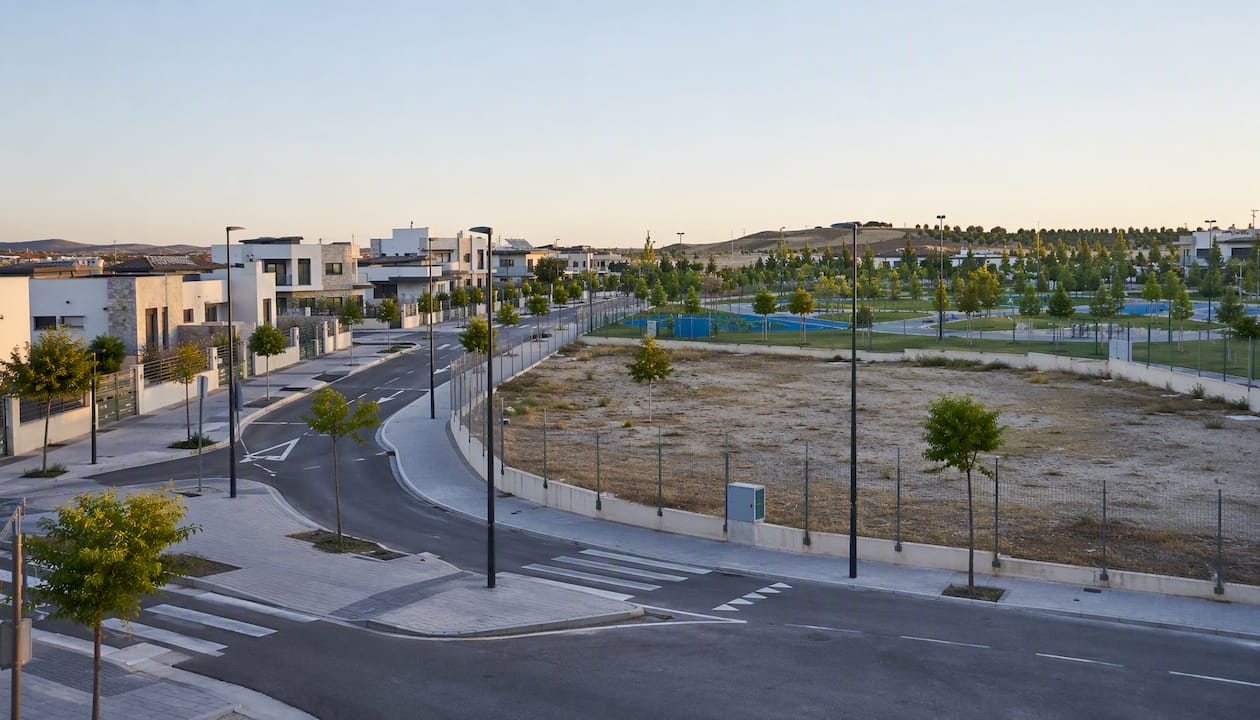
The development sector of Los Ahijones, on the eastern outskirts of Madrid, is one of the most frequently cited examples of a large-scale junta de compensación in Spain. Covering several hundred hectares, it brought together dozens of landowners under a single junta to deliver roads, parks, schools, and residential plots across a major new urban district.
The process illustrated several lessons that apply directly to buyers in coastal markets today.
First, the timeline was far longer than originally projected. Planning approvals, infrastructure financing, and administrative challenges extended the process well beyond the initial estimates. Owners who had budgeted for a five-year process found themselves still waiting after a decade. For buyers in active juntas in Marbella, Mallorca, or Barcelona, this is not an anomaly: it is a realistic scenario.
Second, derramas arose at multiple points during execution. Infrastructure cost overruns, changes in technical specifications, and legal challenges all generated additional levies that members had not anticipated at the time of purchase. Buyers who had not reserved liquidity for these calls faced real financial pressure.
Third, the registration of result parcels and the formal cession of public land to the council took considerably longer than the works themselves. Members received their buildable plots only after a further administrative process that added months to the timeline.
Three quick lessons for buyers:
- Verify the timetable independently, not just from the seller’s projections.
- Reserve liquidity for at least one or two unexpected derramas above the budgeted amount.
- Confirm that the result parcel registration process has started, or ask when it is expected to begin.
An adviser’s perspective on what buyers get wrong
Foreign buyers consistently underestimate one thing about juntas: the difference between owning land within a junta sector and owning a completed property. They are not the same transaction, and treating them as equivalent is the most common and costly mistake.
A plot subject to a pending Proyecto de Urbanización is not a passive investment. It is an active financial commitment with an uncertain timeline and the legal obligation to contribute to costs you cannot fully predict at the point of purchase. The value uplift is real when the process completes, but the path to that outcome requires patience, liquidity, and professional oversight.
The most effective protection is a conditional purchase structure. If you are buying a plot where the Proyecto de Urbanización has not yet received final municipal approval, consider making the contract conditional on that approval being granted within a defined period. This gives you an exit if the project stalls at the administrative stage, which is precisely where delays most often occur.
Get a Spanish property lawyer involved before you sign anything, not after. The statutes, the bases, and the latest minutes will tell your lawyer more about the real risk than any conversation with the seller. Early legal advice on a junta purchase is not a cost; it is the most efficient use of your due diligence budget.
How Property-lawyers can help you with junta due diligence
Buying land in a junta area in Spain is manageable with the right legal support, and that support needs to be local, English-speaking, and experienced with Spanish planning law.

Property-lawyers is a directory of vetted, independent, English-speaking property lawyers, organised by region and city. Whether your plot is in Barcelona, Madrid, Marbella, or Mallorca, you can find a specialist who understands juntas, reparcelación, and the regional planning rules that apply to your sector.
Two specific benefits for buyers in junta areas:
- Faster due diligence. A lawyer from the Property-lawyers directory knows which documents to request, which municipal offices to contact, and which regional rules apply, cutting weeks off the process.
- English-language advice on Spanish law. You receive clear explanations of your obligations, your rights, and your options, without needing to navigate Spanish legal documents alone.
Find out what legal fees for a Spanish property lawyer typically look like, or search the directory now at Property-lawyers to find a specialist in your target region.
Sources
The following authoritative sources cover the legal framework and practical mechanics of juntas in Spain:
- Ley del Suelo y Rehabilitación Urbana (Real Decreto Legislativo 7/2015), arts. 126-130
This article is general information, not a substitute for advice from a qualified lawyer. Consult a qualified legal professional about your own circumstances before acting on anything here.
FAQ
What is a junta de compensación in Spain?
A junta de compensación is a private body formed by landowners within a designated development sector in Spain. It executes the urbanisation works, redistributes plots through the Proyecto de Reparcelación, and cedes public land to the municipality, operating under public-law controls despite its private status.
Can a UK buyer be forced to join a junta?
Yes. If your plot falls within a designated sector and a junta is constituted, you are legally bound to participate. Refusal does not exempt you: the administration can incorporate your land compulsorily or expropriate it at an officially assessed price (justiprecio).
What is a derrama and how much could it cost?
A derrama is an extraordinary levy charged to junta members when urbanisation costs exceed the original budget. The amount varies by project and sector; there is no fixed cap. Buyers should request the full budget, any approved derramas, and the bank guarantees in place before exchange.
How long does the junta process take?
From municipal plan approval to receiving a registered, buildable result parcel, the process typically takes five to eight years or longer in Spain’s coastal markets. Delays at the administrative approval stage and during works reception are common.
How do I check whether a plot is subject to a junta?
Ask your Spanish property lawyer to search the Registro de Entidades Urbanísticas Colaboradoras and the local Land Registry, and to request the municipal planning file for the sector. Property-lawyers can connect you with an English-speaking lawyer who handles these searches as part of standard due diligence.
Recommended
- Spanish timeshare law explained: what UK buyers must know
- Gazumping in Spain: what property buyers must know
- Spanish property registry: what UK buyers must check

Sophie Gutenberg is a legal content specialist focused on Spanish property law, real estate transactions, conveyancing, due diligence and tax issues affecting international property buyers in Spain. She works alongside qualified Spanish property lawyers .
